

The cadence of breakthroughs in the quantum computing sector has reached a fever pitch, with significant milestones in error correction, fault tolerance, and hardware architecture now appearing on a near-weekly basis. As the industry moves beyond the theoretical and into the realm of practical engineering, the focus is shifting from simple qubit counts to the creation of robust, full-stack ecosystems. This transition is being driven by a realization among both vendors and enterprise users that the path to quantum advantage requires a seamless integration of specialized hardware, sophisticated software, and classical high-performance computing (HPC) infrastructure.
For global enterprises, the rapid maturation of quantum technology is no longer a peripheral concern. Organizations across diverse sectors—from pharmaceuticals to logistics—are increasingly investigating how they can leverage current quantum capabilities while preparing for the arrival of more scalable, fault-tolerant systems. According to a recent analysis by global consultancy McKinsey & Co, more than 300 organizations worldwide are already actively collaborating with quantum computing providers, with many more engaged in internal experimentation.
The consensus among business leaders has shifted significantly. Many now acknowledge that quantum technology is advancing more quickly than previously anticipated, prompting a reevaluation of strategic roadmaps to secure early competitive advantages. McKinsey’s reporting suggests that quantum technology companies are hitting technical milestones ahead of their own internal schedules. With ambitious roadmaps now placing the arrival of fault-tolerant quantum computing within the next few years, the pressure on enterprises to develop internal expertise and integrate these systems into existing workflows has intensified.

This shift in urgency is reflected in the evolving strategies of the industry’s leading vendors. There is a clear move toward offering full-stack solutions that encompass more than just the underlying quantum processing units (QPUs). Modern quantum offerings now include comprehensive software suites, sophisticated developer tools, and advanced capabilities for hybrid environments that blend quantum and classical resources. The goal is to provide a complete package that includes AI integrations and specialized APIs for optimization, making the technology more accessible to a broader range of developers and researchers.
A prime example of this industry-wide pivot was Intel’s recent $2.3 billion acquisition of quantum software specialist Classiq. The deal, finalized late last month, signaled Intel’s intent to transition from a decade-long research focus to a commercial business model. Pushkar Ranade, Intel’s Chief Technology Officer, noted that while the company has spent ten years refining quantum chips and software development kits (SDKs) as part of a research-and-development phase, the integration of Classiq represents a definitive move into the actual quantum computing business.
Intel is not alone in this pursuit. The roster of companies building out full-stack capabilities includes industry titans and specialized pioneers alike, such as IBM, D-Wave, Rigetti, and IonQ. Among these, Quantinuum has emerged as a major force, particularly following its 2021 formation through the merger of Honeywell’s Quantum Solutions and the software-focused Cambridge Quantum Computing. By combining world-class trapped-ion hardware with advanced software applications like InQuanto and Quantum Origin, Quantinuum has positioned itself as a primary architect of the full-stack era.
The focus on software and developer tools is a critical indicator of the field’s maturity. Josh Savory, Senior Director of Offering Management for Quantinuum, emphasizes that the industry is becoming increasingly preoccupied with what it takes to make quantum computing genuinely useful for end-users. While qubit counts remain a common benchmark for progress, Savory argues that customers ultimately prioritize accurate results delivered at the speeds required by their specific applications. Achieving this requires a delicate balance of high-accuracy hardware, scalable error correction, and deep integration with classical computing workflows.
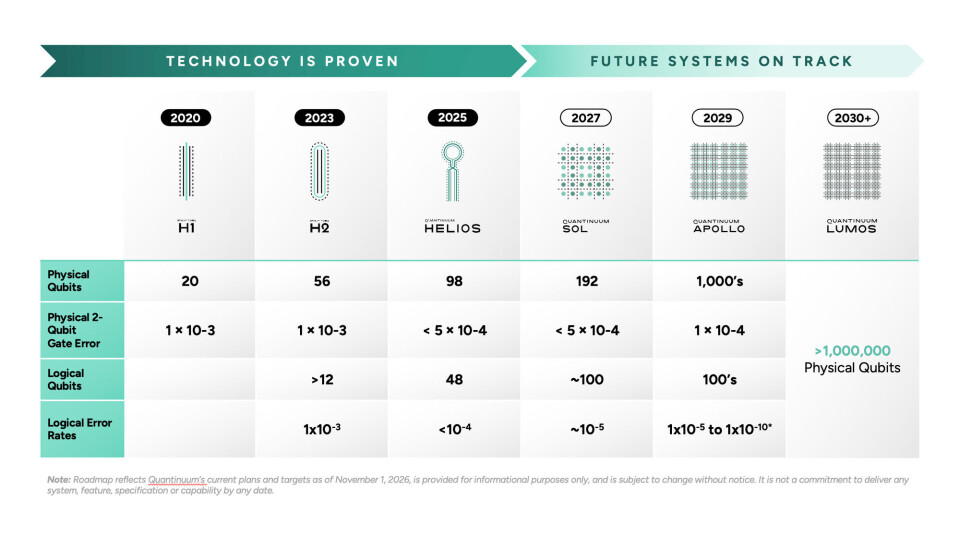
Quantinuum’s strategy revolves around the close co-design of hardware, error correction protocols, and compilers alongside developer tools. This integrated approach allows developers to capitalize on hardware improvements almost as soon as they are implemented. To provide a clear path forward for its partners, Quantinuum recently unveiled an updated roadmap for its Nexus platform, outlining a progression of capabilities leading up to "Apollo," the company’s first scheduled fault-tolerant system, expected in 2029.
The technical foundation for this roadmap was bolstered last year with the launch of "Helios," Quantinuum’s third-generation trapped-ion system. Featuring 98 qubits, Helios recently achieved a remarkable fidelity milestone, reaching 99.9995 percent accuracy. This level of precision—representing only five errors in a million operations—is a crucial threshold that company executives believe puts them within the necessary target range for the upcoming Apollo system. The Nexus platform currently utilizes these hardware capabilities to offer customized error suppression, prebuilt logical qubits, and specialized tools for quantum chemistry.
Looking ahead, the roadmap points toward the "Sol" system, scheduled for next year, which will further expand the capabilities of the Nexus platform. These advancements are designed to ensure that the work developers do today remains relevant as the hardware evolves. A key component of this effort is Guppy FT, a fault-tolerant programming framework that extends the Python-based Guppy language. By providing an open-source library of reusable building blocks and algorithmic primitives, Quantinuum allows developers to focus on the logic of their algorithms while specialists handle the complexities of protecting those algorithms from noise and errors.
Savory notes that the Nexus roadmap is intended to give customers a reason to build with Quantinuum today while providing a clear path to carry those investments into the fault-tolerant era. This includes ensuring that Nexus supports the tools and languages developers are already familiar with, such as Nvidia’s CUDA-Q and Microsoft’s Q#. The platform is designed to fit seamlessly into diverse environments, whether they are based in the cloud, on-premises, or within traditional high-performance computing centers.
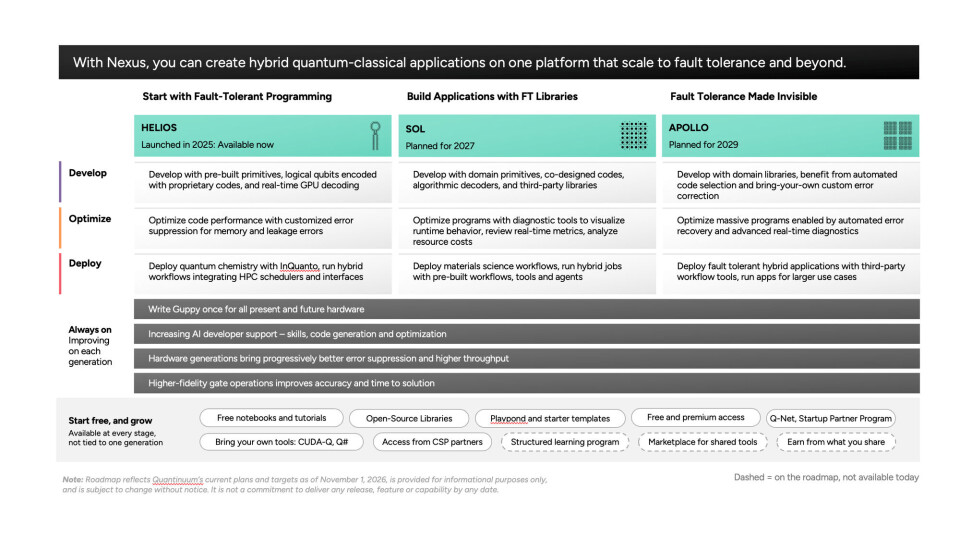
The adoption rates for these tools suggest that the market is responding to this full-stack approach. Approximately 215 companies are currently building on the Nexus platform, and job submissions have increased tenfold over the twelve-month period ending in August compared to the previous year. This surge in activity indicates that the "science project" era of quantum computing is rapidly giving way to a period of active development and application testing.
Quantinuum’s momentum is also visible on the global stage and in its financial performance. The company recently upgraded the "Reimei" quantum computer at the RIKEN institute in Japan, replacing a 20-qubit H1 system with a more powerful 56-qubit H2 computer. This upgrade allows Japanese scientists to more effectively combine quantum computing with supercomputing and AI research. Furthermore, Quantinuum is collaborating with RIKEN and SoftBank to explore the direct integration of quantum systems into AI datacenters in Japan, a move that could redefine the infrastructure of the next decade.
Financially, the company is showing signs of rapid scaling. In the third quarter, Quantinuum reported revenue of $9.1 million, a 233 percent increase over the $2.7 million reported in the same period the previous year. This growth has led the company to raise its full-year revenue outlook to a range of $31 million to $34 million.
As the industry moves toward 2029 and the promise of universal fault tolerance, the distinction between research and business continues to blur. The efforts of companies like Quantinuum, Intel, and IBM suggest that the next few years will be defined not just by how many qubits a system possesses, but by how effectively those systems can be programmed, corrected, and integrated into the broader technological landscape. For the hundreds of organizations already experimenting with the technology, the goal is to be ready when the era of fault-tolerant computing finally arrives, turning today’s experimental code into tomorrow’s industrial solutions.
 Enterprise Tech & Infrastructure
Navigating the Shift to Software-Defined Storage: Expert Strategies for Enterprise Success
The modern enterprise data center is undergoing a fundamental transformation, driven by...
 Enterprise Tech & Infrastructure
Navigating the Complexity of Amazon S3: A Strategic Approach to Enterprise Storage Cost Management
The economic appeal of cloud storage has long been centered on the...
 Enterprise Tech & Infrastructure
The Evolution of Modern Infrastructure: Understanding the Rise and Impact of Hyperconverged Storage
In the rapidly shifting landscape of enterprise technology, the traditional silos of...







