

Savory notes that the Nexus roadmap is intended to give customers a reason to build with Quantinuum today while providing a clear path to carry those investments into the fault-tolerant era. This includes ensuring that Nexus supports the tools and languages developers are already familiar with, such as Nvidia’s CUDA-Q and Microsoft’s Q#. The platform is designed to fit seamlessly into diverse environments, whether they are based in the cloud, on-premises, or within traditional high-performance computing centers.
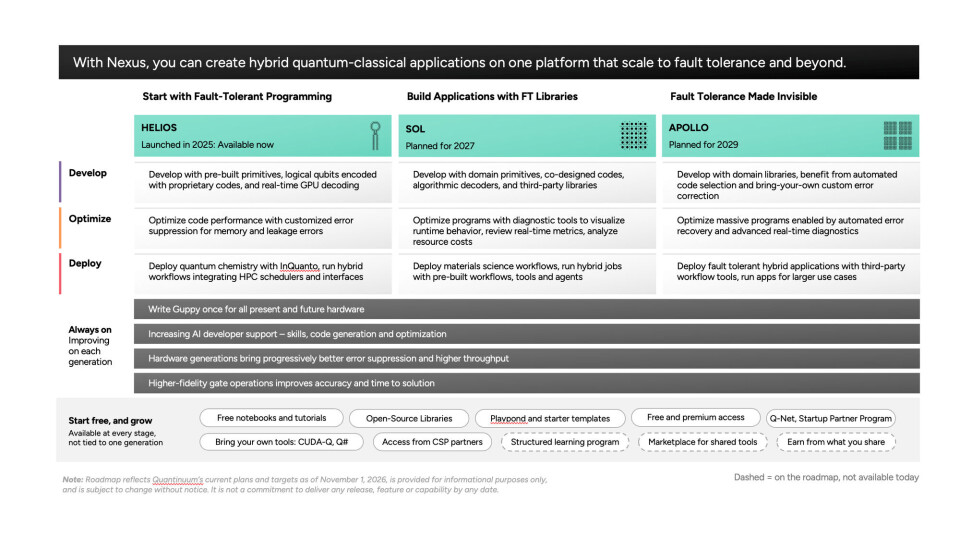
The adoption rates for these tools suggest that the market is responding to this full-stack approach. Approximately 215 companies are currently building on the Nexus platform, and job submissions have increased tenfold over the twelve-month period ending in August compared to the previous year. This surge in activity indicates that the "science project" era of quantum computing is rapidly giving way to a period of active development and application testing.
Quantinuum’s momentum is also visible on the global stage and in its financial performance. The company recently upgraded the "Reimei" quantum computer at the RIKEN institute in Japan, replacing a 20-qubit H1 system with a more powerful 56-qubit H2 computer. This upgrade allows Japanese scientists to more effectively combine quantum computing with supercomputing and AI research. Furthermore, Quantinuum is collaborating with RIKEN and SoftBank to explore the direct integration of quantum systems into AI datacenters in Japan, a move that could redefine the infrastructure of the next decade.
Financially, the company is showing signs of rapid scaling. In the third quarter, Quantinuum reported revenue of $9.1 million, a 233 percent increase over the $2.7 million reported in the same period the previous year. This growth has led the company to raise its full-year revenue outlook to a range of $31 million to $34 million.
As the industry moves toward 2029 and the promise of universal fault tolerance, the distinction between research and business continues to blur. The efforts of companies like Quantinuum, Intel, and IBM suggest that the next few years will be defined not just by how many qubits a system possesses, but by how effectively those systems can be programmed, corrected, and integrated into the broader technological landscape. For the hundreds of organizations already experimenting with the technology, the goal is to be ready when the era of fault-tolerant computing finally arrives, turning today’s experimental code into tomorrow’s industrial solutions.
 Enterprise Tech & Infrastructure
Bridging the Storage Divide: The Strategic Role of Fibre Channel over Ethernet in Modern Data Centers
In the complex landscape of enterprise data management, the tension between high-performance...
 Enterprise Tech & Infrastructure
Datacenter Systems Spending To Go Through The Roof In 2027
In the days immediately preceding the election, market researchers and analysts finalized...
 Enterprise Tech & Infrastructure
Cisco Unveils Automated Control Layer to Bridge the Gap Between Isolated Quantum Nodes and Distributed Architectures
In the rapidly evolving landscape of quantum information science, the primary focus...







