The landscape of workplace productivity is undergoing a fundamental shift as artificial intelligence moves beyond simple data retrieval toward active, autonomous task execution. At the forefront of this transition is Otter.ai, which recently announced a significant evolution of its platform. The company has introduced a new "Work" mode to its AI Chat assistant, a feature designed to transform the service from a passive transcription tool into a proactive AI agent capable of managing complex workflows across a variety of third-party applications, including Salesforce, Jira, and Gmail.
This strategic pivot comes at a pivotal moment for the company. Just last week, Otter.ai secured a substantial $320 million growth investment, a move backed by General Catalyst. This influx of capital underscores the industry’s confidence in Otter’s broader ambition: to move beyond the confines of meeting transcription and establish itself as a central hub for automating the administrative tasks that typically bookend professional collaborations. By focusing on "agentic" capabilities—where the AI can perform multi-step actions rather than just answering questions—Otter is positioning itself to compete in a high-stakes market currently being redefined by the likes of Microsoft, Cisco, and OpenAI.
Otter’s Strategic Shift Toward Multi-Step ‘Work’ Functionality
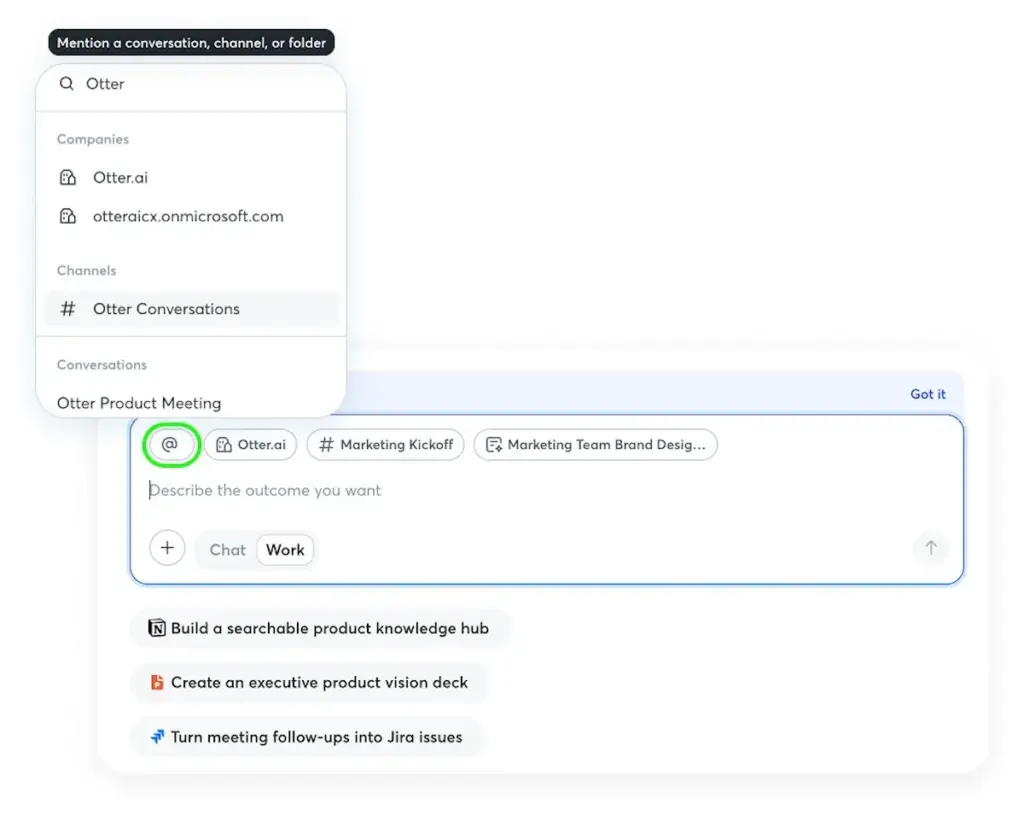
The new "Work" interface, which was officially unveiled on Tuesday, represents a departure from the traditional chat-based interactions users have come to expect from generative AI. While the standard "Chat" option remains available for users to ask questions, retrieve information from transcripts, or generate quick summaries, the "Work" mode is specifically engineered for execution. It is accessible directly within the AI Chat prompt box, offering a distinct path for users who need the AI to perform functional tasks across different platforms.
This separation of duties mirrors a growing trend among leading AI developers. Similar to how platforms like Claude or ChatGPT are beginning to distinguish between simple conversational queries and more complex, agent-led operations, Otter is streamlining its user experience to prioritize action. As part of this overhaul, Otter confirmed that it is removing the previous "Express" and "Advanced" options from its AI Chat interface, consolidating those capabilities into this new, more intuitive framework.
The primary objective of Work mode is to address the "before, during, and after" phases of a meeting. In the high-pressure environment of modern corporate culture, the time spent preparing for a meeting or handling the subsequent administrative "to-do" list often exceeds the duration of the meeting itself. Otter’s new mode aims to reclaim this time by automating the preparation and follow-up processes that often lead to professional burnout and reduced efficiency.
Streamlining the Pre-Meeting and Post-Meeting Lifecycle
Before a meeting even begins, the Work mode can be prompted to generate comprehensive briefing documents. This is not merely a summary of a single previous call; rather, the AI collates information from a history of interactions and pulls relevant data from connected applications. For a sales professional, this might mean a briefing that includes the last three client conversations, current project statuses from Jira, and the latest email exchanges from Gmail. By synthesizing this data into a single document, the AI ensures that participants enter the room—or the Zoom call—fully informed and aligned.
 Small Business IT & Cloud Computing
SAP Integrates AI-Powered Roleplays into Recertification Program to Prioritize Practical Skills Over Rote Memorization
In a significant move to modernize its professional ecosystem, SAP has announced...
 Small Business IT & Cloud Computing
Securing the Digital Hub: A Comprehensive Strategy for Google Account Fortification
In the modern digital landscape, the concept of a "sensitive account" has...
 Small Business IT & Cloud Computing
Stagnating PC Market and Rising Component Costs Leave Windows 10 with Significant Market Share as Windows 11 Adoption Grinds to a Halt
The transition from Windows 10 to Windows 11 has hit a significant...