
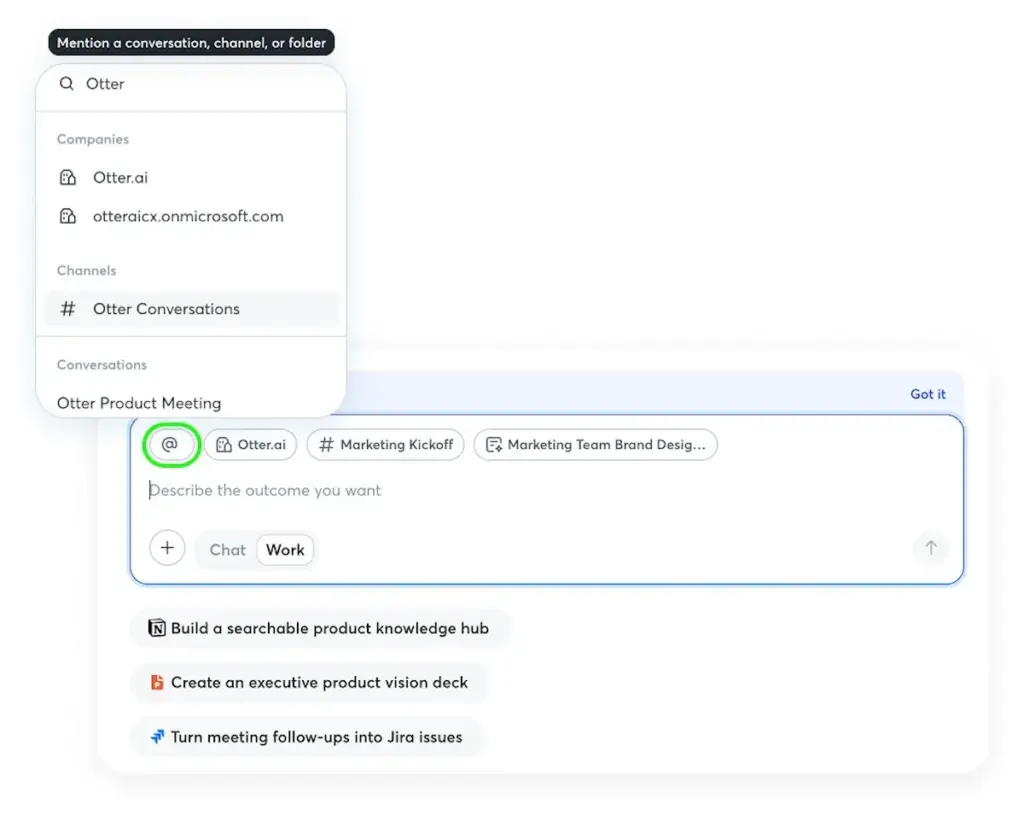
The landscape of workplace productivity is undergoing a fundamental shift as artificial intelligence moves beyond simple data retrieval toward active, autonomous task execution. At the forefront of this transition is Otter.ai, which recently announced a significant evolution of its platform. The company has introduced a new "Work" mode to its AI Chat assistant, a feature designed to transform the service from a passive transcription tool into a proactive AI agent capable of managing complex workflows across a variety of third-party applications, including Salesforce, Jira, and Gmail.
This strategic pivot comes at a pivotal moment for the company. Just last week, Otter.ai secured a substantial $320 million growth investment, a move backed by General Catalyst. This influx of capital underscores the industry’s confidence in Otter’s broader ambition: to move beyond the confines of meeting transcription and establish itself as a central hub for automating the administrative tasks that typically bookend professional collaborations. By focusing on "agentic" capabilities—where the AI can perform multi-step actions rather than just answering questions—Otter is positioning itself to compete in a high-stakes market currently being redefined by the likes of Microsoft, Cisco, and OpenAI.
Otter’s Strategic Shift Toward Multi-Step ‘Work’ Functionality
The new "Work" interface, which was officially unveiled on Tuesday, represents a departure from the traditional chat-based interactions users have come to expect from generative AI. While the standard "Chat" option remains available for users to ask questions, retrieve information from transcripts, or generate quick summaries, the "Work" mode is specifically engineered for execution. It is accessible directly within the AI Chat prompt box, offering a distinct path for users who need the AI to perform functional tasks across different platforms.
This separation of duties mirrors a growing trend among leading AI developers. Similar to how platforms like Claude or ChatGPT are beginning to distinguish between simple conversational queries and more complex, agent-led operations, Otter is streamlining its user experience to prioritize action. As part of this overhaul, Otter confirmed that it is removing the previous "Express" and "Advanced" options from its AI Chat interface, consolidating those capabilities into this new, more intuitive framework.
The primary objective of Work mode is to address the "before, during, and after" phases of a meeting. In the high-pressure environment of modern corporate culture, the time spent preparing for a meeting or handling the subsequent administrative "to-do" list often exceeds the duration of the meeting itself. Otter’s new mode aims to reclaim this time by automating the preparation and follow-up processes that often lead to professional burnout and reduced efficiency.
Streamlining the Pre-Meeting and Post-Meeting Lifecycle
Before a meeting even begins, the Work mode can be prompted to generate comprehensive briefing documents. This is not merely a summary of a single previous call; rather, the AI collates information from a history of interactions and pulls relevant data from connected applications. For a sales professional, this might mean a briefing that includes the last three client conversations, current project statuses from Jira, and the latest email exchanges from Gmail. By synthesizing this data into a single document, the AI ensures that participants enter the room—or the Zoom call—fully informed and aligned.
The capabilities of the Work mode become even more pronounced once the meeting concludes. The transition from a live discussion to actionable outcomes is often where productivity falters. To bridge this gap, the AI assistant can now draft follow-up emails, generate formal Word documents or Notion pages, and export data into PDFs. Perhaps most significantly for enterprise users, the AI can directly update Salesforce records, ensuring that the customer relationship management (CRM) system remains accurate without requiring manual data entry from the sales team.
Despite the autonomous nature of these tasks, Otter has maintained a focus on reliability and oversight. A company spokesperson emphasized that the AI assistant requires explicit human approval before completing these tasks. This "human-in-the-loop" approach is a critical safeguard, particularly when the AI is interacting with external clients via email or modifying sensitive internal databases like Salesforce. It allows users to review the AI’s work, make necessary adjustments, and then authorize the final action, combining the speed of automation with the nuance of human judgment.
Accessibility, Pricing, and the Competitive Landscape
In a move to encourage widespread adoption, Otter has made the Work mode available immediately to all paid users. Unlike the standard Chat mode, which often operates under monthly query limits based on a customer’s specific subscription tier, the Work mode currently has no usage limits. This decision suggests that Otter is eager to integrate its agentic features into the daily habits of its power users, gathering data on how professionals utilize AI agents to manage their broader digital ecosystems.
The timing of this release is validated by current market research. Irwin Lazar, a principal analyst at Metrigy, noted that the industry is moving rapidly from simple data capture to sophisticated workflow automation. According to Lazar, the value proposition for meeting tools is no longer just about what was said, but about making those notes actionable within the context of other platforms. This shift is reflected in a global study conducted by Metrigy titled “Workplace Collaboration & Employee Experience: 2027,” which surveyed 403 organizations. The study found that a staggering 91% of business users want their meeting note-takers to not only record the conversation but also to access and act on context from outside the meeting.
Otter is not alone in this pursuit. The "agentic" space is becoming increasingly crowded as legacy tech giants integrate similar features into their established ecosystems. Lazar pointed to Microsoft’s "facilitator" role within Teams and Cisco’s Webex meeting agent as direct competitors. These tools are also designed to nudge meetings along, track action items, and integrate with broader productivity suites. However, Otter’s independence and its focus on a wide array of third-party integrations—rather than being locked into a single ecosystem like Microsoft 365—may serve as a key differentiator for organizations that use a diverse stack of tools like Slack, Salesforce, and Google Workspace.
Enhancing Real-Time Engagement with Live Assist
In addition to the launch of Work mode, Otter is expanding the reach of its "Live Assist" feature. Previously available in a more limited capacity, Live Assist is now being rolled out to all enterprise customers, with plans to expand access to all paid Otter accounts in the coming weeks. Originally announced in April, Live Assist serves as a private, real-time coach for users during a call.
Unlike the transcription window, which is often visible to others or serves as a record for the group, Live Assist provides a private interface where the user can receive guidance. It can suggest pertinent questions to ask based on the flow of the conversation, track whether specific meeting "objectives" are being met, and provide instant context if a participant joins late or loses the thread of the discussion.
Thomas Randall, a research director at Infotech, highlighted the uniqueness of this feature in a general business context. While similar "widget assist" tools have been common in customer support and call center environments to help agents navigate scripts and solve customer issues, Randall noted that such a tool for internal productivity and general business meetings is quite rare. By bringing the "coaching" model to the average knowledge worker, Otter is attempting to improve the quality of the meeting itself, not just the documentation that follows it.
The Future of Voice AI in the Enterprise
The $320 million growth investment and the subsequent launch of these advanced features signal that Otter.ai is preparing for a future where voice is the primary interface for workplace automation. As generative AI models become more adept at understanding intent and executing multi-step instructions, the barrier between a spoken conversation and a completed task is dissolving.
The transition from "transcription service" to "AI agent" is a significant hurdle, requiring not just technical accuracy but also deep integration into the software that businesses use every day. By enabling its AI to live-update Salesforce and draft Notion documents, Otter is attempting to become an indispensable layer of the corporate tech stack. The success of this strategy will likely depend on how seamlessly these integrations perform and how much trust users place in the AI to handle their professional correspondence and data management.
As organizations continue to grapple with "meeting fatigue" and the administrative burden of a digital-first workplace, the demand for tools that can "access and act on context" will only grow. Otter’s latest updates represent a calculated bet that the future of work belongs to those who can automate the mundane, allowing human workers to focus on the high-level strategy and creative problem-solving that AI cannot yet replicate. With the backing of significant new funding and a clear roadmap toward agentic AI, Otter is positioning itself as a leader in the next generation of workplace collaboration.
 Small Business IT & Cloud Computing
The New Frontier of IT Governance: Smplify and the Challenge of Managing Autonomous AI Agents
The landscape of Apple device management is undergoing a profound transformation, driven...
 Small Business IT & Cloud Computing
After the Blue Tsunami: Why Microsoft Faces a New Era of Oversight, Regulation, and Fiscal Contraction
The political landscape of the United States has undergone a seismic shift...
 Small Business IT & Cloud Computing
Google Positions Gemini as the Central Hub for Enterprise AI Orchestration with New Autonomous Agent Capabilities
At its high-profile Gemini at Work 2026 event this week, Google Cloud...







