
The Supercomputing 2026 conference has officially opened its doors, serving as the premier stage for the most significant advancements in high-performance computing, and Nvidia has wasted no time in asserting its continued dominance in the field. Despite a backdrop of persistent internal and external turmoil that has characterized much of the company’s recent corporate narrative, the silicon giant arrived at the show with a robust slate of announcements intended to solidify its roadmap for the latter half of the decade. Chief among these revelations is the introduction of a new, specialized member of the Rubin GPU family, officially designated as Rubin HPC. This latest silicon endeavor is specifically engineered to meet the burgeoning demands of the scientific and engineering communities, focusing on the acceleration of agentic workflows and complex simulations that involve increasingly massive and intricate data sets.
The debut of Rubin HPC marks a strategic expansion of the Rubin architecture, which was first teased as the successor to the Blackwell platform. By introducing a dedicated high-performance computing variant, Nvidia is signaling a more granular approach to its hardware stack, distinguishing between the needs of general-purpose generative AI and the rigorous, precision-heavy requirements of traditional and AI-augmented scientific research. The company’s messaging at the conference emphasizes that this chip is not merely an incremental update but a fundamental tool designed for the specific needs of scientists, engineers, and data analysts who find themselves at the intersection of classical simulation and the emerging frontier of autonomous AI agents.
To address the most taxing computational workloads currently facing the industry, Nvidia has equipped the Rubin HPC with a staggering amount of processing power. The company confirmed that this new chip boasts the highest number of CUDA cores ever integrated into a single GPU package, officially citing a figure of "more than 50,000." This milestone represents a massive leap in parallel processing capability, providing the raw throughput necessary to handle the trillions of parameters and data points inherent in modern climate modeling, drug discovery, and aerodynamic testing. The sheer density of these cores suggests a significant evolution in Nvidia’s manufacturing and packaging techniques, as the company pushes the boundaries of what can be achieved within the thermal and physical constraints of a data center rack.
While full architectural deep dives are often reserved for later technical sessions, the initial disclosures regarding the Rubin HPC’s core count have led to significant industry speculation regarding its internal structure. The mention of more than 50,000 CUDA cores strongly implies that the Rubin HPC utilizes a multi-die configuration, likely mirroring the sophisticated design seen in the four-die Rubin Ultra GPU. Such a design would necessitate the use of Nvidia’s proprietary NVLink-C2C (Chip-to-Chip) interconnect technology. This high-speed, low-latency link allows multiple dies to function as a single, cohesive processor, effectively bypassing the physical limits of traditional monolithic chip manufacturing. By linking these dies together, Nvidia can scale performance to unprecedented levels while maintaining the programming model that developers have become accustomed to with smaller, single-die chips.
The focus on "agentic workflows" is perhaps the most forward-looking aspect of the Rubin HPC announcement. In the context of high-performance computing, agentic workflows refer to a shift away from static, human-triggered simulations toward a model where AI agents autonomously manage complex sequences of tasks. These agents can monitor the progress of a simulation, identify anomalies, adjust parameters in real-time to optimize results, and even initiate subsequent rounds of testing based on the findings of previous runs. This requires a level of computational agility and "thinking" capacity that goes beyond simple number crunching. By optimizing Rubin HPC for these workflows, Nvidia is positioning its hardware as the brain of an autonomous laboratory, where the chip does not just provide the power to run the math but also the intelligence to manage the scientific process itself.
For the scientists and engineers who make up the core audience of the Supercomputing conference, the promise of Rubin HPC lies in its ability to manage the "data deluge." As sensors, experimental equipment, and digital twins generate ever-larger volumes of information, the bottleneck in research has increasingly become the speed at which that data can be ingested and processed. Nvidia’s emphasis on "large data sets" suggests that Rubin HPC is paired with significant advancements in memory bandwidth and capacity, likely utilizing the latest generations of High Bandwidth Memory (HBM) to ensure that the 50,000+ CUDA cores are never starved for information. This is critical for analysts who must sift through petabytes of data to find the subtle patterns that lead to breakthroughs in materials science or energy efficiency.
The timing of the Rubin HPC announcement is also noteworthy given the "continuing turmoil" mentioned by observers of the company. While Nvidia has faced a series of challenges—ranging from regulatory scrutiny of its market position to the logistical complexities of maintaining a yearly product release cycle—the technical momentum displayed at Supercomputing 2026 suggests that the company’s engineering divisions remain insulated from the broader corporate noise. The Rubin family represents a pivotal moment in the company’s history, as it seeks to maintain its lead over a growing field of competitors who are increasingly offering specialized silicon for AI and HPC. By doubling down on the high-end scientific market with a dedicated HPC chip, Nvidia is attempting to prove that it can serve the needs of the most demanding researchers while simultaneously dominating the commercial AI sector.
Furthermore, the introduction of Rubin HPC reflects a broader trend in the industry toward the convergence of AI and traditional simulation. For decades, high-performance computing was defined by its ability to solve complex partial differential equations through brute-force calculation. However, the modern era of research increasingly relies on AI models to "surrogate" or speed up these traditional simulations. A chip like Rubin HPC is designed to excel at both: providing the FP64 precision required for traditional physics-based math and the specialized tensor processing power needed for the AI models that predict how those physics will behave. This dual-purpose capability is essential for the next generation of supercomputers, which are expected to be heterogeneous environments where AI and HPC are inextricably linked.
As the Supercomputing 2026 conference continues, the industry will be looking for more details on the Rubin HPC’s power consumption, its integration into the wider Blackwell-to-Rubin transition, and the availability of software libraries optimized for its unique core configuration. The move to a four-die structure via NVLink-C2C represents a significant bet on modular silicon design, a path that requires not only hardware excellence but also a robust software ecosystem to ensure that developers can actually utilize the 50,000 cores effectively. Nvidia’s CUDA platform has long been its "moat," and the Rubin HPC launch is a clear indication that the company intends to extend that moat into the realm of multi-die, agentic computing.
In the larger context of the Rubin GPU family, the HPC variant serves as a high-water mark for what the architecture can achieve when pushed to its limits. While other members of the family may be optimized for different power envelopes or specific data center configurations, the Rubin HPC is the "unrestricted" version, designed for the crown jewels of global research—the national laboratories, the top-tier university research centers, and the R&D departments of the world’s largest aerospace and pharmaceutical companies. For these organizations, the ability to accelerate a simulation by even a small percentage can result in years of saved time and billions of dollars in saved costs.
Nvidia’s presence at Supercomputing 2026, punctuated by the Rubin HPC reveal, serves as a reminder of the company’s origins. Before it was a titan of the trillion-dollar AI industry, Nvidia built its reputation on the backs of scientists and researchers who used its gaming hardware to solve the world’s hardest problems. With Rubin HPC, the company appears to be returning to those roots with a renewed focus, providing a specialized tool that recognizes that the future of science is not just about faster math, but about more intelligent workflows. As the show progresses, the Rubin HPC will undoubtedly remain a central topic of discussion, representing both the technical pinnacle of the Rubin architecture and a strategic pivot toward the era of autonomous, agent-driven scientific discovery.
 Hardware Reviews & PC Building
Thieves Targeting High-Value AI Hardware Left with Tons of Sand After Hijacking Nvidia-Branded Trailers
In an era where artificial intelligence has become the primary driver of...
 Hardware Reviews & PC Building
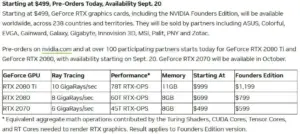
The PC gaming ray tracing obsession began with the first RTX 20 graphics cards released on this day in 2018 — the…
The debut of the GeForce 20 series was spearheaded by the release...
 Hardware Reviews & PC Building
U.S. Data Center Expansion Projected to Drive Unprecedented Surge in Natural Gas Consumption Through 2035
The rapidly evolving landscape of the American technology sector is poised to...







