
FinOps for AI: Managing the Economics of Intelligence
As AI moves from a novelty to a core business expense, Microsoft is introducing a dual-tier pricing and management structure under the umbrella of "FinOps for AI." This discipline is intended to help organizations optimize their AI spend for maximum business value.
For "everyday AI" tasks like drafting emails or summarizing meetings, Microsoft offers a User Subscription License (USL). This model provides a fixed cost for standard Copilot features. A core component of this is "Auto," a routing system that evaluates each request to determine the most cost-effective model that can provide the necessary accuracy and speed.

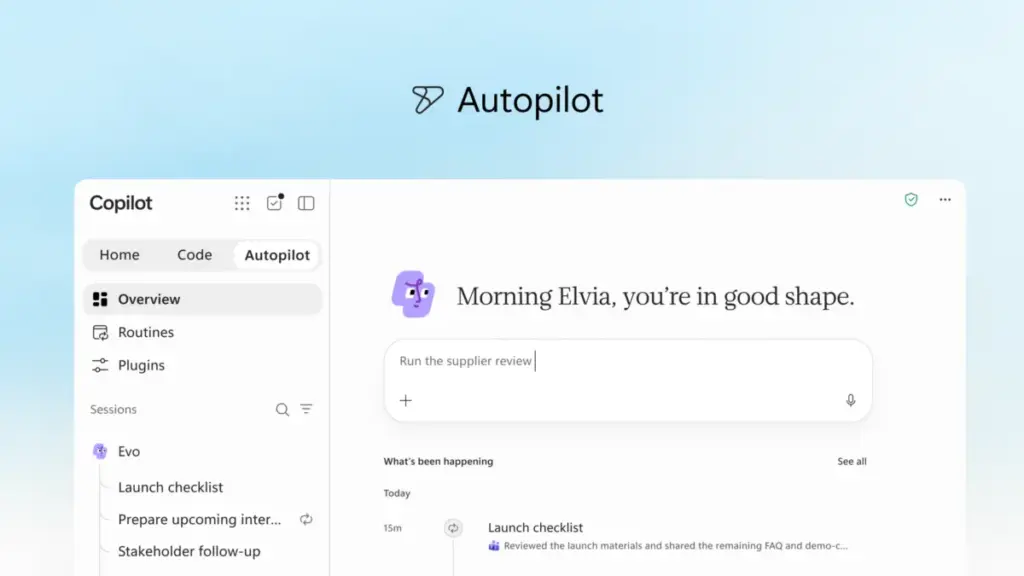
For more complex, "agentic" work—such as the long-running tasks handled by Autopilot or Cowork—Microsoft is utilizing Usage-Based Billing (UBB). This model is designed for advanced workflows that require frontier models like "Astra" and "Fable," allowing businesses to match their costs directly to the value generated by these high-end capabilities.
New tools within Agent 365 and Insights will allow administrators to manage these costs. Admins can set spending policies, route credit requests through automated approval workflows, and restrict which model families are available to specific groups of users. For the end user, transparency is provided through a credit usage dashboard within the Copilot app, showing remaining balances and usage history to ensure work remains within organizational guardrails.
The Future Roadmap: "Today" and Teams Integration
Looking ahead, Microsoft provided a preview of upcoming features aimed at making Copilot even more personalized. Scheduled for private preview in October, a new command center called "Today" will act as a proactive hub across mail, calendar, and Teams. Rather than just listing tasks, "Today" is designed to prepare the work in advance—drafting responses to missed messages, proposing schedule changes, and providing context for forgotten follow-ups.
Furthermore, the "@Copilot" capability in Microsoft Teams is set to expand. When invoked in a channel or group chat, Copilot will have access to the shared context of the entire group. It will be able to explain why certain decisions were made by pulling from past conversations and can even offer to create cross-functional reviews that identify dependencies and owners across different departments.
The "new Copilot" is currently rolling out through Microsoft’s Frontier program, with broader availability expected in the coming weeks and months. These developments represent a clear trajectory for the company: moving away from a world of isolated AI tools and toward a future where persistent, intelligent agents are woven into every facet of organizational life. As Jared Spataro, Microsoft’s lead for AI at Work, noted, these innovations are intended to help every organization leverage AI to solve unique business problems and drive net-new value. Further details on these innovations are expected to be a central focus of the Microsoft Ignite conference in November.
 Productivity Software & Office Suites
Microsoft Reimagines Copilot as a Centralized Engine for the Future of AI-Driven Work
In a major strategic shift aimed at redefining the intersection of human...
 Productivity Software & Office Suites
Microsoft Unveils the Next Generation of Copilot: A Reimagined AI Platform for the Evolving Digital Workplace
In a significant move to redefine the intersection of artificial intelligence and...
 Productivity Software & Office Suites
Microsoft Reimagines Copilot as a Central Hub for AI-Driven Work and Autonomous Agents
In a significant shift for the future of digital productivity, Microsoft has...







