
To support this new era of user-generated software, the company is also launching the Microsoft Copilot Managed Runtime. This hosting infrastructure allows code to run safely within the Microsoft 365 environment under IT governance. It simplifies the process of connecting apps to live data and sharing them across a team, providing a unified foundation for apps built in Cowork, Code, and Copilot Studio. While designed for ease of use by non-developers, the Managed Runtime is also being opened to third-party and professional developers.
The Rise of the Digital Teammate: Autopilot
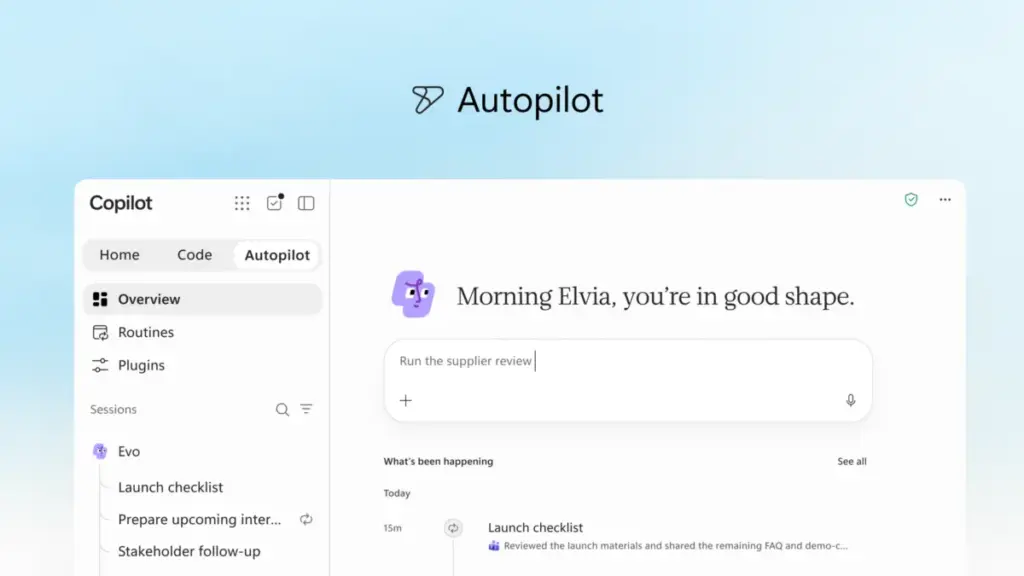
The most ambitious component of the new Copilot is "Autopilot," a persistent and proactive digital agent formerly known as Scout. Unlike standard AI tools that wait for a prompt, Autopilot is designed to function as a digital teammate with its own identity, memory, and workspace.
Users can assign Autopilot a specific role and goal—such as managing a complex supplier review process. Once tasked, the agent can independently build a schedule, monitor communication channels, follow up on threads, and reach out to stakeholders for updates. Because Autopilot is cloud-hosted, it continues to work while the user is away, ensuring that projects maintain momentum without constant human supervision.

Built on the "Microsoft IQ" intelligence platform, Autopilot possesses an understanding of how an organization operates. It is integrated into the existing communication infrastructure, appearing in Teams, Outlook, and various chat channels. This allows human colleagues to @mention the agent just as they would any other team member, all while remaining within the organization’s established security and audit frameworks.
Expanding Business Context and Data Grounding
For AI to be effective in a corporate setting, it must be grounded in the specific data and context of that business. Microsoft is addressing this through "Fabric IQ," which connects Copilot to more than 20 million semantic models in Power BI. This allows the AI to draw on trusted organizational data when performing tasks in Chat or Cowork.
Additionally, Copilot is now gaining deeper integration with Dynamics 365 and Power Platform data. This means that a sales professional working on a proposal can have Copilot automatically incorporate deal histories or active support tickets directly into their document without needing to perform manual lookups in a CRM system.
To manage the various tools and extensions that enhance these capabilities, Microsoft is rolling out a new plugin registry. This unified catalog allows IT departments to centrally approve and manage plugins from Microsoft, third-party partners, and internal developers. This centralized governance is intended to help organizations introduce new AI capabilities at scale while maintaining strict control over data access.
 Productivity Software & Office Suites
Microsoft Reimagines Copilot as a Comprehensive AI System for Enterprise Automation and Custom Development
In a significant shift that signals the next phase of the generative...
 Productivity Software & Office Suites
Microsoft 365 Copilot Surpasses 30 Million Paid Seats as Enterprise AI Shifts from Assistance to Autonomous Agency
In a landmark update during its most recent earnings call, Microsoft announced...
 Productivity Software & Office Suites
Microsoft Unveils the "New Copilot" Ecosystem: Integrating Autonomous Agents, Custom Code, and Advanced Office Workflows
REDMOND, Wash. — In a major step toward redefining the intersection of...







