
Managing the Economics of AI with FinOps
As AI adoption scales, managing the associated costs has become a primary concern for enterprise leaders. Microsoft is addressing this through a new discipline called "FinOps for AI," intended to help organizations optimize their spend and maximize value.
The company is introducing a dual-track pricing and model-selection strategy. For "everyday AI" tasks—such as drafting summaries or quick analysis—Microsoft offers a User Subscription License (USL). This provides access to Copilot at a fixed cost, with an underlying "Auto" feature that automatically selects the most efficient model for the task based on speed, accuracy, and cost.

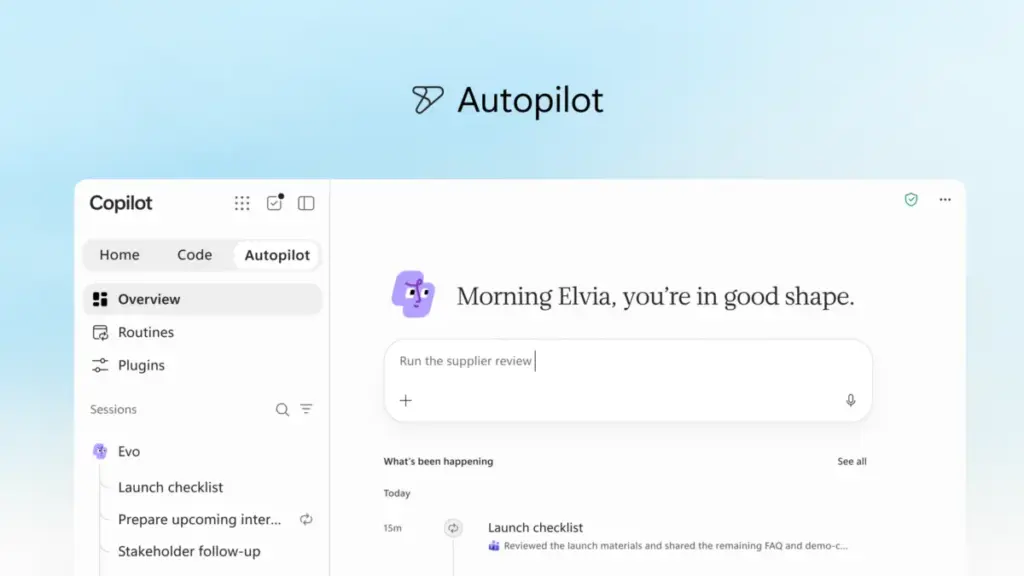
For more intensive, "agentic" work—such as the long-running tasks handled by Cowork, Code, and Autopilot—Microsoft is utilizing usage-based billing (UBB). This allows organizations to use advanced frontier models, such as Astra and Fable, while maintaining full control over their expenditure.
New administrative capabilities within "Agent 365" will allow IT managers to set spending policies, route credit requests through automated approval workflows, and monitor which AI tasks are delivering the highest return on investment. End-users will also be able to see their own credit usage and history, fostering a culture of responsible AI consumption within the workplace.
A Glimpse into the Future: "Today" and Teams Integration
Looking ahead, Microsoft teased several upcoming features designed to make Copilot even more personalized. A new command center called "Today" is set to enter private preview soon. It will act as a proactive dashboard across mail, calendar, and tasks, surfacing what needs immediate attention and even preparing drafts or schedule changes before the user even asks.
Additionally, a new "@Copilot" capability in Microsoft Teams will allow the AI to participate in group chats and channels with a full understanding of the shared context. It will be able to explain why certain decisions were made by analyzing past conversations and offer to prepare cross-functional reviews to keep projects moving forward.
These updates are currently rolling out through Microsoft’s Frontier program, with broader availability expected in the coming months. The company has invited users and developers to explore these innovations further at the upcoming Microsoft Ignite conference in November, where the focus will remain on how AI and autonomous agents can continue to reshape the future of work.
 Productivity Software & Office Suites
Microsoft Announces New AI-Integrated Office Suites to Streamline Small Business Operations
In the demanding ecosystem of small business management, success is often measured...
 Productivity Software & Office Suites
Microsoft Unveils ‘Autopilots’ and Microsoft Scout: The Next Evolution of Autonomous AI Agents for the Enterprise
The landscape of digital productivity is undergoing a fundamental shift, moving away...
 Productivity Software & Office Suites
Microsoft Unveils ‘Autopilots’ and Scout: A New Frontier for Autonomous AI Agents in the Enterprise
The nature of professional productivity is undergoing a fundamental shift, moving away...







