
Under the hood, Code is powered by the same technology as GitHub Copilot, ensuring a robust and professional-grade foundation. However, it is designed to run in a sandboxed environment, hosted securely within an organization’s own tenant to maintain strict data privacy and security. This democratization of coding is intended to make building a custom tracker or an automated workflow as basic a professional skill as writing a memo. To support this, Microsoft is also previewing the Copilot Managed Runtime, an infrastructure that allows these custom-built solutions to run safely and be governed by IT departments while remaining easily accessible to the end-users who created them.
The Rise of Autonomous Agents: Introducing Autopilot
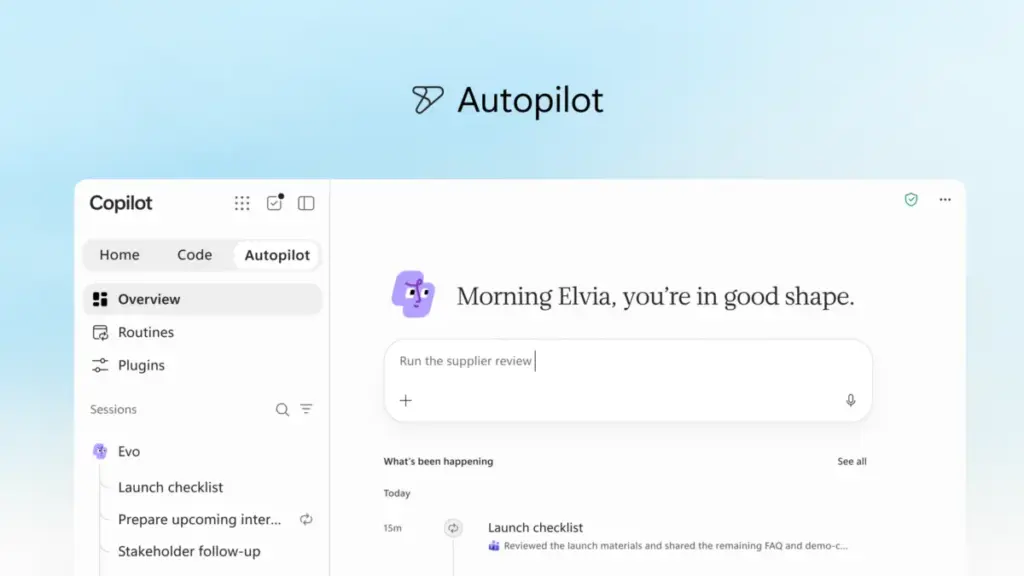
The third pillar of the new experience is "Autopilot," a persistent and proactive digital agent formerly known by the internal codename "Scout." Unlike traditional AI assistants that wait for a user to provide a prompt, Autopilot is designed to work autonomously.
Users can assign Autopilot a specific name, role, and goal. Once activated, the agent can monitor communication channels, follow up on email threads, and manage recurring workflows even when the user is offline. Microsoft provided the example of a full supplier review process: Autopilot can build a schedule, handle the preparation of materials, conduct meetings, and follow up with stakeholders for updates, all while the human user focuses on other priorities.

Because Autopilot is cloud-hosted and possesses its own identity and memory within the organization’s tenant, it functions more like a digital teammate than a tool. It is built on "Microsoft IQ," a unified intelligence platform that allows the agent to understand the specific context and cultural nuances of how a particular organization operates. Autopilot is integrated into Teams, Outlook, and other Microsoft 365 apps, allowing colleagues to @mention it just as they would any other member of the staff.
Expanding Context and Grounding AI in Business Data
For AI to be truly effective in a corporate setting, it must be "grounded" in the specific data of the business. Microsoft is expanding this context through "Fabric IQ," which brings semantic models from Power BI directly into Copilot. This allows Chat and Cowork to pull from trusted organizational data to provide more accurate and relevant insights.
Furthermore, Copilot is now being integrated with Dynamics 365 and Power Platform data. This means that a salesperson drafting a proposal can have Copilot automatically incorporate deal histories, customer support tickets, and specific account data directly into a document without having to manually look up the information in a separate CRM system.
To manage the various capabilities and third-party integrations, Microsoft is launching a new unified plugin registry. This catalog will allow IT administrators to centrally approve and manage plugins from Microsoft, partners, and custom developers, ensuring that users have access to the tools they need while maintaining organizational control and security.
 Productivity Software & Office Suites
Microsoft Announces Fifth Annual Power Platform Community Conference in Las Vegas to Address the Future of AI-Driven Business Processes
As modern enterprises continue to navigate an era defined by rapid digital...
 Productivity Software & Office Suites
Microsoft Announces General Availability of Work IQ APIs, Ushering in the Era of Agentic Software
REDMOND, Wash. — In a move that signals a fundamental transformation in...
 Productivity Software & Office Suites
Microsoft Unveils Advanced AI ‘Skills’ and Data Connectors to Transform Excel for Finance Professionals
The evolution of modern computing has historically followed a predictable trajectory, moving...







