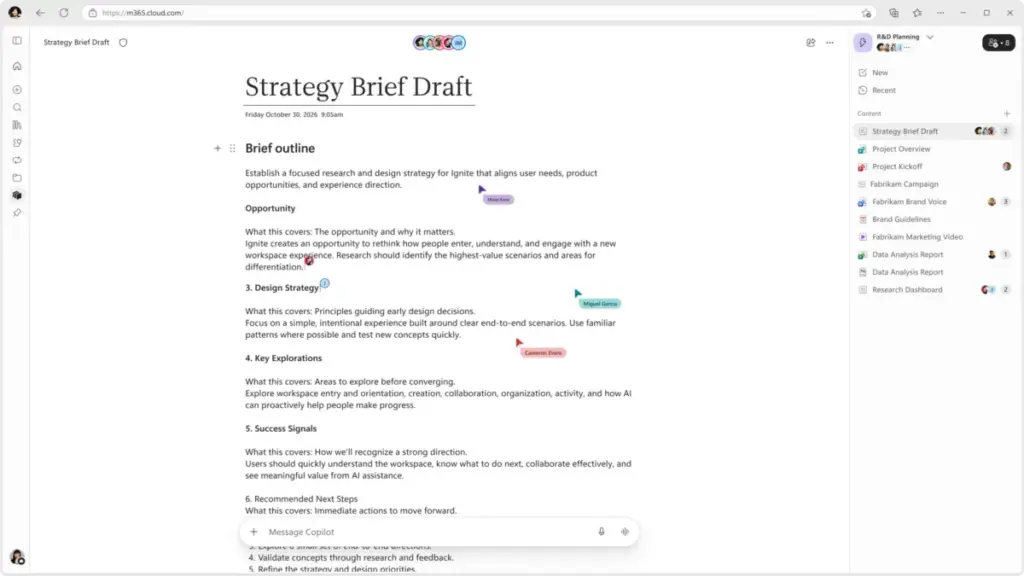
Microsoft addressed this competition directly at Ignite. Jacob Andreou, Microsoft’s executive vice president for Copilot, argued that while the offerings from Anthropic and OpenAI are functional, they lack the depth required for professional-grade work.
“We’ve all seen Anthropic and OpenAI embrace documents, slides, and spreadsheets,” Andreou said during a keynote presentation. “But their simplified viewers and editors force compromise on power and collaboration, and real work needs both. Knowledge work already lives in Word, Excel, and PowerPoint—it’s where your team is collaborating.”
To counter these "AI-native" challengers, Microsoft announced the general availability of Office in Copilot. This feature brings the full, editable versions of Microsoft’s legacy applications directly into the AI assistant’s interface. By doing so, Microsoft hopes to eliminate the friction of switching apps while retaining the advanced formatting and data-processing capabilities that professional users rely on.
Chris Gardner, VP and research director at Forrester, noted that Microsoft’s massive installed base provides a powerful defensive moat. “There are billions of Office documents floating around from the past few decades, and the default for many people is to collaborate through Microsoft 365,” Gardner said. “Inertia is a powerful thing.”
Governance, Lock-in, and the Multivendor Reality
While Microsoft’s "all-in-one" approach offers convenience, it also raises concerns about vendor lock-in and data governance. Max Goss, a senior director analyst at Gartner, warned that the more an organization embeds its workflows into a single AI ecosystem, the harder it becomes to pivot if costs rise or performance plateaus.
The move toward multiplayer environments with autonomous agents also introduces a new layer of complexity for IT administrators. If an employee shares sensitive information with an "autopilot" agent within a Workspace, ensuring that the agent does not inadvertently leak that data to unauthorized users becomes a paramount concern.
“If an employee shares something with an autopilot agent, how do you ensure that this agent doesn’t share with another user who shouldn’t have access?” Goss asked. He noted that while the collaborative vision is compelling, the underlying data governance frameworks must be equally sophisticated to handle these dynamic interactions.
Furthermore, Gartner statistics suggest that Microsoft may be facing a more fragmented enterprise market than it is used to. According to Goss, roughly 66% of organizations using Copilot have also deployed at least two other enterprise AI assistants. This suggests a clear preference among businesses for a multivendor approach, rather than relying solely on one provider.
“Microsoft can no longer assume its Microsoft 365 installed base will automatically translate into Copilot adoption,” Goss said. “Microsoft’s challenge is therefore to demonstrate that deep integration with Office produces materially better outcomes. If it doesn’t, then some may question whether they need the underlying productivity stack.”
 Small Business IT & Cloud Computing
Meta Partners with NEC and Sumitomo to Build Petal, the World’s Highest-Capacity Undersea Cable Connecting the US and France
In a significant move to bolster the backbone of the global internet,...
 Small Business IT & Cloud Computing
Google Bolsters Android Security with New ‘Enhanced Protection’ for Messaging Scams
In the modern digital landscape, the most sophisticated firewall or biometric lock...
 Small Business IT & Cloud Computing
Maximizing Mobile Productivity: The Hidden Architecture of Google Messages on Android
In the modern mobile landscape, the smartphone has transitioned from a simple...