Managing the Economics of Agentic AI
As Microsoft moves toward "agentic" workflows—where AI performs multi-step tasks autonomously—the cost of computing power becomes a critical factor for enterprise customers. To address this, the company introduced Copilot Auto, a tool designed to manage the background complexity and costs of AI operations.
Copilot Auto functions as a routing layer. When a user assigns a complex task, the tool splits it into smaller components and assigns each part to the specific AI model best suited for it—balancing factors like reasoning power, latency, and cost. For example, a simple text summary might be routed to a faster, cheaper model, while a complex financial analysis might be sent to a high-reasoning model.
This routing capability is increasingly important as Microsoft introduces usage-based billing. While standard Copilot chat queries are included in the flat $30-per-user monthly enterprise fee, more complex "agentic" tasks often draw from a pool of paid "Copilot Credits."
However, analysts note that the system is still maturing. Goss pointed out a current limitation in the "Auto" tool: while it can recommend that a user switch from a free Chat task to a paid "Cowork" task for more complexity, it does not yet effectively route users back the other way. This leads to situations where organizations might overspend on high-tier "Cowork" credits for simple tasks that could have been handled for free.
“People are using Cowork for simple things they can actually achieve in Copilot for free,” Goss said. “Microsoft hasn’t solved this yet.”
Looking Ahead: The "Today" Feature and Seamless Integration
Beyond the structural changes to Workspaces and Office, Microsoft also previewed "Today," a personalized morning briefing feature. Available in private preview, "Today" aims to act as a digital chief of staff, providing users with a summary of their daily agenda, flagging important tasks, and even preparing drafts of emails or schedule changes for the user to review and approve.
This proactive approach is part of Microsoft’s broader goal to move AI from a tool that waits for a prompt to a system that anticipates needs. By integrating these features into the OneNote app and other parts of the Microsoft 365 ecosystem over time, the company hopes to make Copilot an indispensable part of the workday.
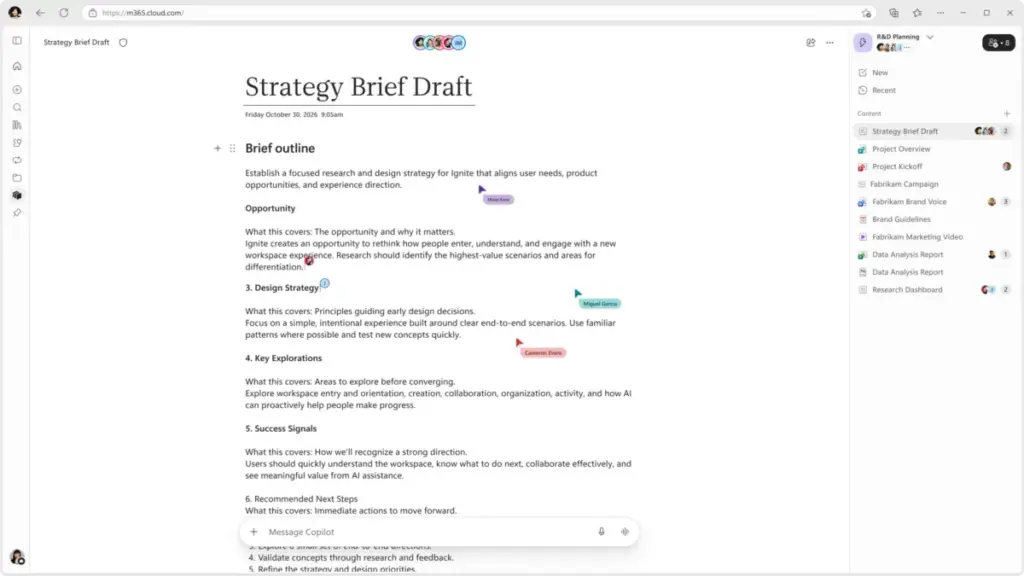
For now, Workspaces and the new "Today" feature remain in early access through Microsoft’s Frontier program. As these tools roll out more broadly, the ultimate test will be whether the "power" of the 30-year-old Office stack can outweigh the agility of the AI-native labs. As Goss observed, the labs are starting from the question of what a human using AI actually needs, while Microsoft is working to retrofit a legacy stack for a new era. The outcome of that clash will likely define the next decade of office productivity.
 Small Business IT & Cloud Computing
Meta Partners with NEC and Sumitomo to Build Petal, the World’s Highest-Capacity Undersea Cable Connecting the US and France
In a significant move to bolster the backbone of the global internet,...
 Small Business IT & Cloud Computing
Alibaba Unveils Qwen4-Max with Claims of Massive Cost Reductions and Enhanced Cyber Defenses Amid Analyst Skepticism
Alibaba has officially pulled back the curtain on its latest flagship artificial...
 Small Business IT & Cloud Computing
Precision Over Volume: Specialized AI Expertise Commands Premium Salaries in a Shifting Tech Job Market
The landscape of information technology recruitment is undergoing a fundamental transformation. For...