
Microsoft has announced a comprehensive reimagining of its Copilot platform, signaling a significant shift in how artificial intelligence is integrated into the daily flow of professional work. The update introduces a redesigned Copilot app designed to serve as a central nervous system for organizational productivity, connecting the traditional tools of the Microsoft 365 suite with a new generation of autonomous agents and low-code development capabilities.
This transformation is rooted in a vision to expand what individuals and organizations can achieve by embedding AI directly into the "flow of human ambition." Rather than acting as a peripheral assistant, the new Copilot is positioned as a foundational layer that can build, customize, and scale AI solutions across various business functions. The announcement highlights three primary pillars of the new experience: Home, Code, and Autopilot, alongside significant updates to how businesses manage the costs and data grounding associated with enterprise-grade AI.
A New Experience for Every Mode of Work
The centerpiece of this update is "Home," a redesigned starting point within the Copilot app that serves as a unified interface where conversational interaction and delegated tasks converge. In the modern workplace, where employees constantly pivot between meetings, emails, and document editing, Home is intended to provide a grounding experience. It allows users to review recent activities, receive proactive suggestions on how AI can assist with current projects, and resume work exactly where it was left off.
Within this new interface, Microsoft distinguishes between two primary modes of interaction: Chat and Cowork. Chat remains the familiar, instant conversational interface used for quick inquiries, data lookups, and drafting short communications. Cowork, however, represents a shift toward delegation. In this mode, users define a complex task—such as responding to a Request for Proposal (RFP), creating a product launch kit, or preparing a financial close package—and Copilot manages the process from end-to-end. This involves iterative work that traditionally required human oversight at every minor step, but can now be managed as a holistic project by the AI.
Furthermore, Microsoft is tightening the integration between Copilot and its core productivity software through "Office in Copilot." This feature embeds the full functionality of Word, Excel, and PowerPoint directly into the Copilot experience. The objective is to eliminate the friction of app-switching, which often leads to broken formatting or the creation of multiple, disconnected versions of the same file. Users can now draft briefs or model budgets within the Copilot interface, and the AI creates real, editable documents that remain in sync across the entire Microsoft 365 ecosystem. This allows for live collaboration; for instance, a user can @mention a teammate within the Copilot conversation, and that teammate’s edits will appear in real-time within the document being generated.

The individual Office apps are also receiving specialized updates. PowerPoint can now automatically ensure decks remain on-brand while allowing users to fine-tune specific slides or apply custom templates via AI. Excel has been enhanced to show exactly what changes Copilot or other collaborators have made, providing a clear audit trail of data manipulations. Additionally, new "Skills" are being introduced across the suite, bringing role-specific expertise—such as specialized legal terminology in Word or complex financial modeling in Excel—directly to the user.
Democratizing Solution Building Through Code
Perhaps the most technical expansion in this update is "Code," a feature that moves AI-assisted solution building beyond the exclusive domain of software developers. Historically, the primary units of knowledge work have been files: documents, spreadsheets, and presentations. Microsoft is now introducing a fourth unit: the purpose-built solution.
Powered by the same underlying technology as GitHub Copilot, the "Code" feature allows any employee to describe an application, an automation workflow, or a data dashboard in natural language. Copilot then determines the best technical approach and builds the tool. These can range from simple desktop widgets for quick reference to sophisticated, cloud-hosted internal apps that can be shared across a team.
To ensure these user-generated solutions meet enterprise security standards, Microsoft is introducing the Microsoft Copilot Managed Runtime. This infrastructure allows the generated code to run safely within the company’s existing Microsoft 365 environment, governed by IT but accessible to the average employee. This environment also supports applications built through Cowork and Copilot Studio, and Microsoft has announced plans to open this runtime to third-party and professional developers in the future.
The Rise of Autopilot: Persistent and Proactive Agents
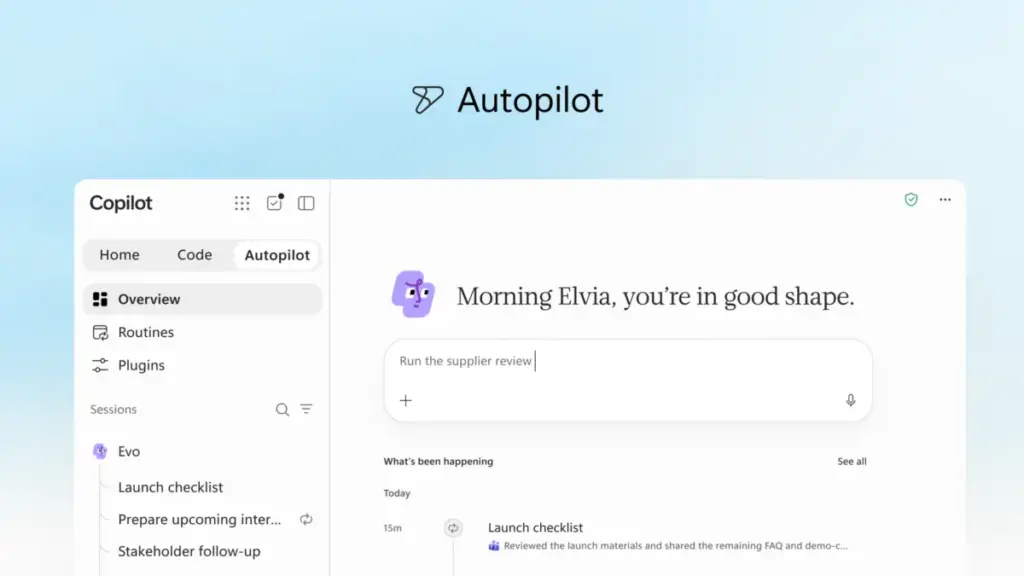
A significant evolution in the platform is the introduction of "Autopilot," a feature previously known during its development phase as Scout. Unlike standard AI assistants that require a prompt to initiate action, Autopilot is designed to function as a digital teammate that operates persistently and proactively.
Users can assign Autopilot a specific name, role, and objective. Once configured, the agent works independently—monitoring communication channels, following up on email threads, and executing recurring tasks without constant human intervention. For example, Autopilot can manage an entire supplier review process, which involves building schedules, handling meeting preparations, and reaching out to stakeholders for status updates. Because it is cloud-hosted, Autopilot continues to work even when the user is offline, ensuring that projects maintain momentum around the clock.

Autopilot is built on "Microsoft IQ," a unified intelligence platform that gives the agent an understanding of the organization’s specific workflows and context. It possesses its own identity, memory, and workspace within the company’s tenant, allowing it to be @mentioned in Teams or Outlook just like a human colleague. Despite its autonomy, Microsoft emphasizes that users remain in control, setting the boundaries and objectives while the agent handles the execution.
Expanding Business Context and Governance
For AI to be effective in a corporate environment, it must be grounded in the specific data and context of that business. Microsoft is addressing this through the expansion of Microsoft IQ, which now integrates Fabric IQ. This connection brings more than 20 million semantic models from Power BI into the Copilot environment, allowing the AI to draw on real-time data for its responses in Chat and Cowork.
Additionally, Copilot is now being grounded in data and workflows from Dynamics 365 and the Power Platform. This means a salesperson drafting a proposal can have Copilot automatically pull in deal histories or customer support tickets directly into the document, eliminating the need for manual lookups.
To manage this growing ecosystem of capabilities, Microsoft is launching a new plugin registry. This unified catalog will house Microsoft-built, partner-built, and custom plugins, providing IT departments with a centralized location to approve and govern the tools employees use to extend Copilot’s functionality.
Navigating the Economics of AI: FinOps for AI
As AI usage scales, managing the associated costs has become a primary concern for enterprise leaders. Microsoft is addressing this through a new discipline called "FinOps for AI," which aims to optimize AI spend for maximum business value.
The company is bifurcating its pricing strategy to reflect different types of AI work. For "everyday AI"—such as summaries, drafts, and quick lookups—Microsoft utilizes a User Subscription License (USL). This model employs a feature called "Auto," which automatically routes requests to the most cost-effective model that can handle the task with sufficient speed and accuracy.

For more complex "agentic work," such as the long-running tasks performed by Autopilot or the solutions built in Code, Microsoft is moving toward Usage-Based Billing (UBB). This allows organizations to match their costs directly to the value generated by advanced models. To help administrators navigate these costs, new management tools are being introduced in "Agent 365," allowing for the setting of spending policies, the routing of credit requests, and the monitoring of which AI tasks are yielding the best outcomes.
A Look Toward the Future: Today and Teams Integration
Microsoft concluded its announcement with a "sneak peek" at features currently in development. Coming soon to the Home interface is "Today," a personalized command center that aggregates information from email, calendars, and Teams. Rather than just listing tasks, "Today" is designed to be proactive—preparing drafts for pending replies, proposing schedule changes, and providing the necessary context for forgotten follow-ups so users can act immediately.
Furthermore, the company is testing "@Copilot in Teams," which will allow the AI to participate in group chats and channels with a full understanding of the shared context and permissions of that group. Users will be able to ask Copilot why certain decisions were made in past conversations, and the AI will be able to propose cross-functional reviews and track dependencies across different departments.
These updates are currently rolling out through Microsoft’s Frontier program, with broader availability expected in the coming weeks and months. The company plans to share further innovations at the upcoming Microsoft Ignite conference in November, where the focus will remain on how these tools empower organizations to reimagine the nature of work through the lens of AI.
 Productivity Software & Office Suites
Microsoft Reimagines Copilot as a Proactive AI Ecosystem for the Enterprise
Microsoft has announced a comprehensive overhaul of its Copilot platform, signaling a...
 Productivity Software & Office Suites
Microsoft Unveils Advanced AI ‘Skills’ and Data Connectors to Transform Excel for Finance Professionals
The evolution of modern computing has historically followed a predictable trajectory, moving...
 Productivity Software & Office Suites
Microsoft Announces Fifth Annual Power Platform Community Conference in Las Vegas to Explore the Future of AI-Driven Business Processes
The landscape of modern enterprise operations is undergoing a fundamental shift. For...







