
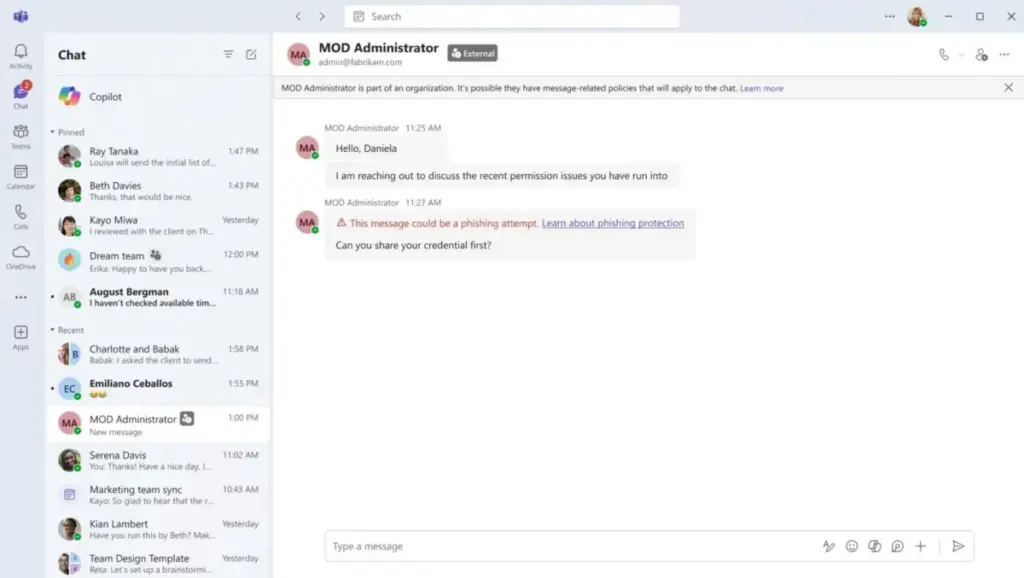
These attackers typically use professional-looking profile pictures and official-sounding titles to convince employees that their account requires urgent maintenance. The goal is frequently to trick the user into granting the attacker remote access to their workstation or to provide a multi-factor authentication (MFA) code under the guise of "verifying" the account. Once the attacker has remote access or an MFA bypass, they can move laterally through the corporate network, exfiltrating data or deploying ransomware.
By implementing context-aware detection, Microsoft aims to catch the linguistic markers of these help desk scams. If a new contact begins a conversation by immediately asking for remote access or a verification code, the AI can flag this as suspicious behavior, even if the links or files being shared (if any) are not inherently malicious. This proactive approach allows the system to intervene at the moment of the attempt, rather than after a compromise has already occurred.
Deployment Strategy and the "Background Validation" Phase
In a post shared via the Microsoft 365 Message Center, the company outlined a cautious and methodical rollout plan for the new security tool. Microsoft understands that in an enterprise environment, false positives—where legitimate business communication is incorrectly flagged as a scam—can be highly disruptive. To mitigate this risk, the feature will undergo a phased implementation.
"During initial quality validation, detection may run in the background without showing warnings to users," the company stated in the Message Center post. This "shadow mode" allows the AI to process real-world data and refine its detection algorithms without interfering with daily operations. It gives Microsoft’s engineers the opportunity to calibrate the sensitivity of the AI, ensuring that it can accurately distinguish between a legitimate urgent request from a colleague and a fraudulent high-pressure tactic from an attacker.
Once the validation phase is complete and the system meets Microsoft’s standards for accuracy, the feature will move into its active phase. At that point, users will begin to see warnings when the AI detects potential phishing or suspicious conversational patterns. These warnings are expected to serve as a critical "speed bump," prompting users to pause and verify the identity of the person they are speaking with before proceeding with a sensitive request.
Balancing Security with User Privacy
The introduction of any tool that "analyzes conversations" inevitably raises questions about privacy and data usage, especially within a corporate context where sensitive business intelligence is shared daily. Microsoft has been proactive in addressing these concerns, explicitly stating that the new security feature is not a tool for surveillance or workplace monitoring.
 Small Business IT & Cloud Computing
OpenAI Terminates Contractors for Utilizing Artificial Intelligence in Model Training Processes
In an industry defined by the rapid advancement of artificial intelligence, a...
 Small Business IT & Cloud Computing
GhostCode: The Emerging Phishing Threat Exploiting Microsoft 365 Device Authorization Flows
In a significant escalation of identity-based cyberattacks, security researchers have uncovered a...
 Small Business IT & Cloud Computing
Seagate and Toshiba Locked in Bidding War for TDK Magnetic Head Business as AI Demand Surges
The global hard disk drive industry, once a crowded field of dozens...







