
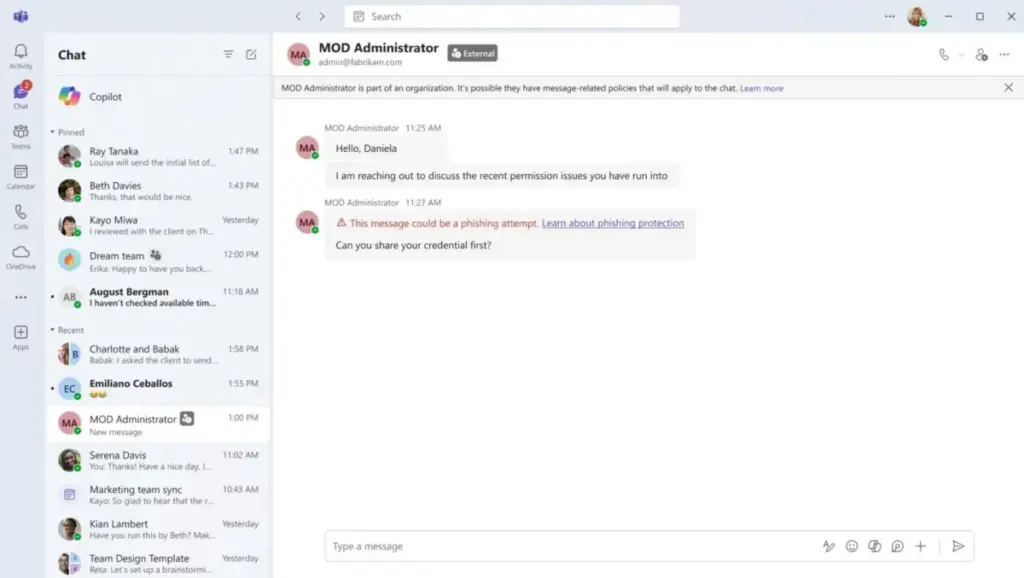
As the landscape of cyber threats continues to evolve from traditional email-based attacks toward more sophisticated social engineering on collaboration platforms, Microsoft has announced a significant upgrade to its security suite for Microsoft Teams. The tech giant is preparing to launch a new AI-powered security feature designed specifically to detect phishing, scams, and identity theft by analyzing the context and content of conversations in real-time. This move represents a strategic shift in how the company approaches platform security, moving beyond the simple scanning of malicious links and attachments to a more nuanced understanding of conversational behavior.
The new tool, first reported by Bleeping Computer, marks a departure from legacy security protocols that often rely on static signatures or known "bad" URLs. Instead, this AI-driven system will scrutinize the linguistic patterns and intent within messages to identify red flags that might suggest a user is being targeted by a bad actor. By focusing on the nuances of human interaction, Microsoft aims to close a critical gap in enterprise security that has been increasingly exploited by cybercriminals over the last several years.
A Shift Toward Behavioral and Contextual Analysis
For years, the primary line of defense in digital communication has been the identification of technical indicators of compromise (IoCs). These include things like suspicious file extensions, blacklisted IP addresses, or URLs that lead to known credential-harvesting sites. While these methods remain essential, they are often insufficient against modern social engineering tactics where no malicious payload is immediately present. In many contemporary attacks, the initial interaction is entirely benign—a simple "Hello" or an inquiry about a project—designed solely to build rapport before the "hook" is delivered.
Microsoft’s new AI-powered feature is designed to address this "long game" of social engineering. By analyzing the behavior within messages, the tool can identify requests that are out of character or typical of a scammer’s playbook. This includes high-pressure language, unusual requests for sensitive information, or attempts to move a conversation toward an unsecure or unauthorized platform. According to Microsoft, the tool will be particularly vigilant when a user interacts with new contacts. Because these individuals have no established history of interaction within the organization, they naturally pose a higher security risk, and the AI will prioritize these threads for deeper contextual analysis.
This focus on behavioral context is a direct response to the increasing complexity of "Business Communication Compromise" (BCC). Just as Business Email Compromise (BEC) costs organizations billions of dollars annually, attackers have realized that the informal and high-trust environment of Microsoft Teams makes it an ideal breeding ground for similar exploits. Users who might be skeptical of an unsolicited email are often more inclined to trust a message received through an internal collaboration tool, assuming that the sender has already been vetted by their organization’s IT department.
Addressing the Threat of IT Help Desk Impersonation
The development of this feature follows a series of urgent warnings from Microsoft regarding a specific and highly effective attack vector: the impersonation of IT help desk staff. In these scenarios, attackers gain access to a Teams environment—often through a compromised guest account or by exploiting external access settings—and then message employees while masquerading as technical support personnel.
These attackers typically use professional-looking profile pictures and official-sounding titles to convince employees that their account requires urgent maintenance. The goal is frequently to trick the user into granting the attacker remote access to their workstation or to provide a multi-factor authentication (MFA) code under the guise of "verifying" the account. Once the attacker has remote access or an MFA bypass, they can move laterally through the corporate network, exfiltrating data or deploying ransomware.
By implementing context-aware detection, Microsoft aims to catch the linguistic markers of these help desk scams. If a new contact begins a conversation by immediately asking for remote access or a verification code, the AI can flag this as suspicious behavior, even if the links or files being shared (if any) are not inherently malicious. This proactive approach allows the system to intervene at the moment of the attempt, rather than after a compromise has already occurred.
Deployment Strategy and the "Background Validation" Phase
In a post shared via the Microsoft 365 Message Center, the company outlined a cautious and methodical rollout plan for the new security tool. Microsoft understands that in an enterprise environment, false positives—where legitimate business communication is incorrectly flagged as a scam—can be highly disruptive. To mitigate this risk, the feature will undergo a phased implementation.
"During initial quality validation, detection may run in the background without showing warnings to users," the company stated in the Message Center post. This "shadow mode" allows the AI to process real-world data and refine its detection algorithms without interfering with daily operations. It gives Microsoft’s engineers the opportunity to calibrate the sensitivity of the AI, ensuring that it can accurately distinguish between a legitimate urgent request from a colleague and a fraudulent high-pressure tactic from an attacker.
Once the validation phase is complete and the system meets Microsoft’s standards for accuracy, the feature will move into its active phase. At that point, users will begin to see warnings when the AI detects potential phishing or suspicious conversational patterns. These warnings are expected to serve as a critical "speed bump," prompting users to pause and verify the identity of the person they are speaking with before proceeding with a sensitive request.
Balancing Security with User Privacy
The introduction of any tool that "analyzes conversations" inevitably raises questions about privacy and data usage, especially within a corporate context where sensitive business intelligence is shared daily. Microsoft has been proactive in addressing these concerns, explicitly stating that the new security feature is not a tool for surveillance or workplace monitoring.
According to the company, no messages analyzed by the tool will be saved specifically for the purpose of the security check, nor will the content of these conversations be used to train Microsoft’s broader AI models. The tool is designed to function as a real-time filter rather than a data-collection mechanism. Microsoft further emphasized that the data will be used solely for security purposes and will not be repurposed for advertising or any other secondary uses.
This commitment to privacy is essential for maintaining the trust of enterprise clients, many of whom operate in highly regulated industries like finance, healthcare, and law. In these sectors, the unauthorized monitoring of communications could lead to significant legal and compliance issues. By keeping the analysis local to the security function and ensuring that data is not retained for model training, Microsoft aims to provide a "privacy-first" security solution.
Automated Implementation and Rollout Timeline
For IT administrators, the implementation of this new feature will be relatively seamless. Microsoft has confirmed that IT teams do not need to manually configure the tool or adjust complex settings to get it up and running. The feature will be automatically enabled as part of the standard Teams security updates, ensuring that even organizations with limited IT resources are protected by the new AI layer.
The rollout is scheduled to begin in early November 2026. Following the initial deployment and the background validation phase, the feature is expected to reach general availability during the first half of December 2026. This timeline suggests that Microsoft is aiming to have the system fully operational before the end of the year, providing a robust defense during a season when cyberattacks often spike due to holiday-related distractions and reduced staffing in many offices.
As Microsoft Teams continues to serve as the primary operating system for the modern workplace, the integration of context-aware AI security represents a necessary evolution in defense. By moving beyond the "what" of a message (links and files) and focusing on the "how" and "why" of the conversation, Microsoft is attempting to stay one step ahead of attackers who rely on the nuances of human psychology to bypass technical safeguards. For the millions of users who rely on Teams daily, this update promises a more secure environment where the AI works silently in the background to identify threats before they can do damage.
 Small Business IT & Cloud Computing
Bridging the AI Value Gap: Why Organizations Must Shift from Cost-Cutting to a ‘Return on Intelligence’
As the initial wave of artificial intelligence enthusiasm transitions into a period...
 Small Business IT & Cloud Computing
After the Blue Tsunami: Why Microsoft Faces a New Era of Oversight, Regulation, and Fiscal Contraction
The political landscape of the United States has undergone a seismic shift...
 Small Business IT & Cloud Computing
IEA Forecasts Massive Surge in Global Data Center Power Demand Driven by Rapid AI Expansion
The global energy landscape is facing a transformative shift as the rapid...






