
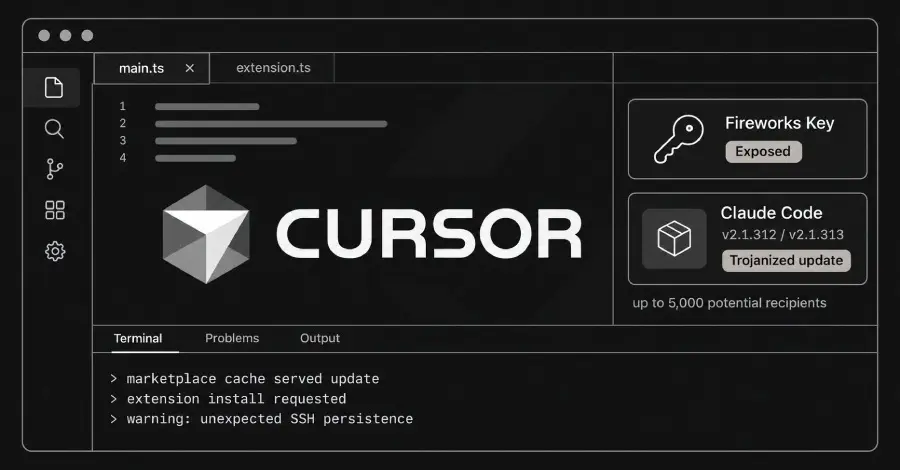
In a detailed post-mortem that highlights the growing complexities of AI supply chain security, the AI-powered code editor Cursor has confirmed that a recent security breach was triggered by the theft of an access key from Fireworks AI. This initial compromise eventually led to the distribution of a trojanized version of Anthropic’s official Claude Code extension through the Cursor Marketplace, an incident that has sent ripples through the software development and cybersecurity communities.
The disclosure, released on November 15, 2026, provides a comprehensive look at how a vulnerability in a third-party service provider can escalate into a direct threat to end-users. According to Cursor, the chain of events began when an attacker obtained an access key that Cursor had issued to Fireworks AI, a platform used for running large language models. This key was reportedly exposed following a separate breach at Fireworks AI, allowing the unauthorized party to gain a foothold in Cursor’s secondary data environments.
The Anatomy of the Initial Breach
The security incident began to unfold when the attacker utilized the stolen Fireworks AI credential to gain access to a read-only storage bucket. This bucket was used by Cursor to facilitate data sharing with Fireworks for the purpose of model inference and optimization. While the storage was read-only, the information contained within proved to be a goldmine for the attacker’s next steps.
Cursor explained that the storage bucket held limited traces from "coding agent" sessions. These traces are essentially logs of how the AI interacts with codebases to provide suggestions, debugging, and completions. Crucially, the company noted that these traces were exclusively from sessions where "Privacy Mode" had not been enabled. In Cursor’s ecosystem, Privacy Mode is a critical security feature that allows users to opt out of having their data used for model training or stored in certain types of logs.
The traces in question largely dated back to 2025 and were permitted for use in model training under the platform’s standard terms of service. However, the investigation revealed a failure in the data scrubbing process. Despite automated efforts to remove sensitive information, some credentials had not been properly redacted from these traces. As a result, the attacker was able to harvest API credentials belonging to a small fraction of Cursor’s user base—estimated to be less than 0.01% of the total customer population.
While the percentage of affected users was statistically small, the stolen credentials provided the attacker with the leverage needed to pivot deeper into Cursor’s infrastructure. By utilizing these harvested keys, the threat actor moved laterally to access several software-as-a-service (SaaS) tools used by the company for internal operations.
The Marketplace Escalation and the Trojanized Extension
The most alarming phase of the attack occurred on October 29, 2026. Armed with credentials obtained from the internal SaaS tools, the attacker successfully accessed the cache system used to serve the Cursor Extension Marketplace. The objective was to distribute malware by masquerading as a legitimate, highly trusted tool: Anthropic’s Claude Code extension.

The attacker uploaded a trojanized version of the extension (specifically versions 2.1.312 and 2.1.313) directly into the marketplace’s cache. To the average user, the extension appeared to be a legitimate update to the official Claude Code tool. In reality, the malicious build was designed to install a persistent SSH backdoor on the victim’s machine. Such a backdoor would allow the attacker to maintain remote access to the developer’s system, potentially leading to the theft of source code, proprietary secrets, and further network penetration.
Cursor’s internal monitoring eventually flagged the anomaly, but not before the malicious extension had been available for approximately 11 hours. During this window, the company estimates that at most 5,000 users who requested those specific cached versions potentially received the compromised build.
Upon discovery, Cursor took immediate action to mitigate the threat. The extension marketplace was taken offline to prevent further downloads, and the malicious files were purged from the cache. The company also collaborated with the cloud service provider hosting the attacker’s command-and-control (C2) server to have the infrastructure dismantled. Since November 1, 2026, Cursor reports that no further malicious activity related to this incident has been detected.
Remediation and User Protection
In the wake of the incident, Cursor has implemented a series of aggressive security measures to prevent a recurrence. The company has moved all its inference traffic away from Fireworks AI and deactivated the access key previously issued to the vendor. Furthermore, all access to data sets shared with Fireworks has been terminated.
For the users identified as having downloaded the malicious extension versions, Cursor has issued direct notifications. The company assisted these individuals in revoking any credentials that may have been exposed during the 11-hour window. Additionally, the company performed an extensive sweep to rotate internal credentials and hunt for any signs of deeper persistence within its own production environment.
Importantly, Cursor emphasized that the core components of its service remained secure. There is currently no evidence that the breach impacted:
- Users who had Privacy Mode enabled.
- Customer code repositories hosted on the platform.
- Cursor’s primary production environment.
- The official Cursor application or its primary update channel.
- Other extensions or plugins available on the marketplace.
The company stated that the breach was contained to the specific marketplace cache and the data traces previously shared with the compromised third-party vendor.
Uber and the Widening Impact of the Fireworks Incident
The revelation from Cursor coincides with a broader investigation into the security of Fireworks AI, which appears to have been a central point of failure for multiple high-profile companies. Uber has also confirmed that it was impacted by the same underlying incident at the service provider.

In a filing with the California Attorney General’s office, Uber disclosed that an unauthorized third party had compromised the internal credentials of a service provider on October 9, 2026. While Uber’s public filing did not explicitly name the provider, industry reports and subsequent investigations have linked the breach to Fireworks AI.
According to Uber, the attackers used the compromised credentials to access Uber’s account with the provider, subsequently stealing the driver’s license information of thousands of drivers. Uber’s investigation, which concluded on October 13, determined that the data was connected to the services provided by the third party. The ride-sharing giant has not yet disclosed the exact number of drivers affected, though the theft of government-issued identification poses a significant identity theft risk.
Uber is not the only other victim. Online productivity and note-taking startup Notion also confirmed recently that it suffered a data theft incident linked to the Fireworks AI compromise. These concurrent breaches suggest that the threat actor behind the Fireworks AI attack was systematically targeting the provider’s most prominent clients to harvest data and credentials.
The Risks of the AI Supply Chain
The Cursor and Uber incidents serve as a stark reminder of the risks inherent in the modern AI supply chain. As companies increasingly rely on specialized third-party providers for model inference, data labeling, and AI infrastructure, the attack surface for those companies expands significantly.
In this case, a single compromised key at a service provider allowed an attacker to bridge the gap between a data storage bucket and a software distribution platform. The ability to inject malicious code into a marketplace cache is particularly concerning for the developer community, where trust in tools like Cursor and extensions like Claude Code is paramount.
The incident also highlights the importance of data privacy settings. Cursor’s "Privacy Mode" served as an effective barrier in this instance, protecting users who had opted out of data sharing from having their session traces exposed. However, the fact that API credentials remained in the non-privacy traces despite redaction efforts points to the ongoing difficulty of fully de-identifying complex technical data.
As the industry moves forward, the focus on "Zero Trust" architectures and more rigorous third-party risk management is likely to intensify. For developers, the lesson remains one of vigilance: ensuring that local environments are monitored for unauthorized access and that security features like Privacy Mode are utilized when handling sensitive proprietary information.
Cursor has stated it will continue to monitor its systems and work with security researchers to harden its marketplace and data handling procedures. The company’s decision to move inference traffic off the compromised provider marks a significant step in re-establishing its security perimeter as it looks to move past one of the most sophisticated attacks in its history.
 Cybersecurity Basics & Security News
OpenAI Dismisses Safety Researchers Following Leak of Confidential Infrastructure Data Amid Growing Security Concerns
OpenAI has terminated the employment of three prominent members of its safety...
 Cybersecurity Basics & Security News
Critical CVSS 10 Vulnerability in Canonical LXD and MicroCloud Allows Unauthorized Host Access
In a significant security development for the Linux container and cloud orchestration...
 Cybersecurity Basics & Security News
AI vs. AI: How Researchers Used Claude Opus 5 to Breach OpenAI’s Internal Systems
In a sophisticated demonstration of the "double-edged sword" nature of generative artificial...







