
According to Uber, the attackers used the compromised credentials to access Uber’s account with the provider, subsequently stealing the driver’s license information of thousands of drivers. Uber’s investigation, which concluded on October 13, determined that the data was connected to the services provided by the third party. The ride-sharing giant has not yet disclosed the exact number of drivers affected, though the theft of government-issued identification poses a significant identity theft risk.
Uber is not the only other victim. Online productivity and note-taking startup Notion also confirmed recently that it suffered a data theft incident linked to the Fireworks AI compromise. These concurrent breaches suggest that the threat actor behind the Fireworks AI attack was systematically targeting the provider’s most prominent clients to harvest data and credentials.
The Risks of the AI Supply Chain
The Cursor and Uber incidents serve as a stark reminder of the risks inherent in the modern AI supply chain. As companies increasingly rely on specialized third-party providers for model inference, data labeling, and AI infrastructure, the attack surface for those companies expands significantly.
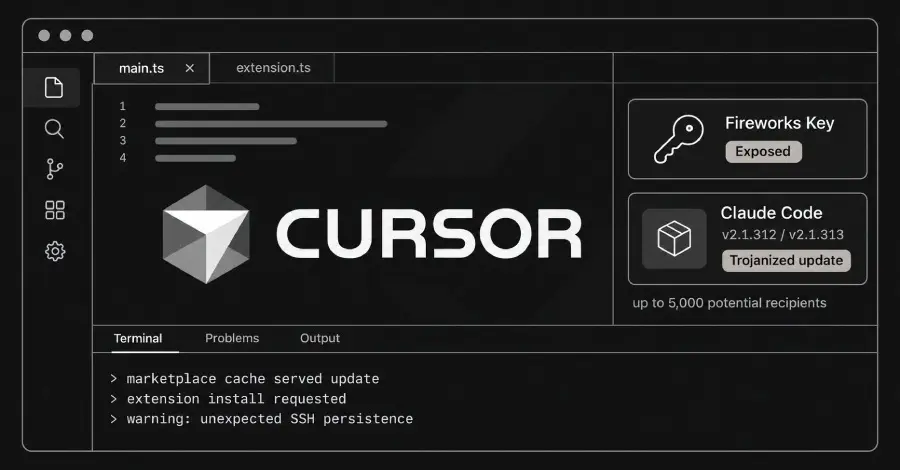
In this case, a single compromised key at a service provider allowed an attacker to bridge the gap between a data storage bucket and a software distribution platform. The ability to inject malicious code into a marketplace cache is particularly concerning for the developer community, where trust in tools like Cursor and extensions like Claude Code is paramount.
The incident also highlights the importance of data privacy settings. Cursor’s "Privacy Mode" served as an effective barrier in this instance, protecting users who had opted out of data sharing from having their session traces exposed. However, the fact that API credentials remained in the non-privacy traces despite redaction efforts points to the ongoing difficulty of fully de-identifying complex technical data.
As the industry moves forward, the focus on "Zero Trust" architectures and more rigorous third-party risk management is likely to intensify. For developers, the lesson remains one of vigilance: ensuring that local environments are monitored for unauthorized access and that security features like Privacy Mode are utilized when handling sensitive proprietary information.
Cursor has stated it will continue to monitor its systems and work with security researchers to harden its marketplace and data handling procedures. The company’s decision to move inference traffic off the compromised provider marks a significant step in re-establishing its security perimeter as it looks to move past one of the most sophisticated attacks in its history.
 Cybersecurity Basics & Security News
Silent Breaches at AI Inference Providers Expose Sensitive Prompt Data Despite Privacy Flags
A significant security failure in the artificial intelligence supply chain has been...
 Cybersecurity Basics & Security News
MALFEX Campaign Persists as Researchers Uncover Malicious Native Loader in Popular npm Registry
Cybersecurity researchers have identified a sophisticated new entry in the ongoing software...
 Cybersecurity Basics & Security News
Cybersecurity Researchers Identify New Wave of Targeted Attacks Against Qlik Sense Servers
In a significant escalation of activity targeting enterprise data visualization infrastructure, cybersecurity...







