
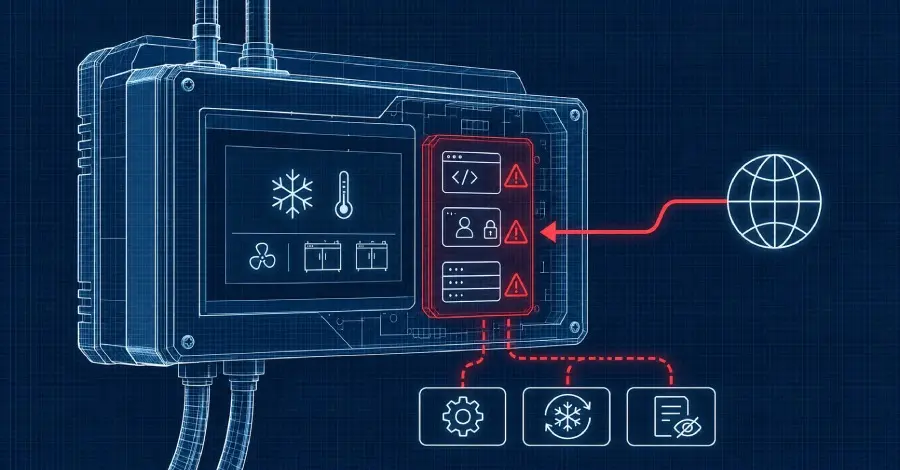
During their investigation, researchers successfully demonstrated this exploit on version 3.3.0 of the firmware and confirmed that the same bugs persist in version 5.3.2, which was the most current version available during the bulk of their research. With root access, a remote actor could alter temperature settings, initiate manual defrost cycles, and delete system logs to hide their presence from technicians.
Perhaps most alarming is the failure of the "Strict mode" protection. Danfoss designed Strict mode as a robust login defense that mandates encrypted connections and session tokens, theoretically closing the web attack surface to unauthenticated users. However, Midnight Blue discovered that the sixth vulnerability exists within the gateway responsible for enforcing Strict mode itself.
In testing environments using an emulator, researchers found that a specific exploit could crash this gateway. While the researchers noted that turning this crash into full code execution would require additional effort, the gateway lacks modern exploit defenses, such as stack canaries, which are standard in most secure software today. This means that even if a store owner follows the manufacturer’s best practices and enables Strict mode, the device remains vulnerable to an attacker who can bypass the gateway entirely.
The researchers also noted that the AK-SM800A lacks a secure boot mechanism. This is a critical architectural omission; without secure boot, an attacker who gains root access can install persistent malware that remains on the device even after a factory reset or a firmware update. In a worst-case scenario, an attacker could "brick" the device, rendering it permanently unusable and forcing the operator to physically replace the hardware.
The Response from Danfoss and National Authorities
The manufacturer, Danfoss, has acknowledged the general threat environment but has yet to issue a specific security advisory for the six flaws identified by Midnight Blue. The company’s latest software package, version 5.4.0, was released in November. While the update guide for this version introduces stricter password requirements, it makes no mention of the vulnerabilities discovered by the Dutch consultancy.
Midnight Blue has criticized the effectiveness of version 5.4.0 as a security fix. In a statement provided to the trade publication Cooling Post, the researchers pointed out that the firmware was likely compiled in late October, prior to their formal vulnerability reports and before the second wave of European cyberattacks. Consequently, they argue that version 5.4.0 cannot be considered a patch for these issues.

The German BSI initially suggested that version 5.4.0 was unaffected, but later issued a correction stating that it cannot rule out the possibility that the latest firmware is still vulnerable. As of now, no CVE (Common Vulnerabilities and Exposures) identifiers have been assigned to these flaws, as the researchers are keeping the technical specifics private while they coordinate a disclosure process with Danfoss.
 Cybersecurity Basics & Security News
U.S. Authorities Seize Infrastructure Used in Massive North Korean Cryptocurrency Theft Campaigns
In a significant blow to the digital financing of sanctioned regimes, the...
 Cybersecurity Basics & Security News
Active Exploitation of Two New Unpatched Zero-Day Vulnerabilities Discovered in Citrix NetScaler Appliances
Security researchers and enterprise IT departments are on high alert following reports...
 Cybersecurity Basics & Security News
China-Linked Cyber Espionage Groups Overhaul Toolkits to Target Southeast Asian Government Entities
A series of sophisticated cyber espionage campaigns attributed to Chinese advanced persistent...







