
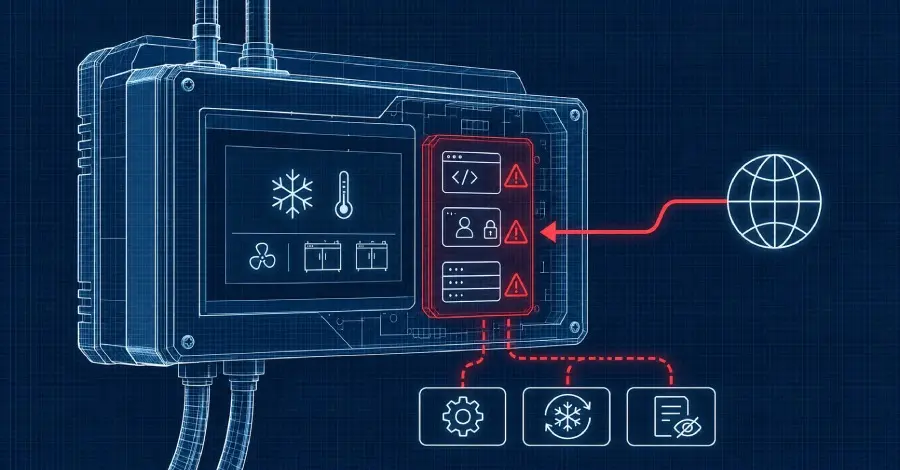
A series of severe security vulnerabilities discovered in widely used industrial refrigeration controllers has prompted urgent warnings from national cybersecurity agencies across Europe. The flaws, found in the Danfoss AK-SM800A series, could allow remote, unauthenticated attackers to seize full control of the systems, potentially leading to the destruction of temperature-sensitive inventory and significant operational disruptions in supermarkets and food storage facilities.
The vulnerabilities were identified by Midnight Blue, a specialized security consultancy based in the Netherlands. According to the firm’s research, the flaws are present in the management interface of the AK-SM800A, a device designed to monitor and regulate refrigeration and freezing units. The researchers have sounded the alarm because, as of this week, no official patch has been released to address these specific issues. Furthermore, the latest firmware update provided by the manufacturer, version 5.4.0, reportedly fails to mitigate the risks.
The discovery has triggered a coordinated response from government cybersecurity bodies in Belgium, Ireland, and Germany. These agencies have taken the unusual step of advising all operators of Danfoss AK-SM800A controllers to immediately remove their management interfaces from the public internet. The consensus among these authorities is that traditional security measures, such as updating firmware or enabling enhanced login protections, are currently insufficient to protect against a targeted exploit of these newly discovered bugs.
A Growing Pattern of Cyberattacks on Cold Storage
The timing of this discovery is particularly concerning given the recent wave of cyberattacks targeting European infrastructure. Starting on October 11, supermarket chains in France reported mysterious malfunctions in their cooling systems. These incidents, which researchers and government agencies have linked to unauthorized access of refrigeration controllers, caused unwanted defrost cycles that ruined massive quantities of perishable stock.
A second wave of similar attacks was observed across Europe just last week, suggesting that threat actors are actively seeking out and exploiting vulnerable industrial control systems (ICS) within the food supply chain. While the German Federal Office for Information Security (BSI) confirmed that the AK-SM800A was involved in previous incidents where refrigeration units were tampered with across multiple countries, it noted that there is currently no direct evidence linking the six newly discovered flaws to those specific historical attacks. However, the potential for these flaws to be utilized in future campaigns remains a primary concern for national security experts.
The vulnerabilities are not merely theoretical. Midnight Blue researcher Carlo Meijer reportedly discovered the six flaws in less than an hour of manual review using firmware that is publicly available for download from the vendor’s website. This ease of discovery highlights a significant security gap in the architecture of the controllers, which are relied upon by maintenance firms to manage store environments remotely.

Technical Breakdown: Root Access and "Strict Mode" Failures
The technical details provided by Midnight Blue paint a troubling picture of the device’s security posture. Five of the six vulnerabilities reside within web request handlers that do not require any form of authentication. Crucially, these handlers operate within a program that runs with root privileges—the highest level of access on the system. By exploiting one of these flaws, an attacker could execute arbitrary code with root authority, effectively gaining total control over the controller’s functions.
During their investigation, researchers successfully demonstrated this exploit on version 3.3.0 of the firmware and confirmed that the same bugs persist in version 5.3.2, which was the most current version available during the bulk of their research. With root access, a remote actor could alter temperature settings, initiate manual defrost cycles, and delete system logs to hide their presence from technicians.
Perhaps most alarming is the failure of the "Strict mode" protection. Danfoss designed Strict mode as a robust login defense that mandates encrypted connections and session tokens, theoretically closing the web attack surface to unauthenticated users. However, Midnight Blue discovered that the sixth vulnerability exists within the gateway responsible for enforcing Strict mode itself.
In testing environments using an emulator, researchers found that a specific exploit could crash this gateway. While the researchers noted that turning this crash into full code execution would require additional effort, the gateway lacks modern exploit defenses, such as stack canaries, which are standard in most secure software today. This means that even if a store owner follows the manufacturer’s best practices and enables Strict mode, the device remains vulnerable to an attacker who can bypass the gateway entirely.
The researchers also noted that the AK-SM800A lacks a secure boot mechanism. This is a critical architectural omission; without secure boot, an attacker who gains root access can install persistent malware that remains on the device even after a factory reset or a firmware update. In a worst-case scenario, an attacker could "brick" the device, rendering it permanently unusable and forcing the operator to physically replace the hardware.
The Response from Danfoss and National Authorities
The manufacturer, Danfoss, has acknowledged the general threat environment but has yet to issue a specific security advisory for the six flaws identified by Midnight Blue. The company’s latest software package, version 5.4.0, was released in November. While the update guide for this version introduces stricter password requirements, it makes no mention of the vulnerabilities discovered by the Dutch consultancy.
Midnight Blue has criticized the effectiveness of version 5.4.0 as a security fix. In a statement provided to the trade publication Cooling Post, the researchers pointed out that the firmware was likely compiled in late October, prior to their formal vulnerability reports and before the second wave of European cyberattacks. Consequently, they argue that version 5.4.0 cannot be considered a patch for these issues.

The German BSI initially suggested that version 5.4.0 was unaffected, but later issued a correction stating that it cannot rule out the possibility that the latest firmware is still vulnerable. As of now, no CVE (Common Vulnerabilities and Exposures) identifiers have been assigned to these flaws, as the researchers are keeping the technical specifics private while they coordinate a disclosure process with Danfoss.
The Dutch researchers have expressed frustration with the current state of ICS security, calling the practice of patching individual flaws or relying on features like Strict mode a "misallocation of scarce security and personnel resources." They suggest that the underlying codebase likely contains numerous other similar vulnerabilities that have yet to be found.
What Operators Can Do
In the absence of a definitive patch, the primary recommendation from international cybersecurity experts is the immediate isolation of these devices from the public internet. The Centre for Cybersecurity Belgium (CCB) and Ireland’s National Cyber Security Centre (NCSC) have both issued advisories emphasizing that internet exposure must be eliminated regardless of whether the firmware is up to date or if Strict mode is enabled.
Operators are urged to move the management interface of the AK-SM800A behind a firewall or a Virtual Private Network (VPN). This ensures that only authorized personnel with internal network access can reach the controller. Additionally, the German BSI recommends that any operator who suspects their system may have been tampered with should immediately change all administrative credentials and conduct a thorough physical inspection of the connected refrigeration equipment to ensure it is operating within safe parameters.
However, disconnecting these systems is not always a straightforward task. Many supermarkets rely on third-party maintenance firms that monitor these controllers 24/7 via the internet. The Belgian advisory warns operators to review their service contracts and insurance policies before cutting off data transmissions, as doing so might inadvertently violate service-level agreements or void insurance coverage for spoiled stock. The recommended approach is to transition to a protected remote access solution that allows for continued monitoring without exposing the device to the open web.
Danfoss’s own documentation has historically recommended that the AK-SM800A should not be directly reachable from the public internet. An update guide from the company explicitly states: “This recommendation applies to all software versions, including those with Strict Mode enabled.” Despite this, a significant number of units remain exposed globally, often due to legacy configurations or a lack of awareness regarding the risks of internet-connected industrial hardware.
The current situation serves as a stark reminder of the vulnerabilities inherent in the "Internet of Things" (IoT) and Industrial Control Systems. As threat actors increasingly target the physical infrastructure that supports daily life, the security of a supermarket’s freezer may become just as critical as the security of a bank’s database. For now, the message to operators is clear: disconnect, verify, and wait for a formal resolution from the manufacturer.
 Cybersecurity Basics & Security News
OpenAI Dismisses Safety Researchers Following Leak of Confidential Infrastructure Data Amid Growing Security Concerns
OpenAI has terminated the employment of three prominent members of its safety...
 Cybersecurity Basics & Security News
GitHub Actions Compromised in ‘Mini Shai-Hulud’ Attack Disabled Again Following Brief Reappearance
The cybersecurity landscape has been reminded once again of the persistent and...
 Cybersecurity Basics & Security News
Critical Remote Code Execution Vulnerability Discovered in GitLab AI Gateway
GitLab has issued an urgent security advisory regarding a critical vulnerability discovered...







