
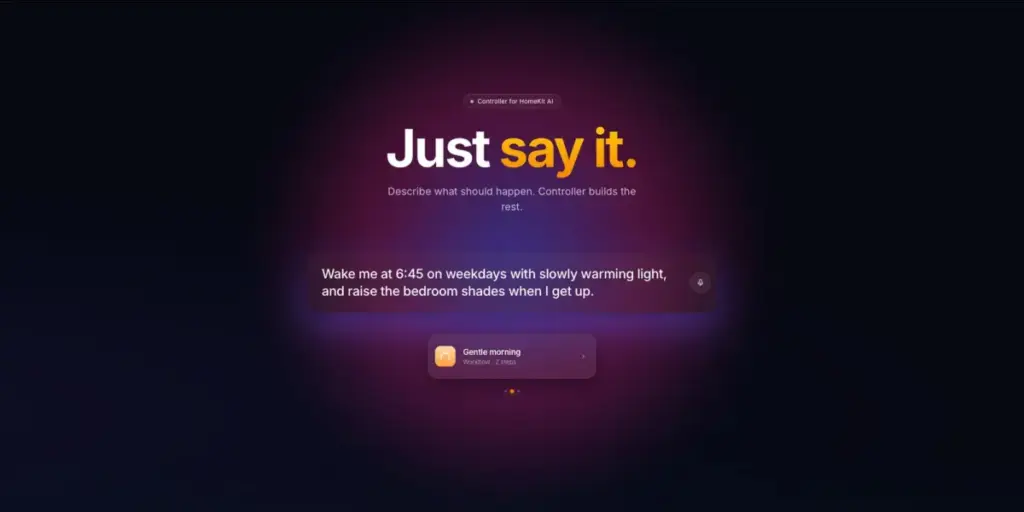
Another example provided by the team showcases the ease of setting atmospheric scenes: "Movie night: dim the living room lights to 20% and close the curtains." This highlights the AI’s ability to group multiple device categories—lighting and window coverings—under a single custom-named scene with specific state requirements. Furthermore, the AI demonstrates its proficiency with conditional logic through a security-focused prompt: "If someone comes home after midnight, turn only the hallway light to 15%." This specific request requires the app to understand location-based triggers, time-of-day constraints, and precise brightness levels, ensuring that the automation provides safety without disturbing the rest of the household.
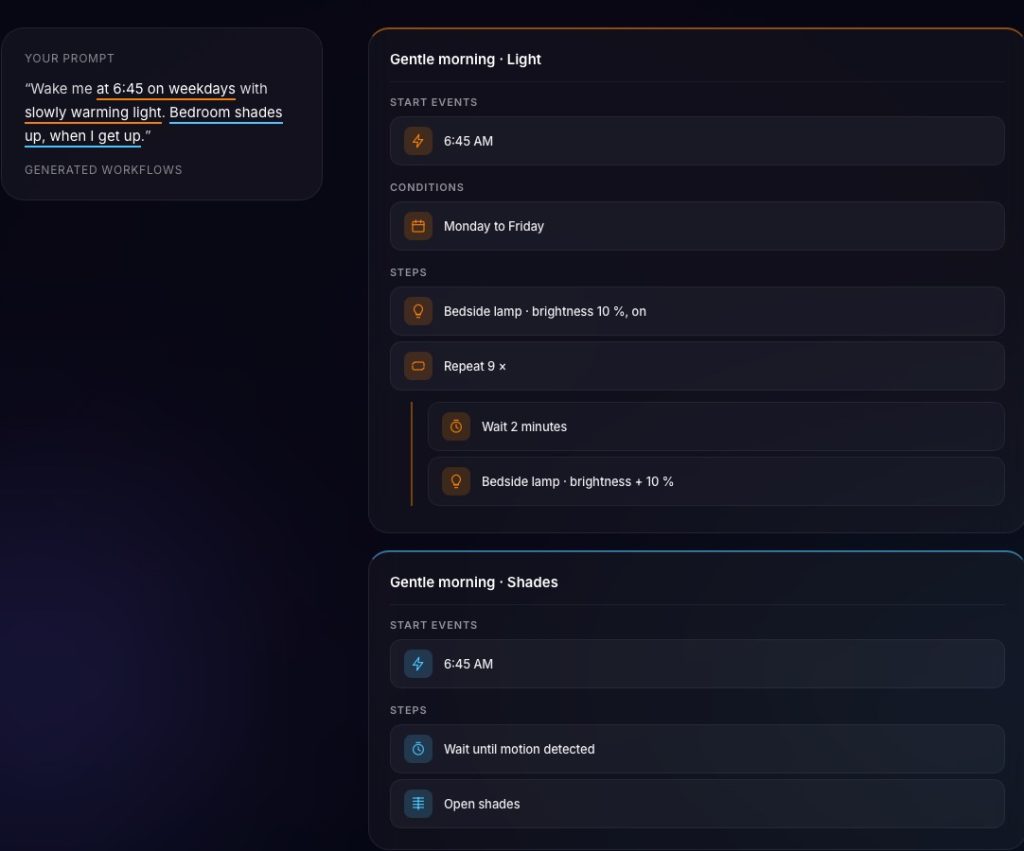
The technical achievement here lies in how the app translates human intent into the rigid, structured language of HomeKit commands. When a user provides a prompt, the AI must parse the sentence for specific keywords, identify the relevant devices within the user’s existing HomeKit setup, and then construct a logic flow that Apple’s HomeKit framework can execute. For instance, in the morning routine example, the AI must distinguish between "weekdays" and "weekends," identify which devices are "lights" and "shades," and interpret "slowly warming" as a command for a gradual increase in both brightness and color temperature over a set duration.
Early testing of the feature suggests that the implementation is robust, even in homes that are not yet fully saturated with smart technology. In one instance, a user with a limited setup—consisting of only a few smart lights and a single smart plug—tested the system by asking the app to switch on a bedroom fan (connected via the smart plug) whenever the living room lights were turned off. Despite the simplicity of the hardware available, the AI successfully interpreted the causal link between the two actions and created a functional automation instantly. This indicates that the feature is not just for those with dozens of devices, but can also help beginners maximize the utility of a few key components.
The timing of this update is particularly noteworthy as the broader tech industry shifts toward "agentic" AI—systems that do not just provide information but take action on behalf of the user. While Apple has recently announced its own suite of "Apple Intelligence" features designed to make Siri more capable of handling on-device tasks, third-party developers like those behind Controller for HomeKit are often able to move faster and provide more specialized tools for niche power users. By integrating AI directly into the automation creation process, Controller for HomeKit is positioning itself as an essential companion for those who find the standard Home app too restrictive or cumbersome.
Controller for HomeKit has long been regarded as one of the premier third-party alternatives to Apple’s native solution. It offers a suite of advanced features that go beyond simple device control, including the ability to back up HomeKit configurations, view detailed logs of device activity, and manage complex smart home data that is often hidden from view. The addition of natural language automation is a logical extension of this "pro" toolset, making the app’s advanced capabilities more accessible without stripping away the depth that long-time users expect.
 Smart Home & IoT Solutions
Abode Expands Home Security Perimeter with New Apple Home-Compatible Garage and Outdoor Sensors
In the rapidly evolving landscape of do-it-yourself home security, the focus has...
 Smart Home & IoT Solutions
Apple Expands Smart Home Ecosystem with New Aqara Accessories and Third-Party Hardware Ahead of Major Product Launches
In a significant update to its retail and digital storefronts this week,...
 Smart Home & IoT Solutions
Apple and LG Collaborate on Major Smart Home Expansion to Reboot the HomeKit Ecosystem
In a significant strategic shift aimed at revitalizing its presence in the...







