

The promise of the modern smart home has always been one of seamless convenience, where technology anticipates the needs of the inhabitants and responds without the need for constant manual intervention. However, for many users within the Apple ecosystem, the reality of setting up complex automations has often involved navigating a labyrinth of menus, triggers, and conditional logic within the native Home app. While Apple has made significant strides in making basic controls intuitive, the "power user" experience—creating intricate scenes that involve multiple devices, specific timeframes, and nuanced behaviors—remains a daunting task for the average consumer.
Seeking to bridge this gap between technical capability and user accessibility, the developers of Controller for HomeKit have released a significant update centered around a new artificial intelligence feature. Marketed under the straightforward tagline "Just say it," the update aims to revolutionize how users interact with their smart home infrastructure by leveraging natural language processing to handle the heavy lifting of automation programming.
The core philosophy behind the "Just say it" feature is the elimination of friction. Instead of requiring users to manually select a trigger, define a set of conditions, and then assign specific actions to individual devices, the app now allows users to simply describe their desired outcome in plain English. The underlying AI engine interprets the intent behind the request and automatically generates the necessary HomeKit scenes, workflows, and automations required to bring that vision to life.
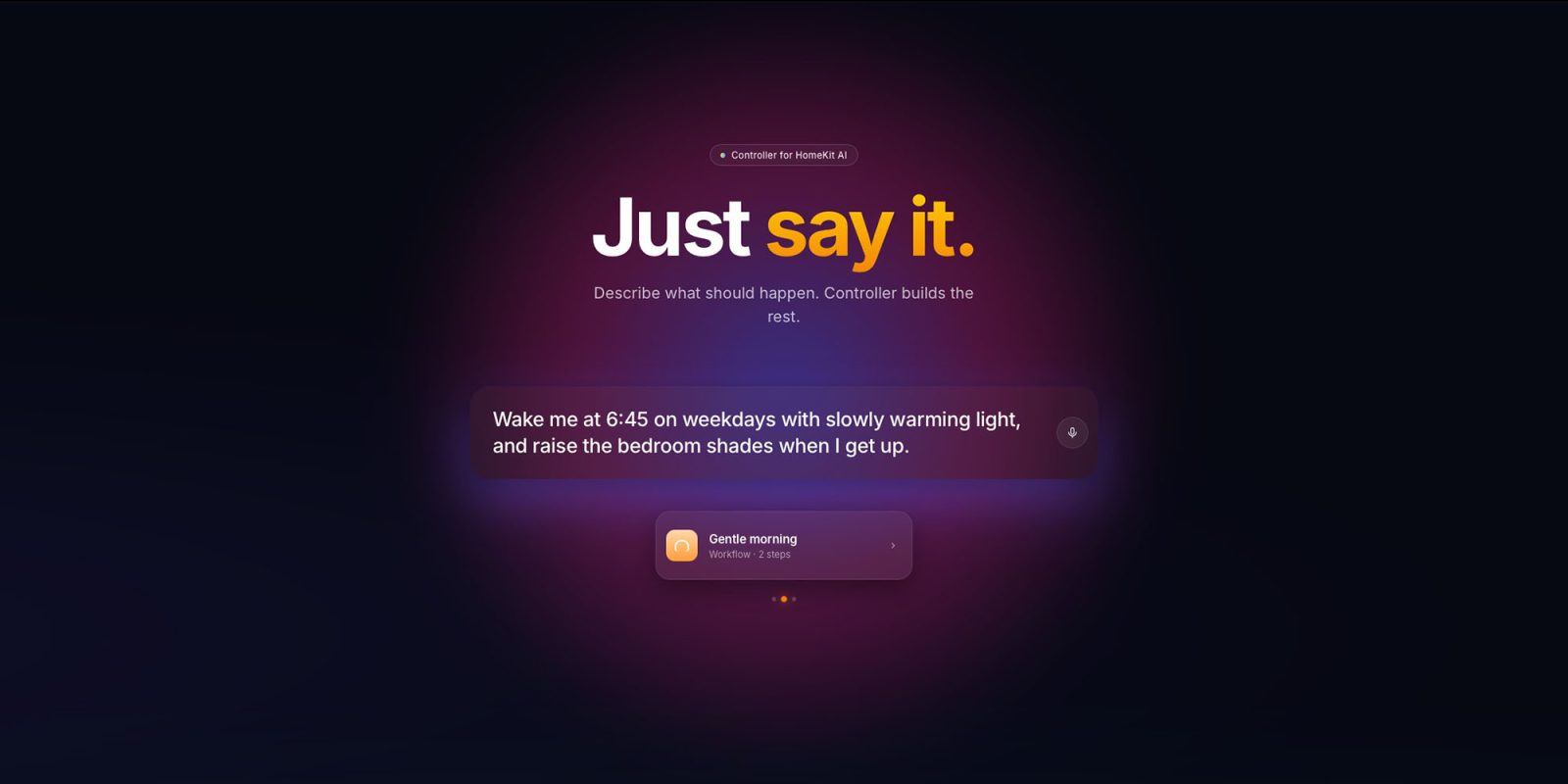
According to the developers, the goal is to allow the user to focus on the "what" and the "why" of their smart home, while the app manages the "how." By removing the need to understand the underlying architecture of HomeKit’s automation engine, the update opens up advanced smart home configurations to a much broader audience.
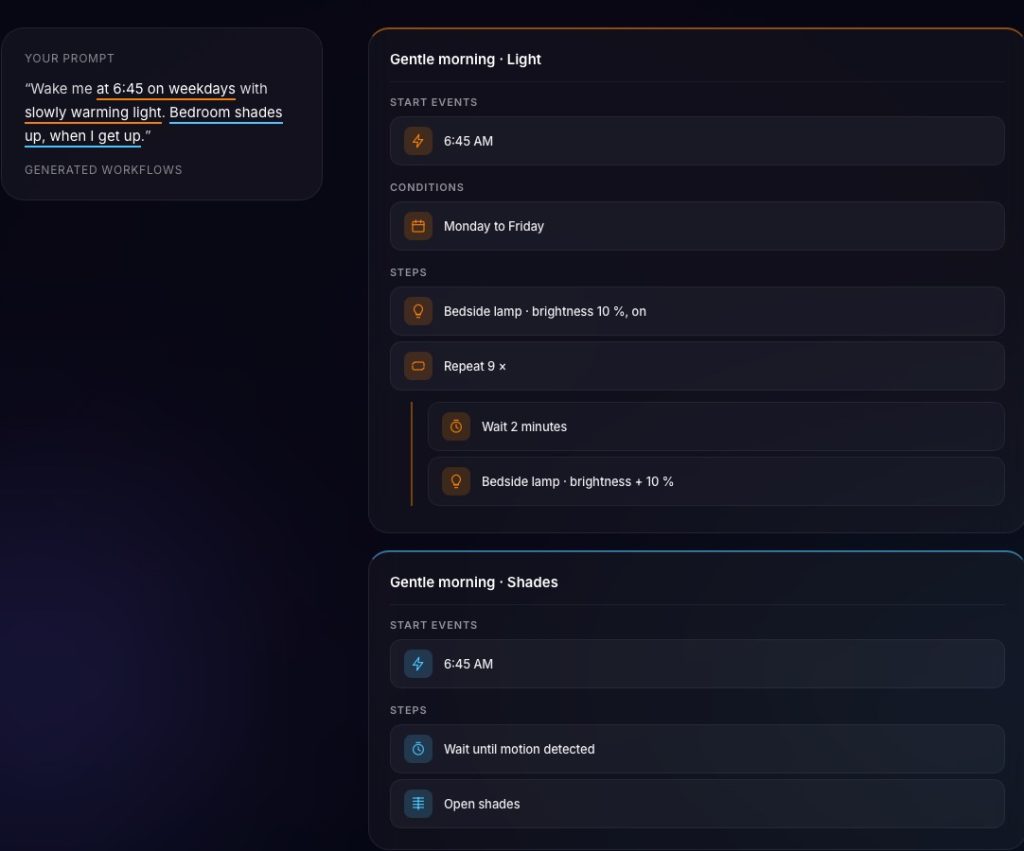
To illustrate the versatility of this new tool, the developers have highlighted several practical scenarios that demonstrate how the AI handles multi-step requests. One such example focuses on a comprehensive morning routine: "Wake me at 6:45 on weekdays with slowly warming light, and raise the bedroom shades when I get up." In a traditional setup, this would require the creation of a time-based trigger restricted to specific days, a command for a light transition—which can be notoriously finicky to program—and a secondary automation or scene linked to a motion sensor or a manual override for the shades. The "Just say it" feature distills these disparate steps into a single, conversational command.
Another example provided by the team showcases the ease of setting atmospheric scenes: "Movie night: dim the living room lights to 20% and close the curtains." This highlights the AI’s ability to group multiple device categories—lighting and window coverings—under a single custom-named scene with specific state requirements. Furthermore, the AI demonstrates its proficiency with conditional logic through a security-focused prompt: "If someone comes home after midnight, turn only the hallway light to 15%." This specific request requires the app to understand location-based triggers, time-of-day constraints, and precise brightness levels, ensuring that the automation provides safety without disturbing the rest of the household.
The technical achievement here lies in how the app translates human intent into the rigid, structured language of HomeKit commands. When a user provides a prompt, the AI must parse the sentence for specific keywords, identify the relevant devices within the user’s existing HomeKit setup, and then construct a logic flow that Apple’s HomeKit framework can execute. For instance, in the morning routine example, the AI must distinguish between "weekdays" and "weekends," identify which devices are "lights" and "shades," and interpret "slowly warming" as a command for a gradual increase in both brightness and color temperature over a set duration.
Early testing of the feature suggests that the implementation is robust, even in homes that are not yet fully saturated with smart technology. In one instance, a user with a limited setup—consisting of only a few smart lights and a single smart plug—tested the system by asking the app to switch on a bedroom fan (connected via the smart plug) whenever the living room lights were turned off. Despite the simplicity of the hardware available, the AI successfully interpreted the causal link between the two actions and created a functional automation instantly. This indicates that the feature is not just for those with dozens of devices, but can also help beginners maximize the utility of a few key components.
The timing of this update is particularly noteworthy as the broader tech industry shifts toward "agentic" AI—systems that do not just provide information but take action on behalf of the user. While Apple has recently announced its own suite of "Apple Intelligence" features designed to make Siri more capable of handling on-device tasks, third-party developers like those behind Controller for HomeKit are often able to move faster and provide more specialized tools for niche power users. By integrating AI directly into the automation creation process, Controller for HomeKit is positioning itself as an essential companion for those who find the standard Home app too restrictive or cumbersome.
Controller for HomeKit has long been regarded as one of the premier third-party alternatives to Apple’s native solution. It offers a suite of advanced features that go beyond simple device control, including the ability to back up HomeKit configurations, view detailed logs of device activity, and manage complex smart home data that is often hidden from view. The addition of natural language automation is a logical extension of this "pro" toolset, making the app’s advanced capabilities more accessible without stripping away the depth that long-time users expect.
However, the power and convenience of these features come with a premium pricing structure. The app operates on a subscription model, which has become the standard for high-maintenance software that requires ongoing server support for AI processing and frequent updates to stay compatible with Apple’s evolving frameworks. The "Essentials" tier is priced at $40 per year, providing access to the core suite of advanced management tools. For those seeking the full experience, including the most advanced automation features, the "Plus" tier is available for $80 per year. To allow users to gauge the value of the AI integration and other pro features within their own specific home environments, the developer offers a seven-day free trial.

For many, the cost of the subscription will be weighed against the time saved and the increased functionality of their home. Smart home enthusiasts often spend hours troubleshooting automations that fail to trigger or conflict with one another. If an AI can reliably build these systems in seconds, the value proposition becomes much clearer for those with extensive investments in smart lighting, climate control, and security systems.
As the smart home market continues to mature, the focus is shifting from simple connectivity to intelligent orchestration. The "Just say it" feature in Controller for HomeKit represents a significant step in this direction, moving away from the "toggle and slider" interface of the past decade toward a more natural, intent-based interaction model. While the developer encourages users to share their experiences and feedback as they integrate the tool into more complex environments, the initial rollout points toward a future where the complexity of the smart home is hidden behind a simple conversation.
The update is now available for download, and while it remains to be seen how it will compete with future native updates from Apple, it currently stands as a powerful option for users looking to unlock the full potential of their HomeKit-enabled devices with minimal manual effort. Whether managing a small apartment with a handful of lights or a sprawling estate with hundreds of integrated components, the ability to simply "say it" and have the home respond accordingly is a compelling glimpse into the next generation of domestic technology.
 Smart Home & IoT Solutions
SwitchBot Unveils Lock Vision Series Featuring 3D Facial Recognition and Native Matter Integration
In the rapidly evolving landscape of smart home security, the transition toward...
 Smart Home & IoT Solutions
Apple Expands Smart Home Ecosystem with New Third-Party Accessories and Aqara Matter Integration
In a strategic update to its retail and online storefronts this week,...
 Smart Home & IoT Solutions
Schlage Launches Sense Pro Smart Deadbolt, Introducing Precision Ultra Wideband Technology to Apple Home Users
Building on the momentum of its initial reveal earlier this year at...







