
As artificial intelligence shifts from simple chat interfaces to "super-agents" capable of managing complex, multi-day workflows, a fundamental technical bottleneck has emerged: the limits of the context window. In a recent design essay titled “Exploring Super-agent Design,” researchers associated with DeepSeek Harness introduced a conceptual framework known as "Chain of Recall." This architectural pattern proposes a way to grant long-running AI agents a persistent, reliable memory without saturating their limited context capacity, using a system of stable identifiers and a graph-based retrieval strategy.
The proposal, published on November 1, 2026, arrives at a time when the industry is grappling with the "forgetfulness" of autonomous agents. While large language models (LLMs) have seen their context windows expand significantly, they remain a finite resource. An agent tasked with monitoring GitHub repositories, managing continuous integration (CI) pipelines, and participating in team chats can generate hundreds of events daily. For an agent that never stops running, the work performed yesterday quickly pushes today’s relevant data out of the active context, leading to errors, hallucinations, or a complete loss of task continuity.
The Context Window as a Cache
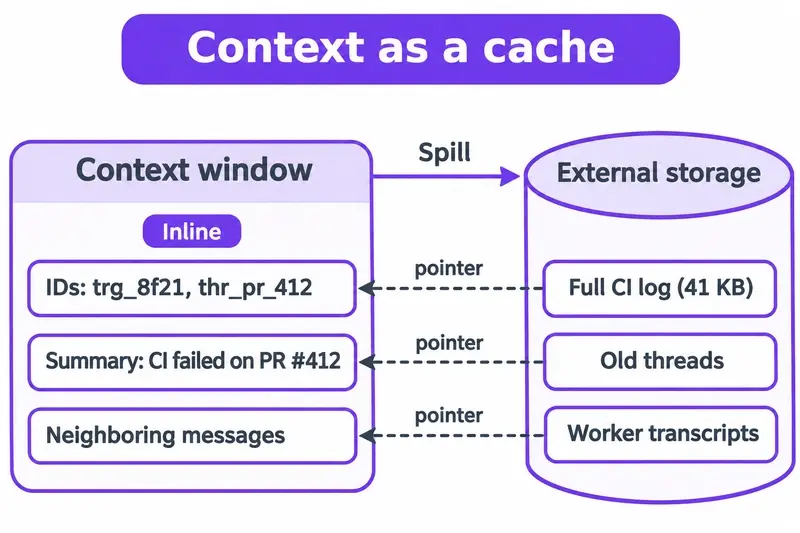
The core philosophy behind Chain of Recall is to treat an AI agent’s context window not as a permanent storage area, but as a high-speed cache. In traditional computing, a cache holds the most frequently or recently used data, while the bulk of information stays in slower, larger storage. Chain of Recall applies this logic to AI by utilizing two distinct actions: "inline" and "spill."
In this model, "inline" information consists of essential data points that remain directly within the prompt, such as unique IDs, brief summaries of recent events, and the most immediate messages in a conversation. Everything else—full logs, historical transcripts, and massive data payloads—is "spilled" to external storage. When data is spilled, it is not deleted; rather, it is replaced in the context window by a stable pointer or identifier.
This approach ensures that the agent’s prompt remains lean. For instance, if a CI failure occurs, the agent does not need to keep a 40-kilobyte log file in its active memory. Instead, it retains a single-line summary and a stable ID. If the agent later determines that the specific details of that failure are necessary to solve a problem, it can use the ID to "recall" the full log from the external database. This method prevents the agent from paying the "token tax" on large files until they are absolutely required for the task at hand.
The Architecture of Stable Identifiers
The reliability of Chain of Recall hinges on the permanence of its identifiers. In the architecture described by DeepSeek Harness, three primary types of objects form the backbone of the agent’s memory: Triggers, Threads, and Workers.
Triggers represent incoming events, such as a new chat message, a webhook notification, or a CI callback. Each trigger is assigned a unique, immutable ID. These triggers are organized into Threads, which represent a sequence of related events, such as a specific pull request discussion or a single email chain. Finally, Workers are isolated agent sessions responsible for executing specific tasks.

These objects do not exist in isolation; they form a reference graph. A Trigger belongs to a Thread, a Thread is managed by one or more Workers, and a Worker’s final report cites the specific Triggers it acted upon. By maintaining these links, the agent creates a navigable map of its own history. Because the IDs never change, the agent can traverse this graph to find information across different sessions and timeframes, effectively creating a "chain" of memories that can be pulled into focus as needed.
Navigating the Memory Graph: Multi-Hop Retrieval
The practical power of Chain of Recall is best illustrated through what researchers call "multi-hop retrieval." In a standard AI setup, if a user asks a question about a decision made several days ago, the agent might struggle if the relevant conversation has been purged from its context. Under the Chain of Recall pattern, the agent performs a targeted search through its own reference graph.
Consider a scenario where a developer asks an AI agent on a Friday why a specific piece of retry logic was added to a payments module. The original discussion happened on Tuesday and has long since been moved to "spill" storage. Rather than guessing or searching through massive volumes of unstructured text, the agent follows the chain: it identifies the relevant Thread ID from its summary history, fetches the Thread record to see which Worker was assigned to the task, and then retrieves that Worker’s specific report to find the original CI log or chat message that triggered the change.
This process involves three small, precise API calls. It eliminates the need for the agent to hold the entire week’s history in its prompt, and it significantly reduces the risk of "hallucination" because the agent is following exact pointers to historical facts rather than trying to reconstruct them from a compressed summary.
Chain of Recall vs. Vector Memory
It is important to distinguish Chain of Recall from other popular memory techniques like Retrieval-Augmented Generation (RAG) or continuous summarization. While RAG is highly effective for finding information based on "similarity"—asking the system to find documents that "look like" the current query—Chain of Recall is designed for "relational" accuracy.
Vector memory (RAG) excels at handling large volumes of unstructured documents where the agent needs to find general information. However, RAG can sometimes miss specific facts if they are phrased differently than the query. In contrast, Chain of Recall is deterministic. If a Worker is linked to a specific Trigger, that link is absolute.
In a sophisticated super-agent design, these systems are likely to work in tandem. A vector index might be used to identify the starting point of a search—finding the correct Thread ID—at which point Chain of Recall takes over to navigate the specific, linked events that followed. This creates a memory hierarchy similar to that of a modern operating system, where different types of data are stored and retrieved based on how they are used.
The Importance of API Reliability

Because Chain of Recall relies on a series of API calls to "hop" from one piece of information to the next, the underlying infrastructure must be exceptionally stable. The DeepSeek Harness essay outlines several "contracts" that the supporting APIs must fulfill to prevent the memory chain from breaking.
First and foremost is the requirement for stable resolution. If an agent requests a specific ID, the system must return that record or a clear error. If a system returns a successful status code but an empty body, or if IDs change after a database migration, the agent’s chain of thought is effectively severed. Furthermore, the system must support consistent pagination and provide clear "404 Not Found" messages for missing data. These errors allow the agent to understand that a piece of memory is truly gone, rather than letting it assume the data is present but empty, which often leads to logical errors in the agent’s output.
To maintain this stability, developers are increasingly turning to automated testing tools to validate their memory endpoints. For instance, using a command-line interface to define and test these endpoints ensures that the "links" in the chain remain functional even as the agent’s software is updated or refactored.
A Design Pattern, Not a Product
While the concept of Chain of Recall is compelling, the researchers at DeepSeek Harness have issued a clear caveat: this is an architectural pattern, not a feature that can be toggled on with a switch. Much of the implementation exists within a prototype plugin—dsh-superagent-prototype—which is explicitly described as a non-official product.
The essay positions Chain of Recall as a solution to one of the "open problems" in AI development: long-term memory. While the prototype demonstrated promising results, it also highlighted the inherent costs of such a system. In one experiment, removing the direct transfer of thread data increased cache-read tokens by approximately 37%, representing the computational overhead required to maintain a functional memory system.
The Future of Agentic Memory
Chain of Recall represents a significant step toward creating AI agents that can function as true digital coworkers. By moving away from the idea that an agent must "remember" everything in its active context, and toward a model where it "knows where to look," developers can build systems that are both more efficient and more reliable.
This approach is particularly suited for environments where data is naturally structured into discrete, linkable events—such as software development, project management, and customer support. In these fields, the "why" and "how" of a decision are often found in the connections between a chat message, a task ticket, and a code commit.
As AI agents continue to evolve, the challenge of memory will remain central to their utility. Chain of Recall offers a clear, testable path forward, emphasizing that for an AI to truly have a long-term memory, it doesn’t just need a bigger brain—it needs a better filing system.
 Software Development & Scripting for IT
The Evolution of Polymorphic Serialization: Why System.Text.Json Offers a Safer Path for Obfuscated .NET Applications
In the landscape of .NET development, maintaining the integrity of serialized data...
 Software Development & Scripting for IT
Afterlight: Bridging the Supernatural and Open-Source AI in a New Browser-Based Storytelling Studio
As the final week of Hacktoberfest 2024 unfolds, the global developer community...
 Software Development & Scripting for IT
Bridging the Gap: How Sess is Revolutionizing Human-in-the-Loop Interactions for Autonomous AI Agents
The rapid evolution of artificial intelligence has transitioned from simple text-based chatbots...







