
Navigating the Memory Graph: Multi-Hop Retrieval
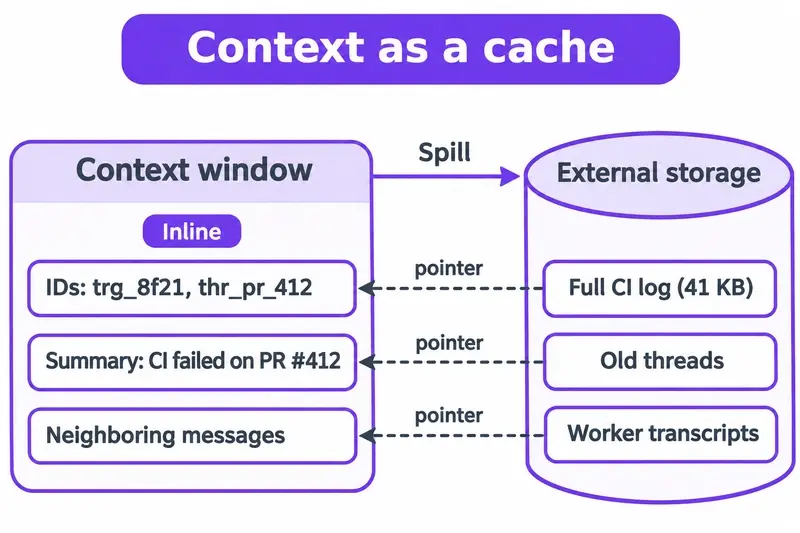
The practical power of Chain of Recall is best illustrated through what researchers call "multi-hop retrieval." In a standard AI setup, if a user asks a question about a decision made several days ago, the agent might struggle if the relevant conversation has been purged from its context. Under the Chain of Recall pattern, the agent performs a targeted search through its own reference graph.
Consider a scenario where a developer asks an AI agent on a Friday why a specific piece of retry logic was added to a payments module. The original discussion happened on Tuesday and has long since been moved to "spill" storage. Rather than guessing or searching through massive volumes of unstructured text, the agent follows the chain: it identifies the relevant Thread ID from its summary history, fetches the Thread record to see which Worker was assigned to the task, and then retrieves that Worker’s specific report to find the original CI log or chat message that triggered the change.
This process involves three small, precise API calls. It eliminates the need for the agent to hold the entire week’s history in its prompt, and it significantly reduces the risk of "hallucination" because the agent is following exact pointers to historical facts rather than trying to reconstruct them from a compressed summary.
Chain of Recall vs. Vector Memory
It is important to distinguish Chain of Recall from other popular memory techniques like Retrieval-Augmented Generation (RAG) or continuous summarization. While RAG is highly effective for finding information based on "similarity"—asking the system to find documents that "look like" the current query—Chain of Recall is designed for "relational" accuracy.
Vector memory (RAG) excels at handling large volumes of unstructured documents where the agent needs to find general information. However, RAG can sometimes miss specific facts if they are phrased differently than the query. In contrast, Chain of Recall is deterministic. If a Worker is linked to a specific Trigger, that link is absolute.
In a sophisticated super-agent design, these systems are likely to work in tandem. A vector index might be used to identify the starting point of a search—finding the correct Thread ID—at which point Chain of Recall takes over to navigate the specific, linked events that followed. This creates a memory hierarchy similar to that of a modern operating system, where different types of data are stored and retrieved based on how they are used.
The Importance of API Reliability

Because Chain of Recall relies on a series of API calls to "hop" from one piece of information to the next, the underlying infrastructure must be exceptionally stable. The DeepSeek Harness essay outlines several "contracts" that the supporting APIs must fulfill to prevent the memory chain from breaking.
 Software Development & Scripting for IT
Critical "php2shell" Vulnerabilities Trigger Emergency PHP Security Updates to Prevent Remote Execution
The global PHP security team has issued an emergency set of updates...
 Software Development & Scripting for IT
Troubleshooting the "Silent" Failure: Why Zoho CRM Workflows Stop Triggering and How to Restore Automation Integrity
For many modern enterprises, the CRM is no longer just a digital...
 Software Development & Scripting for IT
Decoding the Silent Failure: Why WordPress Image Uploads Trigger the Persistent HTTP Error
In the modern landscape of digital publishing, WordPress remains the dominant force,...







