

For years, the mere adoption of Artificial Intelligence was considered the ultimate maturity milestone for IT service management (ITSM) organizations. The narrative was simple: integrate AI, and efficiency would naturally follow. However, as the initial hype transitions into operational reality, a new and more complex challenge has emerged. According to the latest industry data, the primary hurdle for modern IT departments is no longer the implementation of AI, but the rigorous work of turning AI activity into measurable, high-impact business outcomes.
The "adoption-to-value gap" is a phenomenon currently being felt far beyond the confines of the IT service desk. Research from McKinsey highlights a stark contrast in the corporate world: while nearly nine in 10 organizations have integrated AI into at least one business function, nearly two-thirds have yet to successfully scale the technology across the entire enterprise. Furthermore, while 39% of organizations attribute some level of enterprise-level EBIT (Earnings Before Interest and Taxes) impact to AI, the majority report that this impact remains below 5%. This data suggests that while AI is present, it is not yet the transformative engine many predicted it would be.
The 2026 State of ITSM Report from SolarWinds, which surveyed 844 IT professionals, provides a granular look at how this challenge is manifesting within service management. Titled "From AI Potential to Real Payoff," the report suggests that adoption alone does not equate to value. Instead, teams require robust workflows, stringent governance, and specific measures that connect AI activity directly to business results. The findings point toward a more practical, disciplined stage of ITSM maturity where the focus has shifted from "what AI can do" to "how AI can be managed sustainably."
The Evolution of the Service Desk: From Speed to Sustainability
To understand the current state of the industry, it is necessary to look at the trajectory of the last three years of ITSM development. The 2024 State of ITSM Report focused primarily on the foundational practices that allowed teams to resolve work faster. During this period, the conversation was dominated by automation, self-service portals, knowledge management, and Service Level Agreement (SLA) management. The data was clear: organizations utilizing automation saw average incident resolution times that were more than three hours shorter than those that did not. Self-service portals shaved off another two hours, and well-maintained knowledge bases helped teams resolve incidents roughly six hours faster.
By 2025, the focus shifted as Generative AI (GenAI) entered these established workflows. The data from that year showed a significant leap in efficiency; among organizations that enabled GenAI features, the average incident resolution time dropped from 27.42 hours to 22.55 hours—a saving of nearly five hours per incident. Crucially, this improvement did not suggest that AI was a replacement for sound service management. Rather, it proved that AI acted as an accelerant for teams that already possessed structured workflows and high-quality data.

In 2026, the conversation has become significantly more nuanced. AI is no longer a peripheral pilot program or a "promising capability" to be tested in a vacuum. It is now deeply embedded in the daily workday of IT professionals, shaping how they triage requests, draft communications, document incidents, and investigate root causes. However, this deep integration has brought a series of difficult questions to the forefront: Who is responsible for maintaining these AI tools? How much human oversight is required for AI-generated output? And perhaps most importantly, is the time saved on a single ticket actually reducing the total workload, or is it merely creating a vacuum that is immediately filled by more tasks?
The Reality of AI Value: Useful but Rarely Transformative
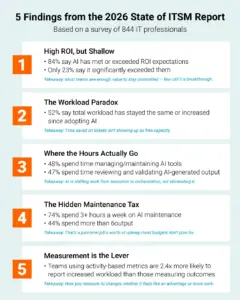
The SolarWinds report indicates that while AI is generally meeting expectations, it is rarely exceeding them in a way that feels revolutionary. Approximately 84% of survey respondents stated that AI has met or exceeded their Return on Investment (ROI) expectations. However, only 23% said it has significantly exceeded those expectations. This gap suggests that while teams are finding practical, "blue-collar" applications for AI, they have yet to unlock the level of business impact that would redefine the role of the service desk within the enterprise.
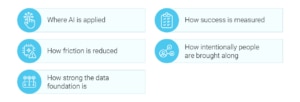
For IT leaders, the metric "we use AI" has become effectively meaningless. Success is no longer defined by the presence of the tool, but by its ability to reduce friction and improve outcomes. The report identifies five key operating disciplines that determine whether AI becomes an operational asset: the fitness of the technology to the specific workflow, the quality of the underlying data, the ability of the team to manage the tool, the governance surrounding its use, and the ability to point to a measurable business result.
The Productivity Paradox: Why Time Saved Does Not Equal Free Capacity
One of the most surprising findings in the 2026 report is that AI-driven efficiency is not necessarily leading to a lighter workload for IT staff. While AI is undeniably saving time on individual tasks—such as summarizing ticket histories, drafting responses to users, and categorizing incoming requests—it is not always reducing the total volume of work.
In fact, 52% of respondents reported that their overall workload has actually increased since adopting AI, while another 19% said it has remained the same. This suggests a "productivity paradox" where ticket-level efficiency does not automatically translate into organizational capacity. When a technician saves 15 minutes on a ticket through AI summarization, that time is often immediately consumed by a higher volume of incoming requests or by the increased complexity of the issues that AI cannot solve.
Furthermore, faster triage and automated knowledge creation can empower a service desk to support a larger business or pursue more proactive projects. While this makes the service desk more productive in a technical sense, the staff often feels just as busy, if not busier, than before. Without outcome-based measurement, it is nearly impossible for leadership to distinguish between a service desk that is drowning in demand and one that is successfully absorbing more work thanks to AI.
The Rising Cost of the "AI Maintenance Tax"
Perhaps the most significant warning for IT leaders is the emergence of what the report calls the "AI Maintenance Tax." The data dispels the myth that AI is a "set it and forget it" solution. Instead, the work of managing AI begins the moment the tool goes live.
Nearly 83% of respondents reported spending at least three hours per week on AI maintenance, with 44% spending six or more hours. Even more telling is that 44% of IT professionals now spend more time maintaining AI tools than they do actually using the output generated by those tools. This maintenance involves a variety of labor-intensive tasks, including reviewing and validating AI-generated content, training and fine-tuning models, addressing data-quality gaps, and monitoring the tools for "hallucinations" or errors.
The report emphasizes that AI must be treated as an ongoing operational service rather than a one-time implementation. Without a dedicated operating model that assigns ownership and tracks maintenance time, the manual effort previously spent on resolving tickets is simply shifted toward checking and correcting the AI. For many organizations, the "efficiency" gained by AI is being partially offset by the "tax" required to keep the system accurate and safe.
Shifting the Focus from Activity to Outcomes
The way an organization measures success can fundamentally change whether AI is perceived as a burden or a benefit. The survey found a direct correlation between measurement strategies and perceived workload: teams that rely on activity-based metrics—such as the number of tickets processed or the number of AI interactions—are 2.4 times more likely to report an increased workload compared to teams that measure business outcomes.
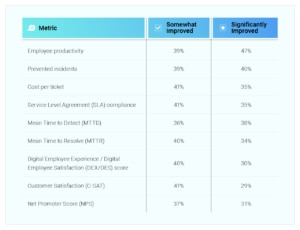
Activity metrics can demonstrate that a tool is being used, but they cannot prove that the service experience has improved or that the business is more profitable. The 2026 research argues that the greatest improvements are found when IT leaders align their metrics with broader business goals. These include improvements in employee productivity across the company, faster time-to-market for business initiatives, and enhanced customer satisfaction.
The reports from 2024 and 2025 proved that automation and GenAI could provide measurable efficiency gains in structured service desk environments. The 2026 report adds a more stringent requirement: IT leaders must now demonstrate that those efficiency gains are moving the needle on outcomes that the rest of the business recognizes and values.
Strategic Recommendations for IT Leaders
The findings of the 2026 State of ITSM Report do not suggest that organizations should slow down their AI adoption. Instead, they point toward the need for a more disciplined and strategic approach to the technology already in place.
First, IT leaders are encouraged to assign clear ownership for AI maintenance. This includes building "data-quality work" into the standard operating procedure and identifying exactly where human review is required to ensure accuracy. By treating AI as a service that requires ongoing care, organizations can prevent the maintenance tax from spiraling out of control.
Second, there is a pressing need to move beyond vanity metrics. Instead of counting AI "hits," leaders should look at how AI is affecting the bottom line or the end-user experience. Finally, the report suggests that reclaimed time—the hours saved by AI—must be intentionally directed toward high-value, proactive work. If leadership does not actively manage where that time goes, it will inevitably be absorbed by low-value tasks, leaving the team feeling overworked despite their technological advantages.
As the industry moves forward, the divide between high-performing IT teams and those struggling with AI will not be defined by who has the most advanced tools. It will be defined by who has the best discipline to manage those tools and the clearest vision of the value they provide to the business.
 Helpdesk & IT Service Management (ITSM)
The Hidden Complexity of Efficiency: SolarWinds Report Reveals the Dual Nature of AI in the Modern Service Desk
The promise of artificial intelligence within Information Technology Service Management (ITSM) has...
 Helpdesk & IT Service Management (ITSM)
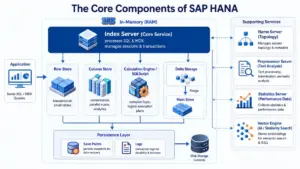
Decoding the Architecture of SAP HANA: A Deep Dive Into the Engine of Modern Enterprise Data
In the rapidly evolving landscape of enterprise resource planning and data management,...
 Helpdesk & IT Service Management (ITSM)
Omdia Research Highlights Significant Cost Savings and Operational Gains for MSPs and IT Teams Adopting Unified Management Platforms
In an era defined by tightening budgets and an explosion of digital...







