

Shifting the Focus from Activity to Outcomes
The way an organization measures success can fundamentally change whether AI is perceived as a burden or a benefit. The survey found a direct correlation between measurement strategies and perceived workload: teams that rely on activity-based metrics—such as the number of tickets processed or the number of AI interactions—are 2.4 times more likely to report an increased workload compared to teams that measure business outcomes.
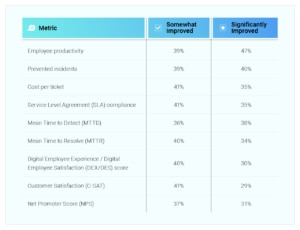
Activity metrics can demonstrate that a tool is being used, but they cannot prove that the service experience has improved or that the business is more profitable. The 2026 research argues that the greatest improvements are found when IT leaders align their metrics with broader business goals. These include improvements in employee productivity across the company, faster time-to-market for business initiatives, and enhanced customer satisfaction.
The reports from 2024 and 2025 proved that automation and GenAI could provide measurable efficiency gains in structured service desk environments. The 2026 report adds a more stringent requirement: IT leaders must now demonstrate that those efficiency gains are moving the needle on outcomes that the rest of the business recognizes and values.
Strategic Recommendations for IT Leaders
The findings of the 2026 State of ITSM Report do not suggest that organizations should slow down their AI adoption. Instead, they point toward the need for a more disciplined and strategic approach to the technology already in place.
First, IT leaders are encouraged to assign clear ownership for AI maintenance. This includes building "data-quality work" into the standard operating procedure and identifying exactly where human review is required to ensure accuracy. By treating AI as a service that requires ongoing care, organizations can prevent the maintenance tax from spiraling out of control.
Second, there is a pressing need to move beyond vanity metrics. Instead of counting AI "hits," leaders should look at how AI is affecting the bottom line or the end-user experience. Finally, the report suggests that reclaimed time—the hours saved by AI—must be intentionally directed toward high-value, proactive work. If leadership does not actively manage where that time goes, it will inevitably be absorbed by low-value tasks, leaving the team feeling overworked despite their technological advantages.
As the industry moves forward, the divide between high-performing IT teams and those struggling with AI will not be defined by who has the most advanced tools. It will be defined by who has the best discipline to manage those tools and the clearest vision of the value they provide to the business.
 Helpdesk & IT Service Management (ITSM)
The Hidden Complexity of Efficiency: SolarWinds Report Reveals the Dual Nature of AI in the Modern Service Desk
The promise of artificial intelligence within Information Technology Service Management (ITSM) has...
 Helpdesk & IT Service Management (ITSM)
SolarWinds Reveals IT Pro Day 2026 Survey Results: Modern Technology Management Mirrored in High-Stakes Professional Sports
As the global technology community gathers to celebrate IT Pro Day 2026,...
 Helpdesk & IT Service Management (ITSM)
Overe Appoints Former Sophos CSO Simon Reed as Strategic Advisor to Accelerate MSP Security Growth
In a significant move aimed at strengthening its leadership and deepening its...







