In the world of high-stakes competitive gaming, the term "clutch" is typically reserved for a player who manages to win a round against overwhelming odds. However, for one Reddit user, the word has taken on a life-saving new meaning that extends far beyond the digital battlefield of a first-person shooter. A gamer identified as /u/antisocialnae recently shared a harrowing experience where their hardware served as a literal shield against a real-world projectile, turning a standard evening of gaming into a brush with mortality. The centerpiece of this survival story is the ASUS TUF VG258QM, a 280Hz gaming monitor that the owner now describes as the single best investment they have ever made.
The incident occurred during the late-night hours, a time when many in the gaming community are deeply immersed in their favorite titles. In this instance, the user was playing Call of Duty, a franchise defined by its fast-paced combat and ballistic intensity. While the sounds of gunfire were likely filling the user’s headset, a very real and far more dangerous sound echoed through their home. A bullet, fired from outside the residence, pierced through the exterior wall of the house. According to the account shared on the social media platform, the projectile was traveling on a trajectory that would have likely struck the user directly had it not been for the placement of their gaming setup.
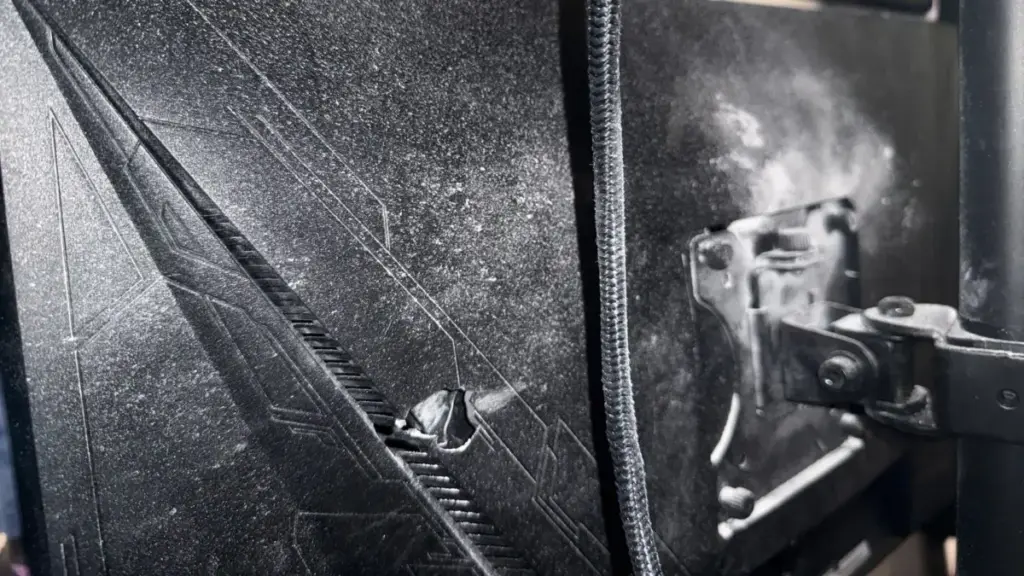
The ASUS TUF VG258QM sat directly in the path of the incoming round. The bullet, having already lost a significant portion of its kinetic energy as it struggled through the structural materials of the home’s outer wall, impacted the back of the monitor. The hardware, primarily constructed of hardened plastics and internal electronic components, managed to absorb the remaining force of the projectile. The result was a shattered display and a destroyed piece of technology, but a perfectly intact human being sitting just inches away on the other side of the screen.
In the aftermath of the event, /u/antisocialnae took to the internet to share photos of the damaged equipment, which quickly went viral across various tech and gaming subreddits. The images show a clear entry point where the bullet struck the rear casing of the monitor, with subsequent damage radiating through the panel. For the user, the loss of the hardware was a negligible price to pay for their safety. They characterized the ASUS TUF VG258QM as "the best $280 [they] ever spent," a sentiment that resonates with the gravity of the situation. While the monitor was designed to provide a high-refresh-rate advantage in virtual combat, its unexpected durability in a real-world crisis has become the focal point of the story.
The "TUF" branding on ASUS’s line of gaming peripherals is intended to signify a level of durability and reliability that exceeds standard consumer electronics. ASUS often markets these products by highlighting "military-grade" testing standards, which typically involve subjecting the hardware to extreme temperatures, vibrations, and humidity to ensure long-term functionality in harsh environments. While the company certainly never intended for its monitors to be tested against live ammunition, the incident has inadvertently provided the brand with a dramatic, albeit unintended, testament to its build quality.
As the story gained traction online, it eventually caught the attention of the manufacturer. ASUS has officially responded to the Reddit post, acknowledging the extraordinary circumstances and expressing relief that the user was unharmed. The company stated that it is looking into the matter and has promised to investigate the details of the incident. While the gaming community has been vocal in calling for ASUS to provide a free replacement for the "hero" monitor, the company has not yet officially confirmed whether it will be sending out a new unit to the survivor. In similar viral instances involving other tech companies, brands have often seized the opportunity for positive public relations by replacing damaged goods, though ASUS appears to be following a formal internal process before making such a commitment.
From a technical and ballistic perspective, the survival of the user is a matter of fortunate physics. It is essential to note that consumer-grade electronics, including the ASUS TUF series, are not bulletproof. The monitors are composed of various layers of plastic, glass, and metal shielding, none of which are rated for ballistic protection. The primary reason the monitor was able to stop the bullet was the interference of the home’s exterior wall. When a projectile hits a solid object like a wall, it undergoes significant deformation and loses a massive amount of velocity. By the time the bullet reached the monitor, it was likely tumbling and traveling at a fraction of its original muzzle velocity. The monitor served as the final barrier, catching the spent round before it could complete its path toward the gamer.
The incident has sparked a wider conversation within the gaming community about the randomness of life and the strange intersections between our digital hobbies and real-world dangers. Many users on Reddit pointed out the grim irony of playing a game centered on gun violence while being targeted by a real-world weapon. Others focused on the placement of gaming desks near windows or exterior walls, a common configuration that many are now reconsidering in light of this event. The thread where the story originated is filled with comments ranging from shock and support to dark humor, with some users jokingly asking if the monitor’s 280Hz refresh rate allowed it to "see the bullet coming."
Despite the lightheartedness of some internet commenters, the reality of the situation remains sobering. Stray bullets entering homes is a terrifying phenomenon that highlights the dangers of celebratory gunfire or nearby criminal activity. For the victim of this particular incident, the focus remains on the sheer luck involved in their survival. The monitor, which was once just a tool for entertainment and a way to gain a competitive edge in Call of Duty, is now a memento of a night that could have ended in tragedy.
As of now, the ASUS TUF VG258QM remains a non-functional piece of plastic and glass, its screen spider-webbed with cracks and its internal circuitry ruined. However, its legacy as a literal life-saver is firmly cemented in the annals of gaming lore. The $280 price tag, which represents a mid-range investment for most serious PC gamers, has yielded a return that is impossible to quantify in financial terms.
The tech industry frequently sees products touted for their toughness, but it is rare to see those claims tested in such a visceral and life-threatening manner. While ASUS continues its investigation into the incident, the story serves as a reminder of the unpredictable nature of everyday life. Whether or not ASUS decides to replace the monitor, the brand has received a level of organic exposure that no marketing campaign could ever replicate. For /u/antisocialnae, the search for a new monitor may soon begin, but it is unlikely that any future purchase will ever carry the same emotional weight or provide the same level of protection as their first ASUS TUF display.
The gaming world continues to watch for ASUS’s next move, hoping that the company will reward the user’s unintentional brand loyalty with a new display. Regardless of the corporate outcome, the incident stands as a remarkable tale of survival, physics, and the unexpected ways in which our possessions can sometimes protect us when we least expect it. For now, the "TUF" monitor sits as a broken but heroic reminder of a late-night gaming session that ended with the most important victory of all: the chance to play another day.
 Hardware Reviews & PC Building
Taipei 101 lit up in support of Jensen Huang — skyscraper adorned with messages of support following resignation…
The backdrop to this public display of support is a corporate and...
 Hardware Reviews & PC Building
Mysterious AMD Zen 6 APU with 24GB of LPDDR5 memory appears in benchmarks — chip may be for next-gen Steam Deck or…
The listing reveals an engineering sample identified by the part number 100-000001930-12_Y....
 Hardware Reviews & PC Building
Asus ROG Xbox Ally X20 tested: Same performance, more comfortable, and a glorious OLED screen
This milestone release comes at a time when the Republic of Gamers...