

When combined, total revenues for the quarter reached $3.66 billion, a 58.5 percent increase compared to the same period last year. The sequential growth of 20.5 percent is particularly notable, as it is two to three times higher than the company’s historical norms. This performance marks the most significant growth period in Arista’s history since its early founding years.
The company’s profitability is equally impressive. Operating income for the quarter was $1.64 billion, up 67.9 percent, while net income rose 82.9 percent to $1.56 billion. This resulted in a net income margin of 42.7 percent, the highest level of profitability the company has ever achieved. Arista ended the quarter with a formidable cash position of $14.36 billion. Furthermore, the company reported $11.4 billion in customer purchase commitments and $6.84 billion in deferred revenues, indicating strong future demand and a stable pipeline.
Looking forward, Ullal provided ambitious targets for the coming years. Arista is on track to sell approximately $3.5 billion in AI-related networking gear and services in 2026, a figure that is expected to double to $7 billion by 2027. The company is also making inroads into campus switching, a market traditionally dominated by Cisco. Arista expects its campus switching revenue to reach $1.25 billion this year and grow to $2 billion in 2027.
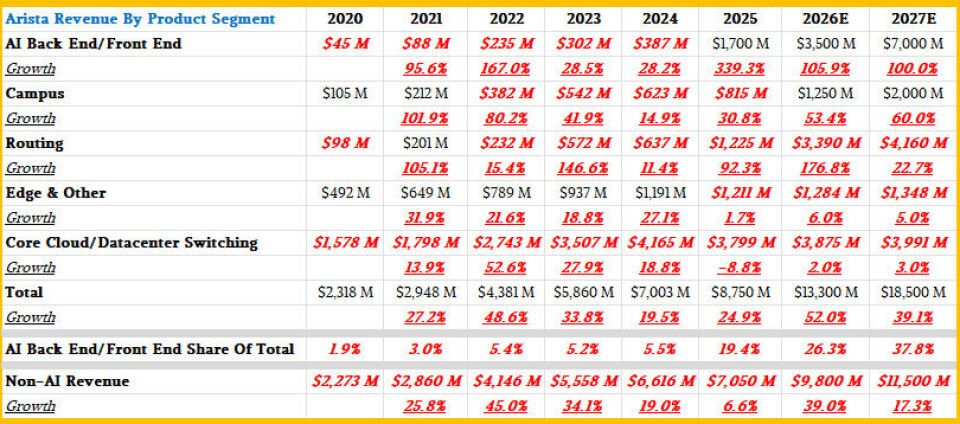
Based on these targets, Arista is projected to grow its overall revenue by 52 percent in 2026, reaching $13.3 billion, followed by another 39.1 percent increase in 2027 to reach $18.5 billion. While the core cloud and data center switching business continues to grow, the primary engine of this expansion is the "scale-across" gear found in the routing product segment. Interestingly, while traditional workloads are seeing more growth in the server market than in switching, Arista’s strategic focus on AI-centric infrastructure appears to be insulating it from broader market fluctuations.
The customer profile for Arista is also evolving. Currently, major contributors like Microsoft and Meta Platforms, which account for 10 percent or more of Arista’s annual revenue, are working with the company on ESUN scale-up networks for their respective internal AI chips, such as Microsoft’s Maia and Meta’s MTIA. These "cloud titans" are expected to remain heavy spenders through 2027. Ullal also hinted that one or two additional large-scale spenders might join this elite group in the coming year, further fueling the company’s growth trajectory.
The market is currently at a major inflection point. In 2024 and 2025, Arista’s AI conversations were limited to a handful of customers building clusters in the range of 50,000 to 100,000 Nvidia GPUs, with InfiniBand still serving as a common interconnect. By 2026, Arista already has over a hundred customers utilizing its AI-centric Etherlink switches. By the end of 2027, the company forecasts that it will provide the networking foundation for 10 gigawatts of AI cluster capacity, supporting more than ten different types of accelerators. As the industry moves away from proprietary silos toward open Ethernet standards, Arista is positioning itself as the primary architect of the next generation of AI infrastructure.
 Enterprise Tech & Infrastructure
The Evolving Landscape of Enterprise Storage: Evaluating the Performance and Strategic Roles of SSDs and HDDs
In the rapidly advancing world of data center infrastructure, the choice between...
 Enterprise Tech & Infrastructure
Navigating the Hidden Complexities of Amazon S3: Strategies for Mitigating Enterprise Storage Overspend
The financial architecture of cloud storage is often more complex than it...
 Enterprise Tech & Infrastructure
AMD Extends Lead in Datacenter Dominance with Launch of Sixth-Generation "Venice" Epyc Processors
The trajectory of the modern datacenter has, for the past decade, been...







