

The consensus among these players is that Ethernet is the inevitable future for the interconnect hierarchy. While Nvidia’s proprietary solutions currently lead the market in terms of revenue and performance for tightly coupled clusters, they will eventually have to compete with more open, and presumably more cost-effective, alternatives. These alternatives are based on Ethernet running protocols such as the Ultra Ethernet Consortium (UEC) standards, including ESUN and UALink. These protocols are designed to glue GPU memories together and connect components within an accelerator package using standards like UCI-Express.
This transition to an open Ethernet-based AI fabric is not happening overnight. Currently, Arista Networks is generating substantial revenue from selling Ethernet switches for traditional cloud infrastructure and "AI front-end" networks—the fabrics that connect AI clusters to storage systems and the outside world. The company is also seeing significant success with its R-series Ethernet switches, which are enhanced with routing functions to manage "scale-across" linkages. These linkages are vital because power constraints often limit the size of a single data center, forcing hyperscalers to spread AI clusters across multiple facilities and regions.
Despite this success, Arista has yet to realize significant revenue from "scale-up" networks, often referred to as the AI back-end. This is the inner sanctum of the AI cluster where accelerators communicate with one another. While trials are currently underway at major hyperscalers to run ESUN and UALink over Ethernet (UALoE) protocols, the commercial ramp-up is still on the horizon.
During a recent call with Wall Street analysts to discuss the company’s third-quarter financial results, Arista CEO Jayshree Ullal noted that the company is collaborating with a powerhouse group including AMD, Arm, Meta Platforms, Microsoft, and Qualcomm on rack-scale switching. These systems, based on Arista’s Etherlink line, are designed for high-density environments. Ullal expects that scale-up trials based on the ESUN protocol will begin in 2027, focusing on systems with a radix of 128 to 144 accelerators per rack, potentially scaling to 1,024 accelerators across a row. However, production-grade rollouts for these scale-up networks are not anticipated until 2028.
While Arista has not explicitly committed to UALink switching—a technology that would compete directly with Nvidia’s NVSwitch—the possibility remains open. Third-party UALink ASICs from companies like Astera Labs, Marvell, and others are becoming available, providing Arista with potential pathways into that segment. For now, Arista is focused on the massive opportunities in scale-out and scale-across networking, leaving the "scale-in" networking (the connections within the accelerator package itself) to chip designers like Broadcom, Nvidia, and AMD.
Financial Performance and the Path to 2027
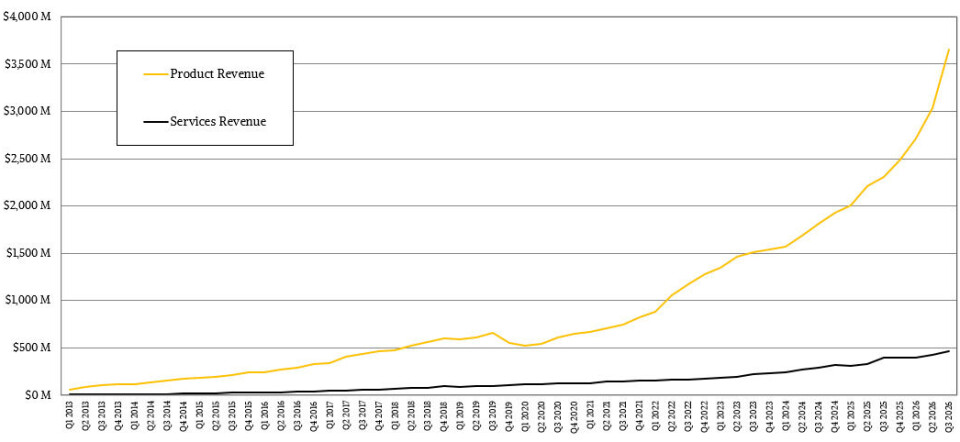
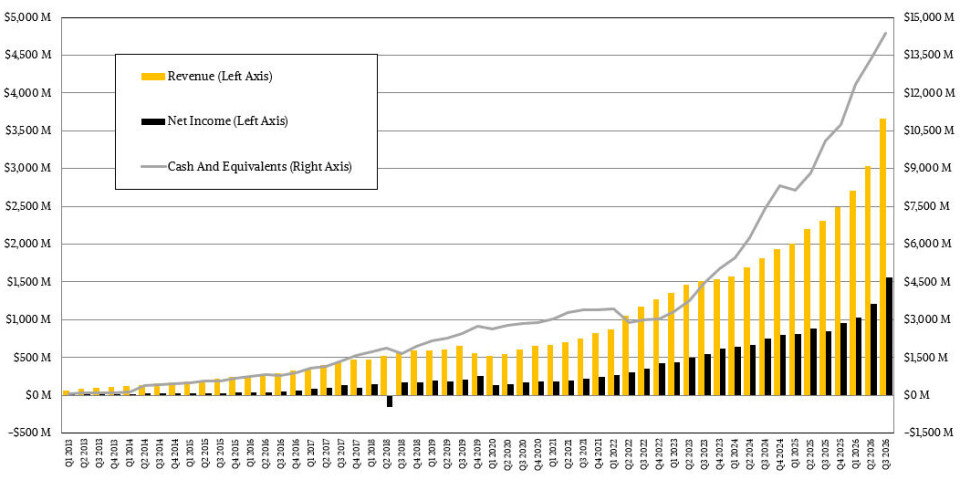
The financial data from Arista’s third quarter confirms that the company is finally entering a period of hyper-growth driven by generative AI. For the quarter ending in September, Arista reported product sales of $3.19 billion, representing a 66.9 percent increase year-over-year and a 22.4 percent increase sequentially. Services revenue also showed steady growth, rising 17.9 percent to $467.6 million.
 Enterprise Tech & Infrastructure
Optimizing the Modern Data Center: Best Practices for Implementing Software-Defined Storage Architecture
The landscape of enterprise data management is undergoing a fundamental transformation as...
 Enterprise Tech & Infrastructure
The Architecture of Data: Understanding the Critical Hierarchy of Computer Memory Systems
In the modern digital landscape, the term "computer memory" serves as a...
 Enterprise Tech & Infrastructure
Nvidia Board Affirms Leadership Transition as Quarterly Revenue Hits Record $115.8 Billion
The narrative surrounding Nvidia has long been synonymous with the vision and...







