

The evolution of computing architecture is rarely a linear progression; it is a series of fits and starts, followed by periods of intense refinement. For the titans of networking, specifically Arista Networks and its long-standing rival Cisco Systems, the journey to optimize for the era of generative artificial intelligence has been a marathon rather than a sprint. While the industry has spent years laying the groundwork, the recent financial performance and strategic outlook provided by Arista suggest that the long-anticipated "hockey stick" growth curve for AI-related networking is finally beginning to materialize. However, as the company’s leadership makes clear, the industry is still only in the early stages of a massive, multi-year transition.
Taming a new computing architecture is a complex endeavor. In the previous era of cloud networking, which spanned roughly from 2010 to 2020, the primary challenge was relatively straightforward: manufacturers needed to produce higher-bandwidth Ethernet switches while simultaneously driving down the cost per bit. As the aggregate bandwidth per Application-Specific Integrated Circuit (ASIC) doubled, the cost of moving data decreased, enabling the creation of larger and more elastic networks. This predictable cycle defined the growth of the modern hyperscale data center.
AI, however, presents an entirely different set of demands. It requires high-radix devices and flatter network topologies because AI workloads are inherently sensitive to latency. In the world of traditional cloud computing, minor delays in data packet delivery were manageable. In the world of AI, where the cost of a Graphics Processing Unit (GPU) or specialized accelerator (XPU) is astronomical compared to standard compute engines, keeping these processors waiting for data is an economic disaster.
The industry often refers to the economic efficiency of these systems as "tokenomics." If GPUs were as inexpensive as "chips"—the common English term for the fried potatoes served in pubs—organizations might tolerate some level of architectural inefficiency. They could simply interleave workloads across more devices to make up for lost time. But with AI training and inference, that is not an option. The high capital expenditure required for AI hardware means that every millisecond of idle time erodes the potential return on investment. If the networking fabric cannot keep pace with the compute engines, it threatens to "kill the goose that lays the golden trillions of tokens."
Furthermore, the management of these massive clusters now requires AI to manage AI. To balance workloads across tens of thousands or even hundreds of thousands of accelerators within a single data center—and potentially millions across multiple regions—requires dynamic routing and the processing of vast amounts of telemetry data. Humans cannot correlate and analyze this data at the speed required to keep the system optimized. This has necessitated the development of tools like Arista’s Autonomous Virtual Assistant (AVA), which uses AI to oversee network health and security. As bad actors increasingly use AI to find and exploit vulnerabilities, the defense of this infrastructure must also be AI-driven. These developments have taken years to reach maturity, but they are now becoming essential components of the modern data center.
The Inevitability of Ethernet
In the current landscape of AI interconnects, there is a clear tension between proprietary systems and open standards. Nvidia, having moved early to create tightly coupled, shared-memory GPU clusters, currently enjoys a significant first-mover advantage. Its NVSwitch and NVLink technologies provide the high-speed, low-latency "scale-up" networking required for modern AI. However, the broader industry—including hyperscalers, cloud builders, national laboratories, and rival chipmakers like AMD—is wary of being locked into a single vendor’s proprietary ecosystem.
The consensus among these players is that Ethernet is the inevitable future for the interconnect hierarchy. While Nvidia’s proprietary solutions currently lead the market in terms of revenue and performance for tightly coupled clusters, they will eventually have to compete with more open, and presumably more cost-effective, alternatives. These alternatives are based on Ethernet running protocols such as the Ultra Ethernet Consortium (UEC) standards, including ESUN and UALink. These protocols are designed to glue GPU memories together and connect components within an accelerator package using standards like UCI-Express.
This transition to an open Ethernet-based AI fabric is not happening overnight. Currently, Arista Networks is generating substantial revenue from selling Ethernet switches for traditional cloud infrastructure and "AI front-end" networks—the fabrics that connect AI clusters to storage systems and the outside world. The company is also seeing significant success with its R-series Ethernet switches, which are enhanced with routing functions to manage "scale-across" linkages. These linkages are vital because power constraints often limit the size of a single data center, forcing hyperscalers to spread AI clusters across multiple facilities and regions.
Despite this success, Arista has yet to realize significant revenue from "scale-up" networks, often referred to as the AI back-end. This is the inner sanctum of the AI cluster where accelerators communicate with one another. While trials are currently underway at major hyperscalers to run ESUN and UALink over Ethernet (UALoE) protocols, the commercial ramp-up is still on the horizon.
During a recent call with Wall Street analysts to discuss the company’s third-quarter financial results, Arista CEO Jayshree Ullal noted that the company is collaborating with a powerhouse group including AMD, Arm, Meta Platforms, Microsoft, and Qualcomm on rack-scale switching. These systems, based on Arista’s Etherlink line, are designed for high-density environments. Ullal expects that scale-up trials based on the ESUN protocol will begin in 2027, focusing on systems with a radix of 128 to 144 accelerators per rack, potentially scaling to 1,024 accelerators across a row. However, production-grade rollouts for these scale-up networks are not anticipated until 2028.
While Arista has not explicitly committed to UALink switching—a technology that would compete directly with Nvidia’s NVSwitch—the possibility remains open. Third-party UALink ASICs from companies like Astera Labs, Marvell, and others are becoming available, providing Arista with potential pathways into that segment. For now, Arista is focused on the massive opportunities in scale-out and scale-across networking, leaving the "scale-in" networking (the connections within the accelerator package itself) to chip designers like Broadcom, Nvidia, and AMD.
Financial Performance and the Path to 2027
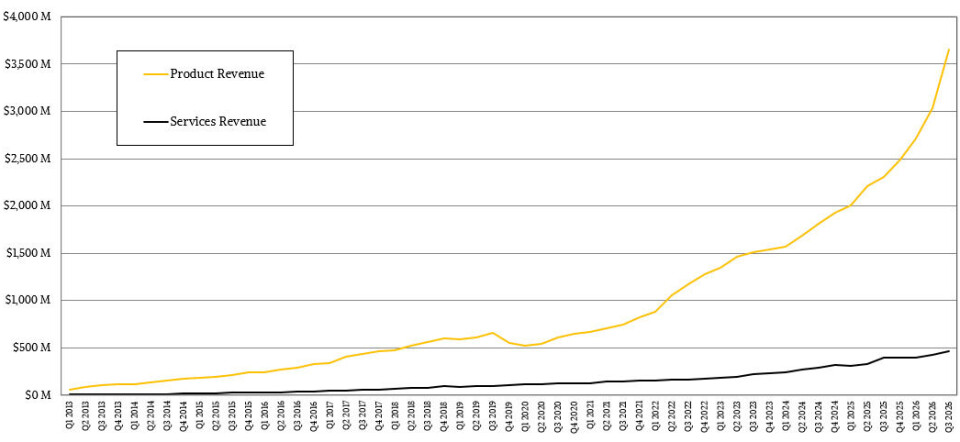
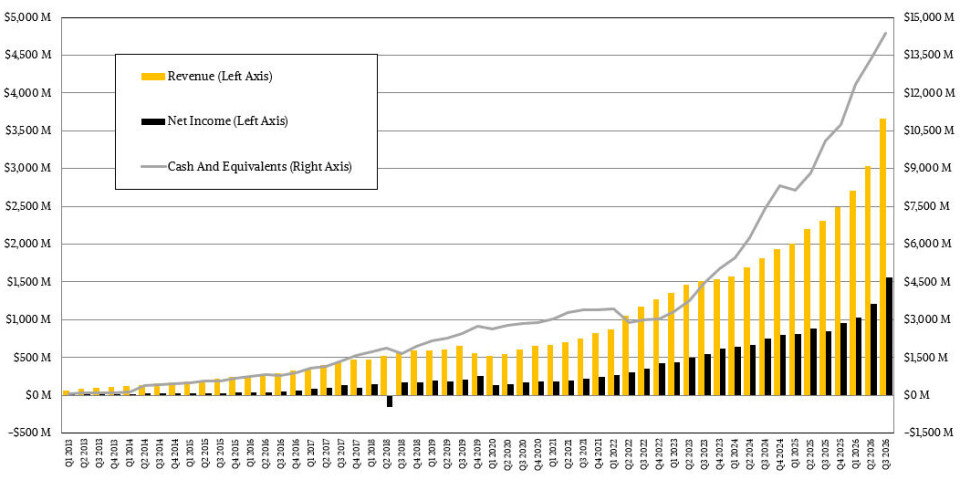
The financial data from Arista’s third quarter confirms that the company is finally entering a period of hyper-growth driven by generative AI. For the quarter ending in September, Arista reported product sales of $3.19 billion, representing a 66.9 percent increase year-over-year and a 22.4 percent increase sequentially. Services revenue also showed steady growth, rising 17.9 percent to $467.6 million.
When combined, total revenues for the quarter reached $3.66 billion, a 58.5 percent increase compared to the same period last year. The sequential growth of 20.5 percent is particularly notable, as it is two to three times higher than the company’s historical norms. This performance marks the most significant growth period in Arista’s history since its early founding years.
The company’s profitability is equally impressive. Operating income for the quarter was $1.64 billion, up 67.9 percent, while net income rose 82.9 percent to $1.56 billion. This resulted in a net income margin of 42.7 percent, the highest level of profitability the company has ever achieved. Arista ended the quarter with a formidable cash position of $14.36 billion. Furthermore, the company reported $11.4 billion in customer purchase commitments and $6.84 billion in deferred revenues, indicating strong future demand and a stable pipeline.
Looking forward, Ullal provided ambitious targets for the coming years. Arista is on track to sell approximately $3.5 billion in AI-related networking gear and services in 2026, a figure that is expected to double to $7 billion by 2027. The company is also making inroads into campus switching, a market traditionally dominated by Cisco. Arista expects its campus switching revenue to reach $1.25 billion this year and grow to $2 billion in 2027.
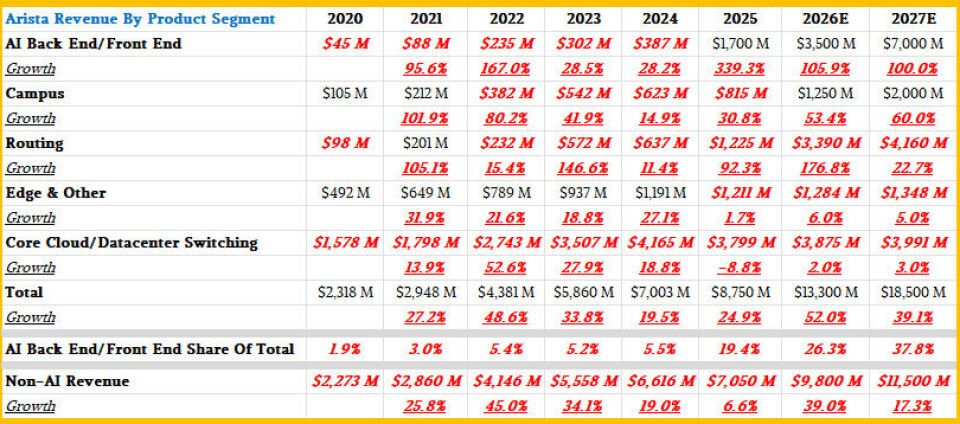
Based on these targets, Arista is projected to grow its overall revenue by 52 percent in 2026, reaching $13.3 billion, followed by another 39.1 percent increase in 2027 to reach $18.5 billion. While the core cloud and data center switching business continues to grow, the primary engine of this expansion is the "scale-across" gear found in the routing product segment. Interestingly, while traditional workloads are seeing more growth in the server market than in switching, Arista’s strategic focus on AI-centric infrastructure appears to be insulating it from broader market fluctuations.
The customer profile for Arista is also evolving. Currently, major contributors like Microsoft and Meta Platforms, which account for 10 percent or more of Arista’s annual revenue, are working with the company on ESUN scale-up networks for their respective internal AI chips, such as Microsoft’s Maia and Meta’s MTIA. These "cloud titans" are expected to remain heavy spenders through 2027. Ullal also hinted that one or two additional large-scale spenders might join this elite group in the coming year, further fueling the company’s growth trajectory.
The market is currently at a major inflection point. In 2024 and 2025, Arista’s AI conversations were limited to a handful of customers building clusters in the range of 50,000 to 100,000 Nvidia GPUs, with InfiniBand still serving as a common interconnect. By 2026, Arista already has over a hundred customers utilizing its AI-centric Etherlink switches. By the end of 2027, the company forecasts that it will provide the networking foundation for 10 gigawatts of AI cluster capacity, supporting more than ten different types of accelerators. As the industry moves away from proprietary silos toward open Ethernet standards, Arista is positioning itself as the primary architect of the next generation of AI infrastructure.
 Enterprise Tech & Infrastructure
Fibre Channel over Ethernet: Navigating the Intersection of Performance and Network Convergence
In the rapidly evolving landscape of enterprise data storage, the demand for...
 Enterprise Tech & Infrastructure
Decoding the Hidden Costs of Amazon S3: Why Storage Rates Are Only the Surface of Enterprise Cloud Spending
In the complex landscape of enterprise cloud infrastructure, Amazon S3 (Simple Storage...
 Enterprise Tech & Infrastructure
Navigating the Shift to Software-Defined Storage: Essential Strategies for Modern Enterprise Data Management
The landscape of enterprise data management is undergoing a fundamental transformation as...







