Apple is planning to expand its smart home hardware lineup with a higher-end version of its newly announced HomeView smart home hub, according to a report from Bloomberg reporter Mark Gurman. Following the recent unveiling of the standard tabletop HomeView device, the Cupertino tech giant is reportedly working on an upgraded tier equipped with a larger 9-inch display mounted on a motorized robotic arm that allows the screen to swivel a full 360 degrees.
Writing in his weekly newsletter, Gurman revealed that this prospective premium smart display is targeted for release in either 2027 or 2028. While Apple has not formally disclosed or named this advanced robotic device, Gurman floated several speculative monikers that the company might consider for marketing purposes, including HomeView Max, HomeView Ultra, or HomeView 360. At present, these names remain entirely speculative, but they reflect potential naming conventions for a higher-tier counterpart to the entry-level smart hub.
The prospect of a 360-degree swiveling display marks a significant hardware departure from the foundational HomeView hub that Apple officially announced. The base tabletop HomeView, introduced on October 13, 2026, features a stationary 7-inch Liquid Retina display. Unlike the prospective high-end model’s motorized arm, the standard HomeView sits in a fixed position on a countertop or desk, serving as a stationary control center for the household.
The official reveal of the original HomeView provided an initial look at Apple’s vision for dedicated home hub hardware. During the announcement, Greg Joswiak, Apple’s Senior Vice President of Worldwide Marketing, detailed how the device blends shared home functionality with personalized features. Joswiak stated that Apple HomeView is designed to be shared by everyone in the home yet feel completely personal to each user, noting that the device recognizes an individual’s face to shift dynamically from a shared household screen to a customized user experience.
The integration of Siri AI and facial recognition technology forms the core software foundation of the current HomeView experience. With the standard 7-inch Liquid Retina display, users can interact with shared home controls or allow the device’s front-facing camera system to identify them upon approach, instantly tailoring on-screen widgets, notifications, and personal data. The introduction of a full 360-degree motorized robotic arm on the reported 2027 or 2028 model would build directly upon this personalized approach, potentially allowing the display screen to physically rotate and track users as they move around a room.
The latest details regarding the robotic 9-inch HomeView build upon a series of rapid leaks and announcements that surfaced throughout October 2026. Just two days prior to Apple’s official "Welcome home" experience in New York, Gurman published a comprehensive leak detailing 16 distinct specifications across Apple’s upcoming home ecosystem updates. That report accurately foreshadowed the unveiling of the touch-enabled HomeView hub, while also pointing to refreshed companion hardware, including a second-generation HomePod mini 2 and a new Apple TV 4K.
The timeline of leaks surrounding Apple’s smart home initiative illustrates an evolving design roadmap across recent months. On September 30, 2026, initial reports from Gurman revealed that Apple was testing a smart home hub featuring an aesthetic reminiscent of the classic iMac G4. Those early reporting details suggested that the hardware would center around a square 6-inch display, with Apple exploring multiple physical form factors, including variants meant for placement on a countertop as well as models designed to be mounted directly onto a wall.
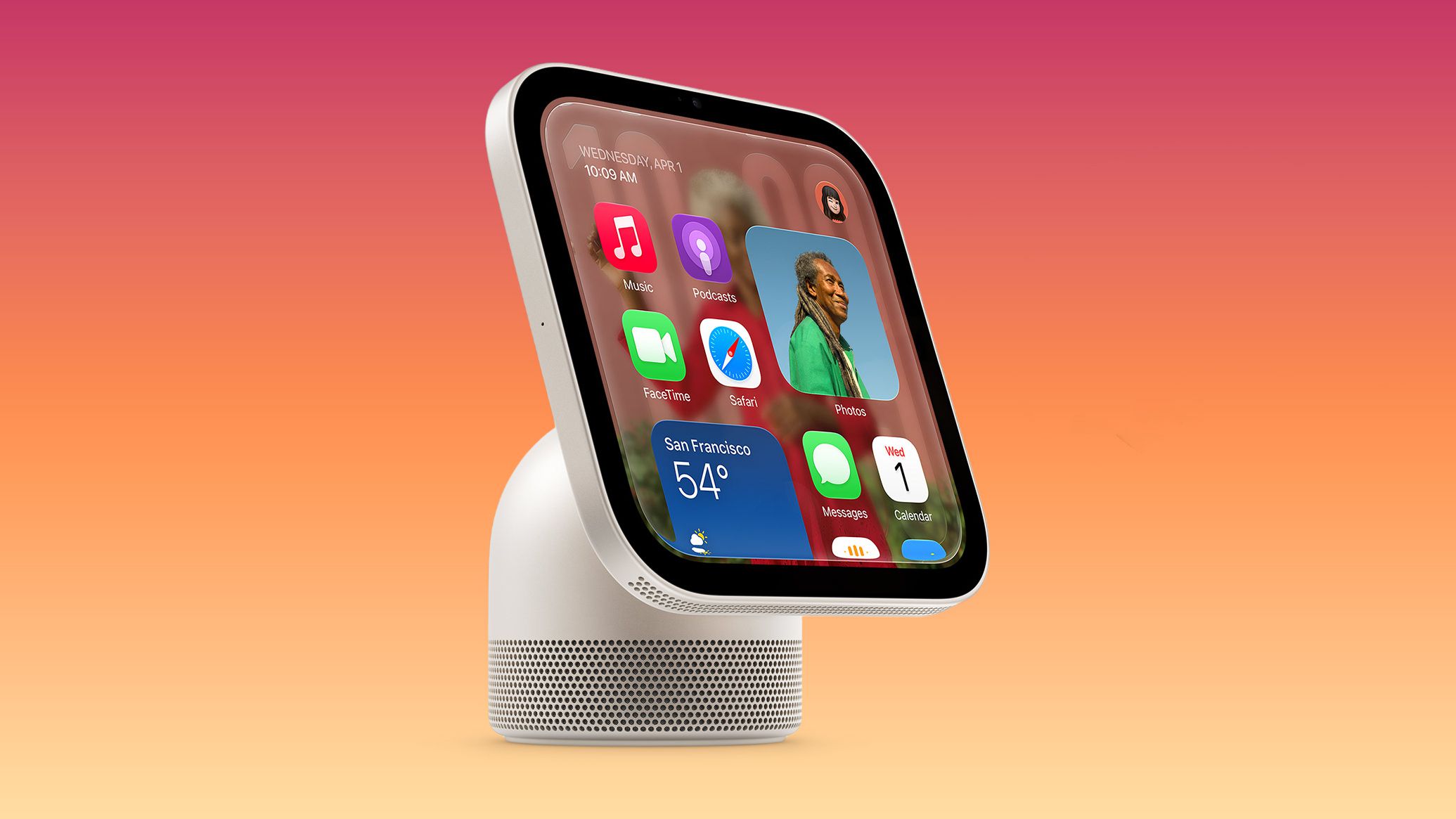
Those early September reports also highlighted specific component choices for the base smart display unit. The early design descriptions noted a single front-facing FaceTime camera paired with an array of integrated microphones and speakers built into a connected base structure. As those leaks progressed into October, the detailed picture of Apple’s immediate release plans came into clearer focus, culminating in the October 13 announcement of the fixed 7-inch Liquid Retina HomeView alongside Siri AI capabilities.
The shift in reported display sizes across Apple’s development cycle reveals a distinct progression in hardware engineering. While late September leaks pointed toward a compact, square 6-inch panel, the consumer model announced in mid-October arrived with a slightly larger 7-inch Liquid Retina display. The newly reported robotic variant represents another step up in display real estate, moving to a 9-inch screen size that provides significantly more visual area for smart home controls, video calls, and media playback.
Beyond display dimensions, the inclusion of a robotic articulation system represents a fundamentally distinct product category within Apple’s smart home architecture. By mounting a 9-inch panel onto a base equipped with a 360-degree rotating robotic arm, the higher-end HomeView would be able to continuously orient its display and FaceTime camera toward active users in a room. This motorized tracking capability contrasts directly with the static form factor of the 7-inch base model, which relies entirely on fixed viewing angles.
Though the exact commercial moniker for the robotic display has not been finalized, the speculative titles suggested by Gurman—HomeView Max, HomeView Ultra, and HomeView 360—align with product naming structures Apple has deployed across other major hardware lines. The "Max" and "Ultra" descriptors are frequently used by the company to designate top-tier performance levels, larger screen sizes, or premium build materials, while "360" explicitly highlights the physical rotational range enabled by the motorized arm mechanism.
The multi-year timeline projected for the robotic display indicates that Apple is treating its smart home expansion as a phased, long-term rollout. The immediate focus remains on the newly introduced standard HomeView, which establishes Apple’s dedicated smart hub category with its 7-inch display, facial recognition switching, and deep integration with Siri AI. Meanwhile, the companion updates leaked ahead of the "Welcome home" event—including the new Apple TV 4K and the HomePod mini 2—demonstrate how Apple is refreshing its broader surrounding hardware ecosystem to support its updated home experience.
As development continues on the higher-end project, the prospective 2027 or 2028 release window leaves a multi-year gap between the debut of the baseline 7-inch HomeView and the arrival of its motorized counterpart. During this interim period, Apple’s initial 7-inch Liquid Retina hub will serve as the primary hardware platform for the company’s shared household interface and facial recognition software features.
Whether Apple ultimately selects HomeView Max, HomeView Ultra, HomeView 360, or an entirely different name, the upcoming device points toward an ambitious direction for the company’s home hardware strategy. By combining a larger 9-inch screen with full 360-degree robotic movement, Apple appears to be preparing a premium alternative tailored for users seeking an active, motorized smart home display to complement its standard tabletop offerings.
 macOS & Apple IT Support
Amazon Slashes Prices on Apple M6 Mac Mini and M5 Max Mac Studio in Latest Weekend Sales Event
Amazon has introduced significant price reductions across Apple’s desktop computer lineup this...
 macOS & Apple IT Support
Apple Retail Outlets to Offer Custom Boot-Screen Personalization for iPhone Duo Launch in the United States
Apple is preparing a unique, tailored experience for customers purchasing the new...
 macOS & Apple IT Support
IFixit Teardown Finds Apple’s AirPods 5 Are Slightly More Repairable, Earning First-Ever Non-Zero Score Despite ‘Disaster’ Charging Case
In its traditional deep-dive disassembly video, repair authority iFixit has taken apart...