
The Competitive Stand-off with Nvidia and Intel
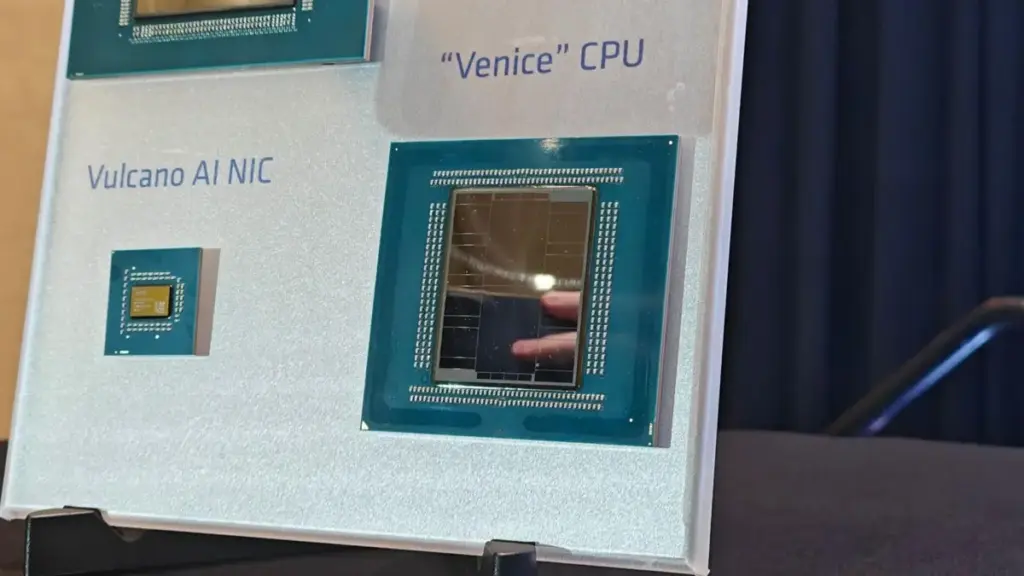
The comparison with Nvidia’s Vera architecture is particularly noteworthy because it highlights the divergence in design philosophies between x86 and ARM. Nvidia has been gaining ground in the data center by pairing its powerful GPUs with custom ARM CPUs, such as the Grace Superchip. By demonstrating that Venice can outperform Vera by such a wide margin, AMD is making the case that x86 remains the superior architecture for general-purpose server workloads and high-density compute.
The 20% per-core advantage claimed for the 96-core Venice model against the 88-core Vera is a critical metric for enterprise customers. Many software licenses are sold on a per-core basis, meaning that higher performance per-core directly translates to lower total cost of ownership (TCO) for the customer. If AMD can deliver significantly more work per core while maintaining competitive power envelopes, it places immense pressure on Nvidia’s CPU-only offerings.
The contrast with Intel is even more pronounced in AMD’s internal testing. The claim of a 3.4x performance increase over Intel Xeon competition suggests that AMD believes it has widened the gap in throughput-heavy applications. While Intel has been focusing on specialized accelerators integrated into its Xeon chips—such as those for AI and data compression—AMD’s strategy with Venice appears to be centered on raw, scalable throughput and massive architectural efficiency.
SPEC CPU 2026 and the Importance of Integer Rate
The benchmarks cited in the white paper rely heavily on the SPEC CPU 2026 Integer Rate test. This benchmark is widely regarded as the industry standard for measuring the general-purpose compute performance of a processor. It simulates a variety of real-world tasks, including compilers, data compression, and various algorithmic workloads.
AMD’s decision to use SPEC CPU 2026 as the primary battleground for Venice is a clear signal to IT decision-makers. It emphasizes that these chips are not just specialized "AI-only" components, but are instead versatile workhorses capable of handling everything from traditional enterprise applications to the most modern cloud-native stacks. The integer rate performance is a direct reflection of the Zen 6 core’s ability to handle complex instructions efficiently, and the 20% per-core lead suggests that the architectural improvements in Zen 6 go beyond simply adding more cores to a die.
 Hardware Reviews & PC Building
US Video Game Hardware Sales Experience Historic Decline as PlayStation and Xbox Reach Multi-Year Lows
The United States video game industry is currently grappling with a significant...
 Hardware Reviews & PC Building
Tom’s Hardware Expands Digital Reach with Launch of Official Mobile Application for Android and iOS
The landscape of technology journalism has undergone a profound transformation over the...
 Hardware Reviews & PC Building
Intel Shifts Strategic Focus to Trust Domain Extensions as Software Guard Extensions Era Nears its Conclusion
In a significant realignment of its long-term data center security roadmap, Intel...







