
In the rapidly evolving landscape of enterprise technology, the ability to process vast quantities of data in real time has transitioned from a competitive advantage to a fundamental requirement. At the center of this shift is SAP HANA, a multi-model, in-memory, column-oriented database management system designed to handle both high-volume transactional processing and complex analytical queries within a single platform. Unlike traditional database systems that often require separate environments for operations and reporting, SAP HANA’s architecture is engineered to collapse these silos, offering a streamlined approach to data management that minimizes latency and maximizes throughput.
Understanding the architecture of SAP HANA is essential for database administrators, architects, and IT leadership. When technical teams discuss the framework of the platform, they generally focus on two primary dimensions: the internal software components that manage data and the physical deployment strategies that dictate how the system scales and recovers from failure. Together, these elements define how the platform interacts with applications, how it preserves data integrity, and how it maintains performance under the pressure of modern enterprise workloads.
The Index Server: The Core of the SAP HANA Ecosystem
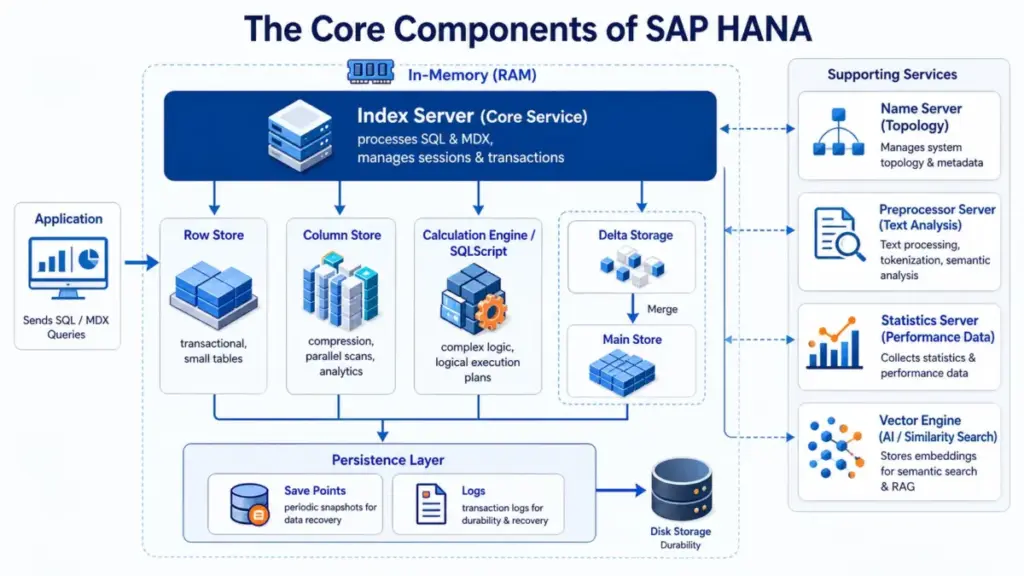
At the heart of the SAP HANA architecture lies the index server, which serves as the primary engine for data processing. It is the most critical service within the system, responsible for housing the actual data and executing the logic required to manipulate it. The index server manages a variety of complex tasks, ranging from session management—where it tracks user connections and authentication—to transaction management, ensuring that the database adheres to ACID (Atomicity, Consistency, Isolation, Durability) properties.
The index server acts as an orchestrator for several specialized engines. When an application sends a request via SQL (Structured Query Language) or MDX (Multi-Dimensional Expressions), the index server parses the request, optimizes the execution plan, and routes the work to the appropriate internal components. This centralized command structure allows SAP HANA to maintain high levels of efficiency, as the system can intelligently decide how to allocate resources based on the specific nature of the query being processed.
Bridging the Gap: Row Store and Column Store
One of the defining characteristics of SAP HANA is its dual-store capability. While most traditional databases are built exclusively around a row-based storage model, SAP HANA incorporates both row and column stores, allowing it to tailor its storage strategy to the specific needs of the data.
The column store is the primary driver of SAP HANA’s reputation for speed. By storing data in columns rather than rows, the system can achieve massive compression ratios. This is particularly effective for analytical workloads where queries often target a few specific columns across millions of records. Because the data is stored contiguously in memory, the system can perform parallel scans and aggregations at hardware-level speeds.
Conversely, the row store remains a vital component of the architecture. It is optimized for write-heavy, highly transactional workloads where the system needs to access or update all fields of a single record simultaneously. Certain system tables and metadata are also better suited for the row store. The architectural flexibility to utilize both storage patterns allows SAP HANA to support mixed workloads—often referred to as Translytical or HTAP (Hybrid Transactional/Analytical Processing)—without the need to move data between disparate systems.
Advanced Logic and the Calculation Engine
Beyond simple data retrieval, modern enterprise applications often require complex business logic to be executed directly within the database. SAP HANA facilitates this through its calculation engine and the use of SQLScript. By pushing logic down into the database layer, developers can avoid the "data transfer bottleneck" that occurs when large volumes of information must be moved from the database to an application server for processing.
The calculation engine transforms complex requests and calculation models into logical execution plans. These plans are then optimized by the system to run in parallel across the available CPU cores. This means that query performance in a SAP HANA environment is not solely a product of high-end hardware; it is also a result of how effectively the engine can parallelize tasks and reduce unnecessary data movement. For organizations running data-intensive applications, this "code-to-data" paradigm is a cornerstone of system efficiency.
 Helpdesk & IT Service Management (ITSM)
The Hidden Complexity of Efficiency: SolarWinds Report Reveals the Dual Nature of AI in the Modern Service Desk
The promise of artificial intelligence within Information Technology Service Management (ITSM) has...
 Helpdesk & IT Service Management (ITSM)
SolarWinds Service Desk September Update Introduces Advanced Process Integrations and Microsoft Teams Automation
As IT environments become increasingly complex and distributed, the demand for more...
 Helpdesk & IT Service Management (ITSM)
Overe Appoints Former Sophos CSO Simon Reed as Strategic Advisor to Accelerate MSP Security Growth
In a significant move aimed at strengthening its leadership and deepening its...







