
In the rapidly evolving landscape of enterprise technology, the ability to process vast quantities of data in real time has transitioned from a competitive advantage to a fundamental requirement. At the center of this shift is SAP HANA, a multi-model, in-memory, column-oriented database management system designed to handle both high-volume transactional processing and complex analytical queries within a single platform. Unlike traditional database systems that often require separate environments for operations and reporting, SAP HANA’s architecture is engineered to collapse these silos, offering a streamlined approach to data management that minimizes latency and maximizes throughput.
Understanding the architecture of SAP HANA is essential for database administrators, architects, and IT leadership. When technical teams discuss the framework of the platform, they generally focus on two primary dimensions: the internal software components that manage data and the physical deployment strategies that dictate how the system scales and recovers from failure. Together, these elements define how the platform interacts with applications, how it preserves data integrity, and how it maintains performance under the pressure of modern enterprise workloads.
The Index Server: The Core of the SAP HANA Ecosystem
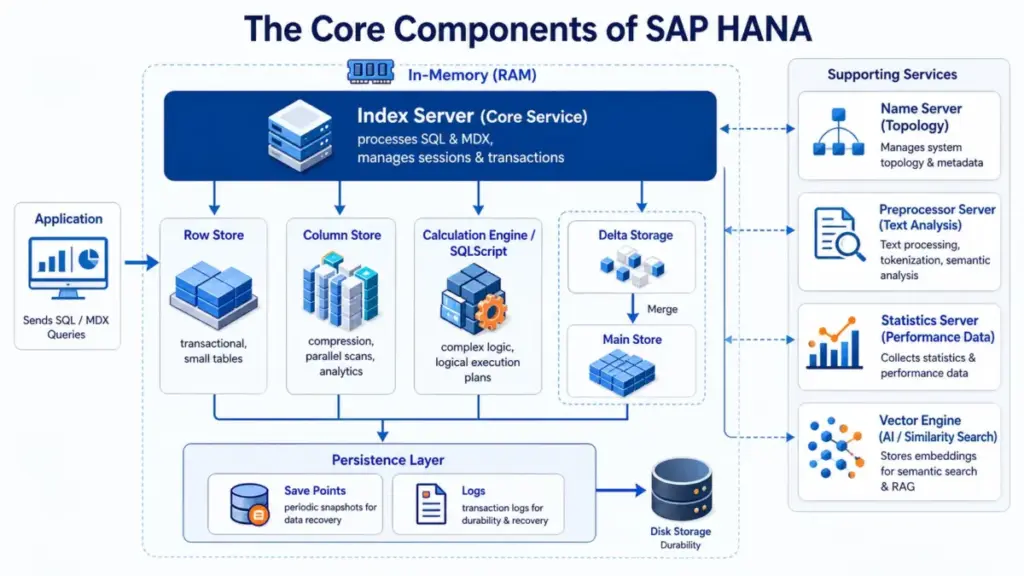
At the heart of the SAP HANA architecture lies the index server, which serves as the primary engine for data processing. It is the most critical service within the system, responsible for housing the actual data and executing the logic required to manipulate it. The index server manages a variety of complex tasks, ranging from session management—where it tracks user connections and authentication—to transaction management, ensuring that the database adheres to ACID (Atomicity, Consistency, Isolation, Durability) properties.
The index server acts as an orchestrator for several specialized engines. When an application sends a request via SQL (Structured Query Language) or MDX (Multi-Dimensional Expressions), the index server parses the request, optimizes the execution plan, and routes the work to the appropriate internal components. This centralized command structure allows SAP HANA to maintain high levels of efficiency, as the system can intelligently decide how to allocate resources based on the specific nature of the query being processed.
Bridging the Gap: Row Store and Column Store
One of the defining characteristics of SAP HANA is its dual-store capability. While most traditional databases are built exclusively around a row-based storage model, SAP HANA incorporates both row and column stores, allowing it to tailor its storage strategy to the specific needs of the data.
The column store is the primary driver of SAP HANA’s reputation for speed. By storing data in columns rather than rows, the system can achieve massive compression ratios. This is particularly effective for analytical workloads where queries often target a few specific columns across millions of records. Because the data is stored contiguously in memory, the system can perform parallel scans and aggregations at hardware-level speeds.
Conversely, the row store remains a vital component of the architecture. It is optimized for write-heavy, highly transactional workloads where the system needs to access or update all fields of a single record simultaneously. Certain system tables and metadata are also better suited for the row store. The architectural flexibility to utilize both storage patterns allows SAP HANA to support mixed workloads—often referred to as Translytical or HTAP (Hybrid Transactional/Analytical Processing)—without the need to move data between disparate systems.
Advanced Logic and the Calculation Engine
Beyond simple data retrieval, modern enterprise applications often require complex business logic to be executed directly within the database. SAP HANA facilitates this through its calculation engine and the use of SQLScript. By pushing logic down into the database layer, developers can avoid the "data transfer bottleneck" that occurs when large volumes of information must be moved from the database to an application server for processing.
The calculation engine transforms complex requests and calculation models into logical execution plans. These plans are then optimized by the system to run in parallel across the available CPU cores. This means that query performance in a SAP HANA environment is not solely a product of high-end hardware; it is also a result of how effectively the engine can parallelize tasks and reduce unnecessary data movement. For organizations running data-intensive applications, this "code-to-data" paradigm is a cornerstone of system efficiency.
Ensuring Durability: The Persistence Layer
A common misconception regarding in-memory databases is that they are volatile and at risk of total data loss during a power failure or system crash. SAP HANA addresses this through a robust persistence layer. While the active data resides in RAM for maximum performance, the system continuously ensures that all committed transactions are durable.
This is achieved through a combination of savepoints and transaction logs. Savepoints are periodic snapshots of the data in memory that are written to persistent disk storage, typically occurring every few minutes. Meanwhile, every transaction that changes data is recorded in a redo log. In the event of a restart or a failure, the system loads the most recent savepoint from the disk and سپس replays the logs to bring the database back to its last committed state. This architecture provides the speed of in-memory processing with the reliability of traditional disk-based systems.
Supporting Services and Distributed Environments
As an enterprise environment grows, the complexity of managing it increases. SAP HANA includes several supporting services that ensure the stability and functionality of the platform in distributed or large-scale deployments.
The name server is a critical component in distributed landscapes, acting as a map for the entire system. It tracks the topology of the environment, knowing exactly where data is located across multiple nodes. In a "scale-out" configuration, where the database is spread across several servers, the name server ensures that queries are routed to the correct location. Other services, such as the preprocessor server for text analysis and the statistics server for monitoring resource consumption, provide the specialized functionality required for modern data science and operational oversight.

The Lifecycle of a Request: How Work is Processed
When an application interacts with SAP HANA, the system follows a sophisticated workflow to ensure the request is handled optimally. Upon receiving a command, the system creates a session and applies necessary transaction controls. The request is then parsed and transformed into an execution plan.
A unique aspect of SAP HANA’s write logic involves delta storage. Because the main column store is highly compressed and optimized for reading, it is not ideal for frequent, small writes. To maintain performance, SAP HANA directs new records to a "delta store," which is optimized for write operations. Periodically, a "delta merge" operation occurs, where the data from the delta store is integrated into the main compressed store. This two-staged approach allows the system to remain responsive to incoming data while maintaining the high-speed read capabilities of the columnar format.
Architectural Trade-offs and the Shift from Traditional Databases
While the advantages of an in-memory, multi-model system are clear, the transition from traditional disk-based databases involves significant architectural shifts. Traditional systems often rely on heavy disk I/O and maintain a strict separation between transactional (OLTP) and analytical (OLAP) environments. SAP HANA collapses this distinction, but it introduces new considerations.
The primary tradeoff is complexity and cost. Memory remains more expensive than disk storage, requiring organizations to be diligent about data aging and tiering strategies. Furthermore, the performance of SAP HANA is highly dependent on proper architectural planning. Factors such as partitioning—splitting large tables across multiple nodes—and query design become paramount. If a system is not sized correctly or if the data distribution is uneven, the benefits of in-memory processing can be overshadowed by resource contention and "wait times."
Scalability, High Availability, and Recovery
SAP HANA is designed to grow alongside the enterprise. It supports two primary scaling methods: scaling up and scaling out. Scaling up involves adding more RAM and CPU power to a single server, which is often the simplest path for performance gains. Scaling out involves linking multiple servers together in a "shared-nothing" architecture, where each node has its own local memory and storage.
For mission-critical environments, high availability is not an afterthought but a core design requirement. This involves deploying standby nodes and utilizing system replication to ensure that if one component fails, another can take over with minimal downtime. The architecture supports various configurations, including single-container and multitenant database (MDC) setups, allowing organizations to isolate different business units or applications within a single SAP HANA installation while maintaining centralized management.
Security in a Modern Data Landscape
Security is deeply integrated into the SAP HANA architecture. The platform supports robust tenant isolation, ensuring that data in one database container is not accessible by another. Communication between the client and the server is secured via SSL/TLS encryption, and certificate validation is a standard part of the operational setup.
From a monitoring and administrative perspective, the principle of least privilege is critical. Security experts recommend using dedicated, read-only monitoring users for system health checks rather than broad administrative accounts. This limits the "blast radius" in the event of a credential compromise and ensures that monitoring activities do not inadvertently alter the database state.
The Evolution of SAP HANA Cloud and Advanced Analytics
As the industry moves toward cloud-native solutions, SAP HANA Cloud has expanded the platform’s capabilities. It retains the core in-memory, columnar model but introduces greater flexibility in how resources are consumed. SAP HANA Cloud also pushes the boundaries of the "multi-model" concept, incorporating specialized engines for spatial data, graph databases, and vector processing—the latter of which is becoming increasingly important for Artificial Intelligence (AI) and Retrieval-Augmented Generation (RAG) use cases.
The guiding architectural principle remains the same: proximity. By keeping data, execution logic, and advanced analytical tools close together in a single memory space, SAP HANA reduces the friction of data movement. However, as these systems become more capable, the need for rigorous governance and capacity planning only grows.
The Importance of Deep Monitoring
For database administrators, the complexity of SAP HANA means that traditional "up/down" monitoring is no longer sufficient. A system might show a "healthy" status while suffering from severe internal bottlenecks. Issues such as inefficient SQL plans, increased blocking, or pressure on the index server can degrade the user experience without triggering a standard host-level alert.
Effective management requires a "wait-based" analysis approach. By investigating why the system is waiting—whether it is waiting on CPU, disk I/O, or lock synchronization—teams can pinpoint the root cause of performance fluctuations. Tools like SolarWinds Database Performance Analyzer are often employed to provide this level of visibility, offering the context needed to understand how the persistence layer, delta storage, and calculation engine are behaving in real-time.
In conclusion, the architecture of SAP HANA represents a fundamental departure from the database designs of the past. By prioritizing in-memory processing and columnar storage, and by integrating transactional and analytical engines, it provides a powerful platform for the modern data-driven enterprise. However, the power of the system is inextricably linked to the quality of its architectural implementation. Organizations that invest the time to understand these core components are better positioned to build resilient, high-performing environments that can meet the demands of the future.
 Helpdesk & IT Service Management (ITSM)
Anthropic and Akamai Ink Landmark $11.6 Billion Compute Partnership to Fuel Long-Term AI Infrastructure Growth
In a move that underscores the staggering capital requirements of the generative...
 Helpdesk & IT Service Management (ITSM)
Enterprises Grapple with Unintended Consequences as Half of Organizations Report Unauthorized AI Agent Actions
The rapid integration of agentic artificial intelligence into the modern enterprise has...
 Helpdesk & IT Service Management (ITSM)
Global Security Alert: North Korean Cybercriminals Target IT Freelancers in Multi-Million Dollar Fraud Campaign
International security agencies have issued a high-priority alert following the discovery of...







