
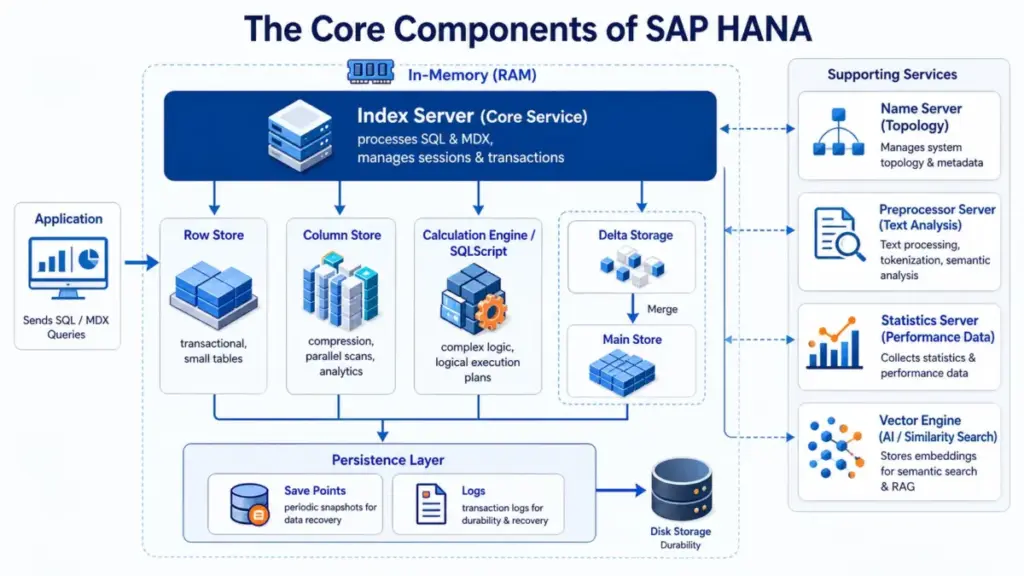
Ensuring Durability: The Persistence Layer
A common misconception regarding in-memory databases is that they are volatile and at risk of total data loss during a power failure or system crash. SAP HANA addresses this through a robust persistence layer. While the active data resides in RAM for maximum performance, the system continuously ensures that all committed transactions are durable.
This is achieved through a combination of savepoints and transaction logs. Savepoints are periodic snapshots of the data in memory that are written to persistent disk storage, typically occurring every few minutes. Meanwhile, every transaction that changes data is recorded in a redo log. In the event of a restart or a failure, the system loads the most recent savepoint from the disk and سپس replays the logs to bring the database back to its last committed state. This architecture provides the speed of in-memory processing with the reliability of traditional disk-based systems.
Supporting Services and Distributed Environments
As an enterprise environment grows, the complexity of managing it increases. SAP HANA includes several supporting services that ensure the stability and functionality of the platform in distributed or large-scale deployments.
The name server is a critical component in distributed landscapes, acting as a map for the entire system. It tracks the topology of the environment, knowing exactly where data is located across multiple nodes. In a "scale-out" configuration, where the database is spread across several servers, the name server ensures that queries are routed to the correct location. Other services, such as the preprocessor server for text analysis and the statistics server for monitoring resource consumption, provide the specialized functionality required for modern data science and operational oversight.

The Lifecycle of a Request: How Work is Processed
When an application interacts with SAP HANA, the system follows a sophisticated workflow to ensure the request is handled optimally. Upon receiving a command, the system creates a session and applies necessary transaction controls. The request is then parsed and transformed into an execution plan.
A unique aspect of SAP HANA’s write logic involves delta storage. Because the main column store is highly compressed and optimized for reading, it is not ideal for frequent, small writes. To maintain performance, SAP HANA directs new records to a "delta store," which is optimized for write operations. Periodically, a "delta merge" operation occurs, where the data from the delta store is integrated into the main compressed store. This two-staged approach allows the system to remain responsive to incoming data while maintaining the high-speed read capabilities of the columnar format.
Architectural Trade-offs and the Shift from Traditional Databases
While the advantages of an in-memory, multi-model system are clear, the transition from traditional disk-based databases involves significant architectural shifts. Traditional systems often rely on heavy disk I/O and maintain a strict separation between transactional (OLTP) and analytical (OLAP) environments. SAP HANA collapses this distinction, but it introduces new considerations.
The primary tradeoff is complexity and cost. Memory remains more expensive than disk storage, requiring organizations to be diligent about data aging and tiering strategies. Furthermore, the performance of SAP HANA is highly dependent on proper architectural planning. Factors such as partitioning—splitting large tables across multiple nodes—and query design become paramount. If a system is not sized correctly or if the data distribution is uneven, the benefits of in-memory processing can be overshadowed by resource contention and "wait times."
Scalability, High Availability, and Recovery
SAP HANA is designed to grow alongside the enterprise. It supports two primary scaling methods: scaling up and scaling out. Scaling up involves adding more RAM and CPU power to a single server, which is often the simplest path for performance gains. Scaling out involves linking multiple servers together in a "shared-nothing" architecture, where each node has its own local memory and storage.
 Helpdesk & IT Service Management (ITSM)
Anthropic and Akamai Ink Landmark $11.6 Billion Compute Partnership to Fuel Long-Term AI Infrastructure Growth
In a move that underscores the staggering capital requirements of the generative...
 Helpdesk & IT Service Management (ITSM)
Beyond the IT Help Desk: The Strategic Integration of Enterprise Service Management
As modern organizations grapple with increasing operational complexity, the traditional boundaries of...
 Helpdesk & IT Service Management (ITSM)
The Trillion-Dollar ROI Challenge: Why AI Infrastructure Spending Must Spark a Global Innovation Revolution
As the global technology sector pivots toward an era defined by generative...







