
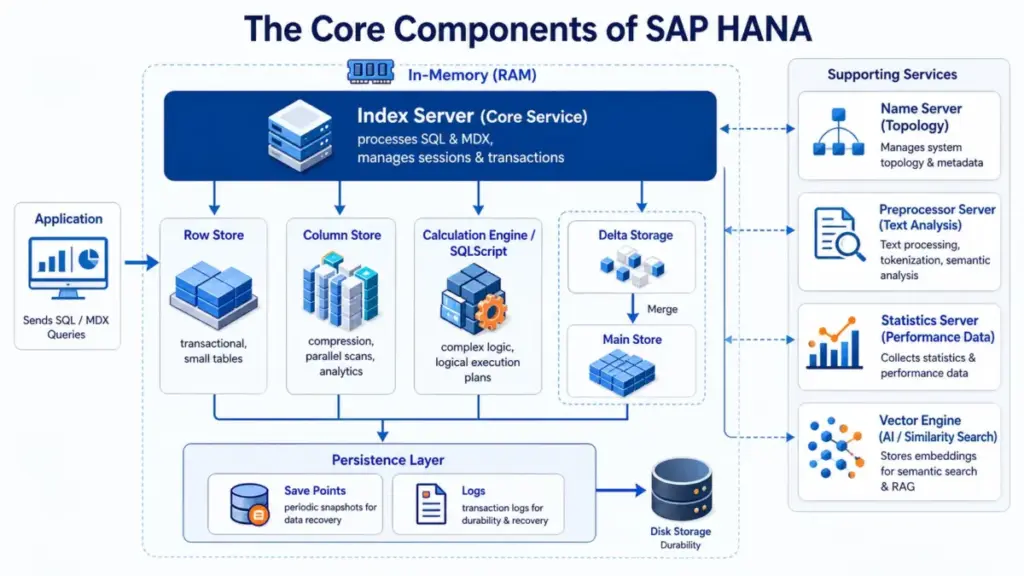
For mission-critical environments, high availability is not an afterthought but a core design requirement. This involves deploying standby nodes and utilizing system replication to ensure that if one component fails, another can take over with minimal downtime. The architecture supports various configurations, including single-container and multitenant database (MDC) setups, allowing organizations to isolate different business units or applications within a single SAP HANA installation while maintaining centralized management.
Security in a Modern Data Landscape
Security is deeply integrated into the SAP HANA architecture. The platform supports robust tenant isolation, ensuring that data in one database container is not accessible by another. Communication between the client and the server is secured via SSL/TLS encryption, and certificate validation is a standard part of the operational setup.
From a monitoring and administrative perspective, the principle of least privilege is critical. Security experts recommend using dedicated, read-only monitoring users for system health checks rather than broad administrative accounts. This limits the "blast radius" in the event of a credential compromise and ensures that monitoring activities do not inadvertently alter the database state.
The Evolution of SAP HANA Cloud and Advanced Analytics
As the industry moves toward cloud-native solutions, SAP HANA Cloud has expanded the platform’s capabilities. It retains the core in-memory, columnar model but introduces greater flexibility in how resources are consumed. SAP HANA Cloud also pushes the boundaries of the "multi-model" concept, incorporating specialized engines for spatial data, graph databases, and vector processing—the latter of which is becoming increasingly important for Artificial Intelligence (AI) and Retrieval-Augmented Generation (RAG) use cases.
The guiding architectural principle remains the same: proximity. By keeping data, execution logic, and advanced analytical tools close together in a single memory space, SAP HANA reduces the friction of data movement. However, as these systems become more capable, the need for rigorous governance and capacity planning only grows.
The Importance of Deep Monitoring
For database administrators, the complexity of SAP HANA means that traditional "up/down" monitoring is no longer sufficient. A system might show a "healthy" status while suffering from severe internal bottlenecks. Issues such as inefficient SQL plans, increased blocking, or pressure on the index server can degrade the user experience without triggering a standard host-level alert.
Effective management requires a "wait-based" analysis approach. By investigating why the system is waiting—whether it is waiting on CPU, disk I/O, or lock synchronization—teams can pinpoint the root cause of performance fluctuations. Tools like SolarWinds Database Performance Analyzer are often employed to provide this level of visibility, offering the context needed to understand how the persistence layer, delta storage, and calculation engine are behaving in real-time.
In conclusion, the architecture of SAP HANA represents a fundamental departure from the database designs of the past. By prioritizing in-memory processing and columnar storage, and by integrating transactional and analytical engines, it provides a powerful platform for the modern data-driven enterprise. However, the power of the system is inextricably linked to the quality of its architectural implementation. Organizations that invest the time to understand these core components are better positioned to build resilient, high-performing environments that can meet the demands of the future.
 Helpdesk & IT Service Management (ITSM)
Strategic Espionage Campaign Linked to Chinese Threat Actor Targets Global AI Policy Experts
In a sophisticated display of targeted cyber espionage, a threat actor aligned...
 Helpdesk & IT Service Management (ITSM)
Keeper Security Hits Major Milestone with 100,000 Enterprise Customers Amid Rapid Growth in Identity Security Market
In a significant validation of the growing demand for unified identity and...
 Helpdesk & IT Service Management (ITSM)
The Shift Toward Pre-emptive Cybersecurity: Why "Detect and Respond" is No Longer Enough in the Age of AI
The cybersecurity landscape has long been characterized by a perpetual game of...







