
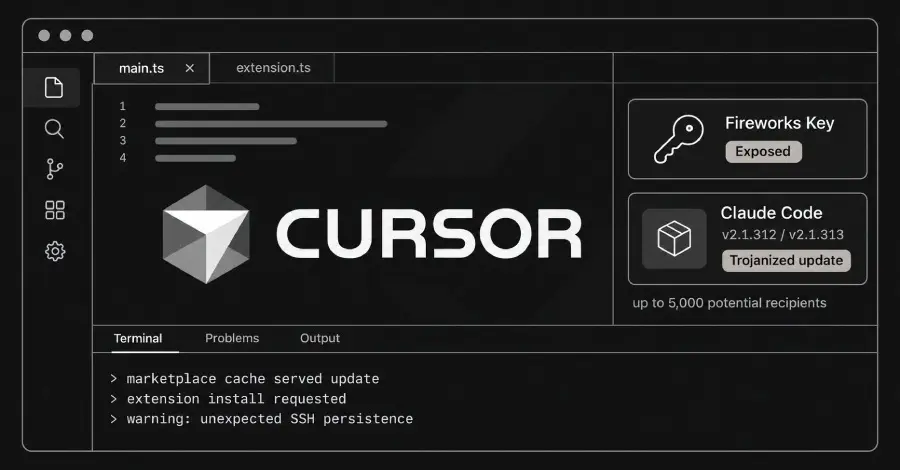
In a detailed post-mortem that highlights the growing complexities of AI supply chain security, the AI-powered code editor Cursor has confirmed that a recent security breach was triggered by the theft of an access key from Fireworks AI. This initial compromise eventually led to the distribution of a trojanized version of Anthropic’s official Claude Code extension through the Cursor Marketplace, an incident that has sent ripples through the software development and cybersecurity communities.
The disclosure, released on November 15, 2026, provides a comprehensive look at how a vulnerability in a third-party service provider can escalate into a direct threat to end-users. According to Cursor, the chain of events began when an attacker obtained an access key that Cursor had issued to Fireworks AI, a platform used for running large language models. This key was reportedly exposed following a separate breach at Fireworks AI, allowing the unauthorized party to gain a foothold in Cursor’s secondary data environments.
The Anatomy of the Initial Breach
The security incident began to unfold when the attacker utilized the stolen Fireworks AI credential to gain access to a read-only storage bucket. This bucket was used by Cursor to facilitate data sharing with Fireworks for the purpose of model inference and optimization. While the storage was read-only, the information contained within proved to be a goldmine for the attacker’s next steps.
Cursor explained that the storage bucket held limited traces from "coding agent" sessions. These traces are essentially logs of how the AI interacts with codebases to provide suggestions, debugging, and completions. Crucially, the company noted that these traces were exclusively from sessions where "Privacy Mode" had not been enabled. In Cursor’s ecosystem, Privacy Mode is a critical security feature that allows users to opt out of having their data used for model training or stored in certain types of logs.
The traces in question largely dated back to 2025 and were permitted for use in model training under the platform’s standard terms of service. However, the investigation revealed a failure in the data scrubbing process. Despite automated efforts to remove sensitive information, some credentials had not been properly redacted from these traces. As a result, the attacker was able to harvest API credentials belonging to a small fraction of Cursor’s user base—estimated to be less than 0.01% of the total customer population.
While the percentage of affected users was statistically small, the stolen credentials provided the attacker with the leverage needed to pivot deeper into Cursor’s infrastructure. By utilizing these harvested keys, the threat actor moved laterally to access several software-as-a-service (SaaS) tools used by the company for internal operations.
The Marketplace Escalation and the Trojanized Extension
The most alarming phase of the attack occurred on October 29, 2026. Armed with credentials obtained from the internal SaaS tools, the attacker successfully accessed the cache system used to serve the Cursor Extension Marketplace. The objective was to distribute malware by masquerading as a legitimate, highly trusted tool: Anthropic’s Claude Code extension.

The attacker uploaded a trojanized version of the extension (specifically versions 2.1.312 and 2.1.313) directly into the marketplace’s cache. To the average user, the extension appeared to be a legitimate update to the official Claude Code tool. In reality, the malicious build was designed to install a persistent SSH backdoor on the victim’s machine. Such a backdoor would allow the attacker to maintain remote access to the developer’s system, potentially leading to the theft of source code, proprietary secrets, and further network penetration.
 Cybersecurity Basics & Security News
Cloudflare Resolves Critical Cross-Tenant Data Leakage Flaw in Container Infrastructure
Cloudflare has recently addressed a significant security vulnerability within its containerized infrastructure...
 Cybersecurity Basics & Security News
OpenAI Dismisses Safety Researchers Following Leak of Confidential Infrastructure Data Amid Growing Security Concerns
OpenAI has terminated the employment of three prominent members of its safety...
 Cybersecurity Basics & Security News
ShinyHunters Suspect Rey Reportedly Detained in Jordan, Helping FBI Identify Group Members
Khader, who also operated under the moniker ReyXBF, is far from an...







