
In the current corporate landscape, the conversation surrounding artificial intelligence has shifted from theoretical potential to operational reality. Business leaders are no longer asking what artificial intelligence can do; they are asking how to build a self-reinforcing system of learning that permeates every level of their organization. At Microsoft, these high-performing organizations are referred to as "Frontier Firms"—enterprises that don’t just use AI, but integrate it into a cohesive, evolving system.
However, the path to becoming a Frontier Firm has remained elusive for many. While the concept of a learning organization is well-understood, the practical blueprint for firm-wide transformation has been missing. To bridge this gap, Microsoft recently launched a comprehensive research initiative in collaboration with Keystone, a global technology and advisory firm. The resulting study, which includes a working paper published by Harvard Business School titled "Organizing AI at Enterprise Scale," provides a data-driven look at how major enterprises are navigating this transition and identifies the specific patterns that lead to success.
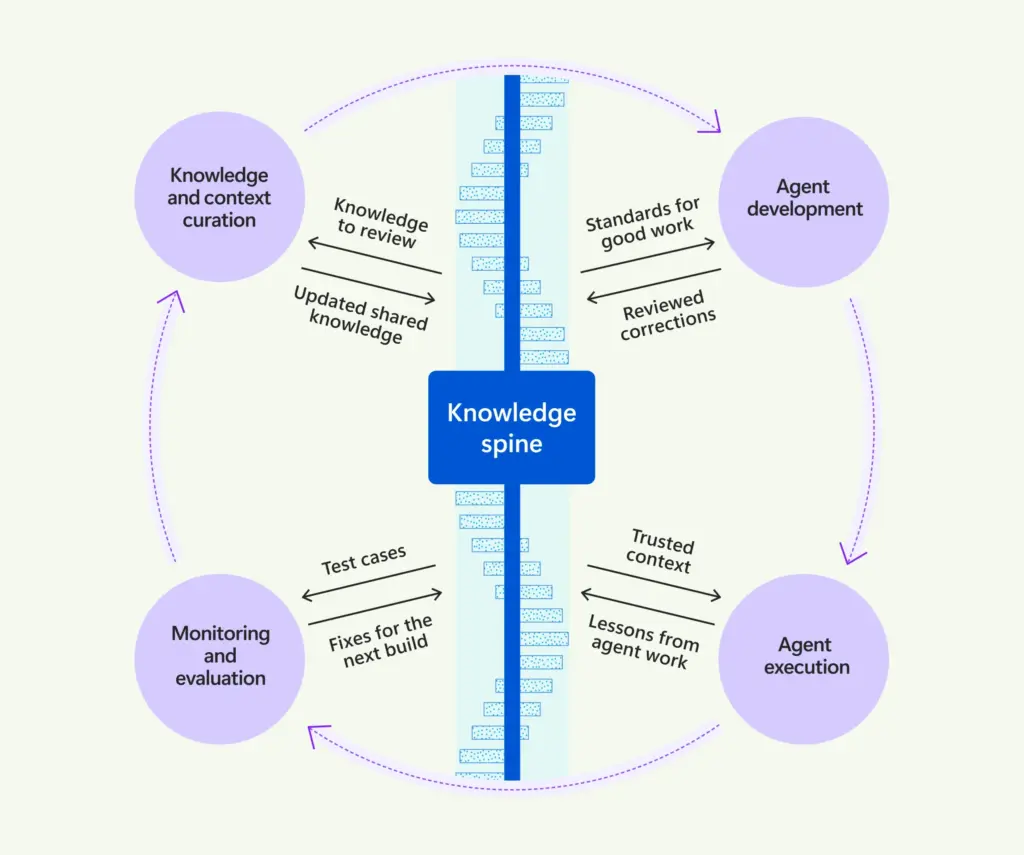
The central finding of the research is the emergence of the "knowledge spine"—a shared system that serves as the central nervous system for an organization’s AI agents. This infrastructure stores and updates the context that agents rely on, while simultaneously capturing the corrections, tests, and lessons derived from the agents’ daily work. According to the study, companies that have begun implementing the components of a knowledge spine are already seeing significant financial advantages, outperforming their peers in both operating margins and return on assets.
The Blueprint for Transformation: From Pilots to Systems
To understand what sets leading companies apart, the research team conducted a multi-phase study. They began by interviewing leaders at 29 organizations with advanced AI deployments, including 18 AI-native startups, to identify the operational commonalities of success. These insights were then used to develop a detailed assessment for over 200 other enterprises across various sectors, including financial services, manufacturing, healthcare, retail, and technology. Every company in the sample employed more than 1,000 people and was already actively using AI.
The researchers grouped these companies into four distinct stages of AI maturity based on how they build, run, coordinate, and learn from their AI agents.
In Stage One, companies operate with a patchwork of AI pilot projects. These efforts are often limited to basic chat functionalities and lack coordination across departments. Because these pilots are not integrated into real business workflows, they rarely show a measurable impact on the bottom line.
Stage Two represents a step forward, where companies begin using agents to tackle specific business workflows across different functions. However, these organizations still lack automated systems for management and orchestration. Instead, they rely on human-led teams and committees to prioritize investments and provide checks and balances. This "human orchestration" creates a bottleneck; because humans must manually check the work of agents, the system is difficult to scale, and the returns on investment are harder to realize.
Stage Three is described by researchers as the critical turning point. At this stage, companies begin to replace human coordination with system-based coordination. This is achieved either by sharing a common knowledge base or by implementing rigorous system-level monitoring of agent outputs. Business outcomes, rather than experimental curiosity, begin to dictate which tasks the agents take on. Many companies find it practical to start this transition within a single department or a specific set of workflows before attempting a company-wide rollout.

Finally, Stage Four represents the "North Star" of enterprise AI. In these organizations, orchestration, governance, and a knowledge spine are fully integrated. Lessons learned from an agent’s performance are fed back into a shared knowledge base, creating a single agentic operating model. In this environment, the system itself takes on the bulk of the coordination and learning, allowing the organization to move at a speed that human-managed systems cannot match.
 Productivity Software & Office Suites
Microsoft Unveils ‘Autopilots’ and Scout: A New Frontier for Autonomous AI Agents in the Enterprise
The nature of professional productivity is undergoing a fundamental shift, moving away...
 Productivity Software & Office Suites
Microsoft Unveils Advanced AI Capabilities for Finance Professionals in Excel, Prioritizing Traceability and Real-World Data
The evolution of enterprise technology has historically followed a predictable trajectory. From...
 Productivity Software & Office Suites
Microsoft Reimagines Copilot as a Centralized AI Ecosystem for the Modern Enterprise
In a significant move to redefine the landscape of digital productivity, Microsoft...







