
The Financial Reality of AI Maturity
The research highlights a clear correlation between AI maturity and financial performance. By comparing the financial results of over 100 public companies in the study from 2022 to 2025, the team found that companies in the top quartile of AI practices saw much stronger growth than those in the bottom quartile. Specifically, high-scoring companies improved their operating margins by more than 5 percentage points more than the lowest-scoring firms. They also saw a return on assets that was approximately 2 percentage points higher.
It is important to note that the study shows correlation rather than direct causation. Because the financial data covers a period that precedes the widespread deployment of the most advanced agentic systems, the researchers suggest that the highest-scoring companies were likely already demonstrating superior operational discipline. However, the data strongly suggests that the practices required to build a knowledge spine are the same practices that drive modern corporate efficiency.
For companies in the bottom two quartiles, margins remained largely stagnant. The researchers point to the "J-curve" phenomenon to explain this. When a disruptive technology arrives, companies often experience a temporary dip or lag in productivity as they reorganize their workflows to accommodate the new tools. With AI agents, this lag often occurs when a firm deploys agents faster than it can build the systems to coordinate them.
The Knowledge Spine: Turning Corrections into Proprietary Intelligence
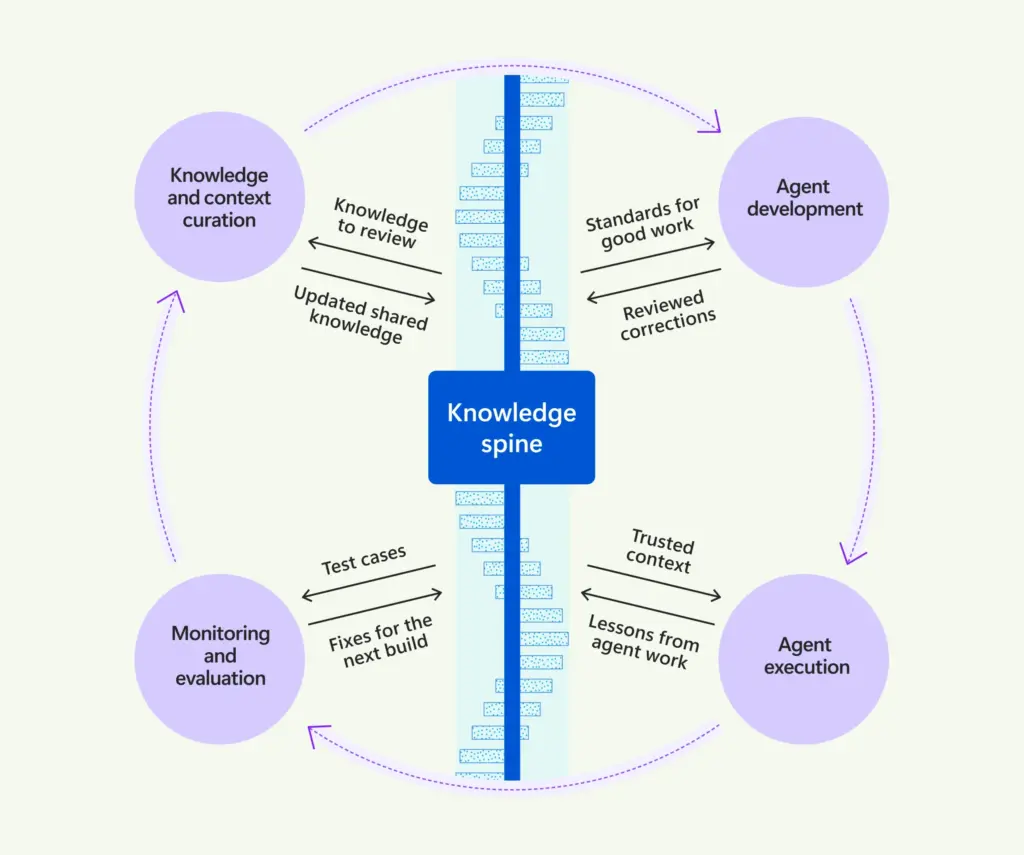
At the heart of the Stage Four enterprise is the knowledge spine. The principle is straightforward: when an AI agent makes a mistake and a human corrects it, that correction should not be an isolated event. Instead, the lesson should be captured and shared so that every other agent in the organization learns from it simultaneously.
This approach transforms a company’s operational history into a unique competitive advantage. While the underlying AI models may be available to everyone, the specific corrections, tests, and business-specific lessons belong to the company alone. This is the philosophy behind Microsoft’s enterprise intelligence layer, Microsoft IQ, which aims to update shared knowledge in one central location for all agents to access.
Building a knowledge spine requires a shift in how leaders view their data and operations. The study identifies four essential practices for organizations looking to build this infrastructure:
First, companies must collect context from diverse sources—including chat applications, systems of record, and internal documentation—and store it centrally. This ensures that agents are always pulling from the most current and relevant information.

Second, organizations must treat fixes as a form of high-value data. Every time a human corrects an agent’s output, that interaction should be converted into a test case for future iterations. This prevents the same error from recurring and gradually sharpens the accuracy of the entire system.
 Productivity Software & Office Suites
Microsoft Unveils ‘Autopilots’ and Scout: A New Frontier for Autonomous AI Agents in the Enterprise
The nature of professional productivity is undergoing a fundamental shift, moving away...
 Productivity Software & Office Suites
Microsoft Reimagines Copilot as a Comprehensive AI System for Enterprise Automation and Custom Development
In a significant shift that signals the next phase of the generative...
 Productivity Software & Office Suites
Microsoft Reimagines the Future of Productivity with a New Generation of Copilot and Autonomous Agents
Microsoft has announced a significant evolution of its artificial intelligence strategy, unveiling...







