In the current corporate landscape, the conversation surrounding artificial intelligence has shifted from theoretical potential to operational reality. Business leaders are no longer asking what artificial intelligence can do; they are asking how to build a self-reinforcing system of learning that permeates every level of their organization. At Microsoft, these high-performing organizations are referred to as "Frontier Firms"—enterprises that don’t just use AI, but integrate it into a cohesive, evolving system.
However, the path to becoming a Frontier Firm has remained elusive for many. While the concept of a learning organization is well-understood, the practical blueprint for firm-wide transformation has been missing. To bridge this gap, Microsoft recently launched a comprehensive research initiative in collaboration with Keystone, a global technology and advisory firm. The resulting study, which includes a working paper published by Harvard Business School titled "Organizing AI at Enterprise Scale," provides a data-driven look at how major enterprises are navigating this transition and identifies the specific patterns that lead to success.
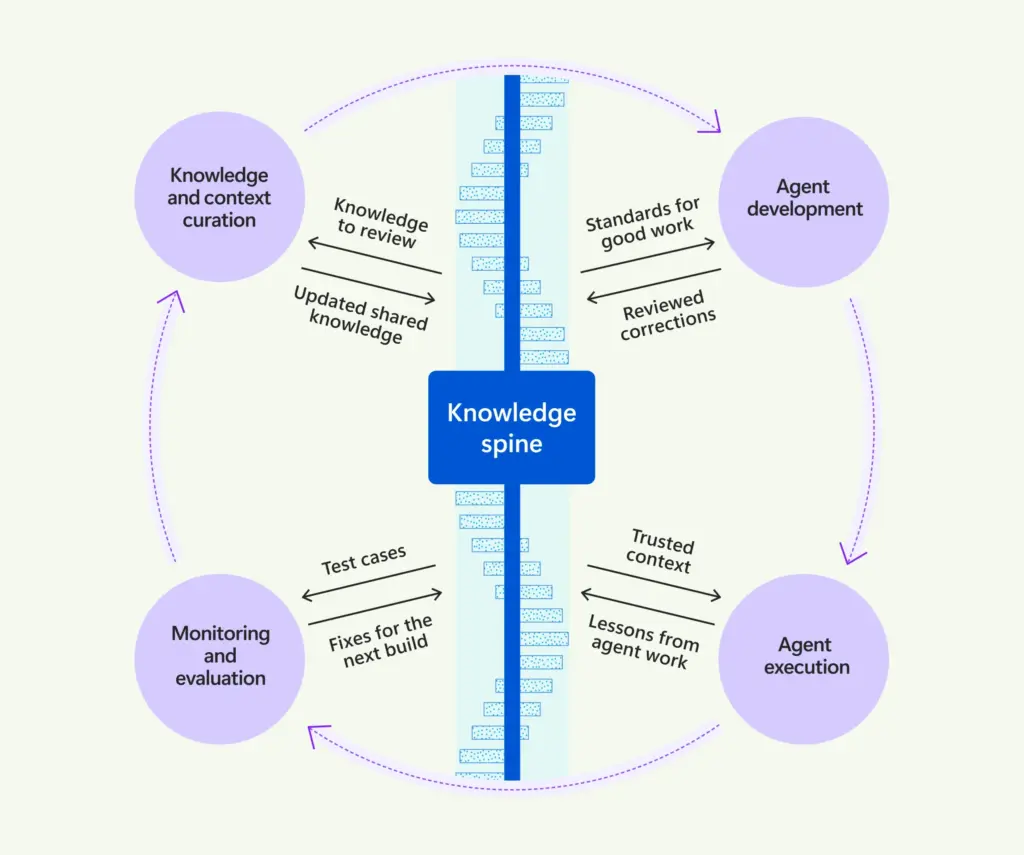
The central finding of the research is the emergence of the "knowledge spine"—a shared system that serves as the central nervous system for an organization’s AI agents. This infrastructure stores and updates the context that agents rely on, while simultaneously capturing the corrections, tests, and lessons derived from the agents’ daily work. According to the study, companies that have begun implementing the components of a knowledge spine are already seeing significant financial advantages, outperforming their peers in both operating margins and return on assets.
The Blueprint for Transformation: From Pilots to Systems
To understand what sets leading companies apart, the research team conducted a multi-phase study. They began by interviewing leaders at 29 organizations with advanced AI deployments, including 18 AI-native startups, to identify the operational commonalities of success. These insights were then used to develop a detailed assessment for over 200 other enterprises across various sectors, including financial services, manufacturing, healthcare, retail, and technology. Every company in the sample employed more than 1,000 people and was already actively using AI.
The researchers grouped these companies into four distinct stages of AI maturity based on how they build, run, coordinate, and learn from their AI agents.
In Stage One, companies operate with a patchwork of AI pilot projects. These efforts are often limited to basic chat functionalities and lack coordination across departments. Because these pilots are not integrated into real business workflows, they rarely show a measurable impact on the bottom line.
Stage Two represents a step forward, where companies begin using agents to tackle specific business workflows across different functions. However, these organizations still lack automated systems for management and orchestration. Instead, they rely on human-led teams and committees to prioritize investments and provide checks and balances. This "human orchestration" creates a bottleneck; because humans must manually check the work of agents, the system is difficult to scale, and the returns on investment are harder to realize.
Stage Three is described by researchers as the critical turning point. At this stage, companies begin to replace human coordination with system-based coordination. This is achieved either by sharing a common knowledge base or by implementing rigorous system-level monitoring of agent outputs. Business outcomes, rather than experimental curiosity, begin to dictate which tasks the agents take on. Many companies find it practical to start this transition within a single department or a specific set of workflows before attempting a company-wide rollout.

Finally, Stage Four represents the "North Star" of enterprise AI. In these organizations, orchestration, governance, and a knowledge spine are fully integrated. Lessons learned from an agent’s performance are fed back into a shared knowledge base, creating a single agentic operating model. In this environment, the system itself takes on the bulk of the coordination and learning, allowing the organization to move at a speed that human-managed systems cannot match.
The Financial Reality of AI Maturity
The research highlights a clear correlation between AI maturity and financial performance. By comparing the financial results of over 100 public companies in the study from 2022 to 2025, the team found that companies in the top quartile of AI practices saw much stronger growth than those in the bottom quartile. Specifically, high-scoring companies improved their operating margins by more than 5 percentage points more than the lowest-scoring firms. They also saw a return on assets that was approximately 2 percentage points higher.
It is important to note that the study shows correlation rather than direct causation. Because the financial data covers a period that precedes the widespread deployment of the most advanced agentic systems, the researchers suggest that the highest-scoring companies were likely already demonstrating superior operational discipline. However, the data strongly suggests that the practices required to build a knowledge spine are the same practices that drive modern corporate efficiency.
For companies in the bottom two quartiles, margins remained largely stagnant. The researchers point to the "J-curve" phenomenon to explain this. When a disruptive technology arrives, companies often experience a temporary dip or lag in productivity as they reorganize their workflows to accommodate the new tools. With AI agents, this lag often occurs when a firm deploys agents faster than it can build the systems to coordinate them.
The Knowledge Spine: Turning Corrections into Proprietary Intelligence
At the heart of the Stage Four enterprise is the knowledge spine. The principle is straightforward: when an AI agent makes a mistake and a human corrects it, that correction should not be an isolated event. Instead, the lesson should be captured and shared so that every other agent in the organization learns from it simultaneously.
This approach transforms a company’s operational history into a unique competitive advantage. While the underlying AI models may be available to everyone, the specific corrections, tests, and business-specific lessons belong to the company alone. This is the philosophy behind Microsoft’s enterprise intelligence layer, Microsoft IQ, which aims to update shared knowledge in one central location for all agents to access.
Building a knowledge spine requires a shift in how leaders view their data and operations. The study identifies four essential practices for organizations looking to build this infrastructure:
First, companies must collect context from diverse sources—including chat applications, systems of record, and internal documentation—and store it centrally. This ensures that agents are always pulling from the most current and relevant information.

Second, organizations must treat fixes as a form of high-value data. Every time a human corrects an agent’s output, that interaction should be converted into a test case for future iterations. This prevents the same error from recurring and gradually sharpens the accuracy of the entire system.
Third, this information must be used to actively shape agent behavior. The goal is not just to fix a single wrong answer, but to change the logic of how the agent handles that specific category of work in the future.
Finally, the knowledge spine must have a designated owner. Accountability is crucial for determining which data sources agents should trust, how to resolve conflicting information, and when to retire outdated documentation.
The Importance of Observability and the ‘Golden Dataset’
Underpinning these practices is the concept of observability. Advanced firms do not simply "deploy and hope." Instead, they create a "golden dataset"—a collection of test cases with clearly defined expected results, often based on past errors. This dataset serves as a benchmark to ensure that any agent, old or new, meets the company’s specific standards.
Later-stage firms also implement detailed operational telemetry. By capturing every action and attempt an agent makes, these companies can identify exactly why a failure occurred and how to remediate it. This evidence-based approach allows companies to grant agents more autonomy over time. When the data proves an agent is consistently accurate, its permissions can be widened; when it falters, it can be pulled back for further training.
A Practical Path Forward
While the prospect of building an enterprise-wide agentic system may seem daunting, the research suggests that few companies succeed by trying to do everything at once. The most effective path is often to start small. By building a knowledge spine for a single team or a handful of connected workflows, a company can prove the concept and refine its processes before scaling.
To determine where they stand, leadership teams can ask themselves three diagnostic questions: When an agent is corrected, does that lesson reach other agents? Is there a shared standard for "good work" that improves every time an error occurs? And finally, is there a clear owner for the knowledge that agents rely on?
If the answer to any of these is "no," the organization has found its starting point. The broader shift in the industry is clear: the focus is moving from the capabilities of individual models to the robustness of the systems that support them. While AI models will continue to evolve and be replaced, the proprietary lessons a company’s agents learn from their own work will remain a permanent asset. Building the infrastructure to capture those lessons is the most critical task for the modern enterprise.
 Productivity Software & Office Suites
Microsoft Reimagines Copilot as a Central Hub for AI-Driven Work and Autonomous Agents
In a significant shift for the future of digital productivity, Microsoft has...
 Productivity Software & Office Suites
Microsoft Shifts Focus from AI Hype to Enterprise Utility as Jared Spataro Outlines New Strategic Roadmap
In a comprehensive message addressed to the global business community, Jared Spataro,...
 Productivity Software & Office Suites
Microsoft Surpasses 30 Million Copilot Seats as Enterprise AI Shifts from Assistants to Autonomous Agents
In a significant update regarding the trajectory of enterprise artificial intelligence, Microsoft...