

In a landmark update shared during its most recent earnings call, Microsoft revealed that Microsoft 365 Copilot has surpassed 30 million paid seats. Perhaps more significant than the total number is the velocity of growth; the tech giant reported that net seat additions more than doubled quarter over quarter. While these figures represent a major commercial milestone, Microsoft leadership suggests they point toward a fundamental shift in the nature of work: a transition where artificial intelligence moves from a passive assistant to an active, autonomous participant in the global economy.
Across various sectors, the initial novelty of generative AI is being replaced by deep integration. Organizations are no longer merely experimenting with large language models; they are redesigning entire workflows around them. This evolution marks the end of the first phase of enterprise AI—which was characterized by deployments, licensing, and individual time-saving—and the beginning of a second phase defined by systemic transformation. In this new era, employees are increasingly acting as directors, overseeing agents that take on complex tasks, multi-stage projects, and long-term processes.
A Step Change in Innovation and Agentic Capabilities
The technological foundation of this shift lies in a new class of AI products: models wrapped in "agentic harnesses." Unlike standard chatbots that respond to a single prompt and then wait for the next instruction, these agents can close their own feedback loops. They are capable of planning, executing, testing, and correcting their own work to deliver a finished result with minimal human intervention.
A primary example of this technology is Copilot Cowork, which reached general availability in June. Cowork is designed to handle multi-step work end-to-end. Once a user defines a task, the system manages the process through to completion. Its multi-model design allows the system to scale its capabilities based on the complexity of the work, utilizing different models as needed. Internal testing by Microsoft suggests this sophisticated approach is not only more capable but also more efficient, proving to be 30% to 40% cheaper than single-model options for complex tasks.
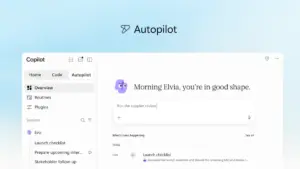
Complementing this is Microsoft Scout, the company’s first "autopilot" agent. Scout operates in the background with its own identity and set of permissions, ensuring that projects continue to move forward even when the human user is focused elsewhere. Both Cowork and Scout are grounded in what Microsoft calls "Work IQ." This contextual layer allows the AI to understand the unique nuances of an organization, including specific roles, project hierarchies, internal priorities, and institutional knowledge, ensuring that the outputs are relevant to the specific business context.
The speed at which these tools are being developed reflects the very transformation Microsoft is promoting. The core engineering team for Copilot Cowork grew from just three members at its inception to nine by the time of its general release. Despite the small headcount, the team achieved remarkable speed-to-market, moving from initial concept to a preview used by half of the Fortune 500 within six months.
Omar Shahine, Corporate Vice President of Microsoft Scout, noted that this breakthrough resulted from rebuilding the software development process itself around agents. "In the past, I spent a lot of time helping teams scale: aligning large groups, coordinating work, and making sure everything moved forward together," Shahine said. "Now it’s more about creating the conditions for expert teams to move quickly, experiment safely, and continuously capture what they learn."
The Depth and Breadth of Global Adoption
 Productivity Software & Office Suites
Microsoft Reports 30 Million Copilot Seats as Enterprise AI Shifts from Assistance to Autonomous Agents
In its most recent earnings report, Microsoft announced a significant milestone in...
 Productivity Software & Office Suites
Microsoft Reimagines Copilot as a Centralized Hub for Agentic Work and Enterprise Automation
In a significant evolution of its artificial intelligence strategy, Microsoft has unveiled...
 Productivity Software & Office Suites
Microsoft Shifts Focus to Enterprise AI Utility: A New Strategic Framework for Agents, Economics, and Partnership
In an era defined by a relentless cycle of artificial intelligence breakthroughs,...







