

In a landmark update shared during its most recent earnings call, Microsoft revealed that Microsoft 365 Copilot has surpassed 30 million paid seats. Perhaps more significant than the total number is the velocity of growth; the tech giant reported that net seat additions more than doubled quarter over quarter. While these figures represent a major commercial milestone, Microsoft leadership suggests they point toward a fundamental shift in the nature of work: a transition where artificial intelligence moves from a passive assistant to an active, autonomous participant in the global economy.
Across various sectors, the initial novelty of generative AI is being replaced by deep integration. Organizations are no longer merely experimenting with large language models; they are redesigning entire workflows around them. This evolution marks the end of the first phase of enterprise AI—which was characterized by deployments, licensing, and individual time-saving—and the beginning of a second phase defined by systemic transformation. In this new era, employees are increasingly acting as directors, overseeing agents that take on complex tasks, multi-stage projects, and long-term processes.
A Step Change in Innovation and Agentic Capabilities
The technological foundation of this shift lies in a new class of AI products: models wrapped in "agentic harnesses." Unlike standard chatbots that respond to a single prompt and then wait for the next instruction, these agents can close their own feedback loops. They are capable of planning, executing, testing, and correcting their own work to deliver a finished result with minimal human intervention.
A primary example of this technology is Copilot Cowork, which reached general availability in June. Cowork is designed to handle multi-step work end-to-end. Once a user defines a task, the system manages the process through to completion. Its multi-model design allows the system to scale its capabilities based on the complexity of the work, utilizing different models as needed. Internal testing by Microsoft suggests this sophisticated approach is not only more capable but also more efficient, proving to be 30% to 40% cheaper than single-model options for complex tasks.
Complementing this is Microsoft Scout, the company’s first "autopilot" agent. Scout operates in the background with its own identity and set of permissions, ensuring that projects continue to move forward even when the human user is focused elsewhere. Both Cowork and Scout are grounded in what Microsoft calls "Work IQ." This contextual layer allows the AI to understand the unique nuances of an organization, including specific roles, project hierarchies, internal priorities, and institutional knowledge, ensuring that the outputs are relevant to the specific business context.
The speed at which these tools are being developed reflects the very transformation Microsoft is promoting. The core engineering team for Copilot Cowork grew from just three members at its inception to nine by the time of its general release. Despite the small headcount, the team achieved remarkable speed-to-market, moving from initial concept to a preview used by half of the Fortune 500 within six months.
Omar Shahine, Corporate Vice President of Microsoft Scout, noted that this breakthrough resulted from rebuilding the software development process itself around agents. "In the past, I spent a lot of time helping teams scale: aligning large groups, coordinating work, and making sure everything moved forward together," Shahine said. "Now it’s more about creating the conditions for expert teams to move quickly, experiment safely, and continuously capture what they learn."
The Depth and Breadth of Global Adoption

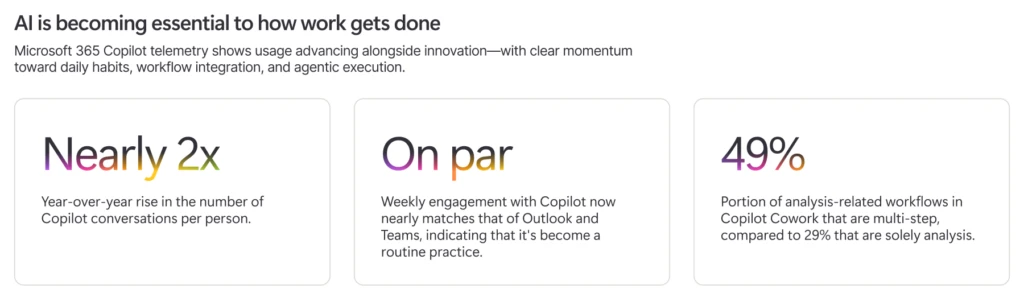
As the technology matures, the way organizations interact with Copilot is changing. Telemetry data from Microsoft 365 reveals that the number of AI-driven conversations per user has nearly doubled over the past year. Furthermore, the number of users engaging with multiple Copilot features simultaneously has seen triple-digit growth. Weekly engagement with Copilot is now on par with foundational productivity tools like Microsoft Outlook and Teams, suggesting that AI has become a permanent fixture of the daily routine.
The data also highlights a move toward complexity. Users are increasingly delegating multi-step workflows to Copilot Cowork. For instance, instead of just asking for a summary, users are asking the AI to analyze a dataset and then draft a corresponding email to stakeholders. When multi-step workflows are involved, analysis-related work accounts for 49% of all tasks, compared to just 29% when performed as a standalone request.
While early adopters were concentrated in the banking, manufacturing, and software sectors, adoption is now accelerating in traditionally more conservative industries. Automotive and healthcare are currently among the fastest-growing sectors for agent adoption.
The scale of deployment is also reaching new heights. The number of Microsoft customers with more than 50,000 seats has increased more than sevenfold year over year. Simultaneously, the number of enterprise customers deploying Copilot to the majority of their information workers grew by nearly 75% in a single quarter. Perhaps most telling is the reduction in "time to value"; the period it takes for a customer to reach 80% monthly active usage has dropped from months to just days over the last year.
Real-World Impact: Efficiency and New Capabilities
The practical applications of this technology are already yielding measurable results across diverse organizations. At Eaton, an intelligent power management company, the focus has been on manufacturing quality. The company implemented an AI-powered quality agent to assist experts in conducting root cause analysis on manufacturing issues. By reviewing approximately 5,000 reports, the agent has accelerated analysis and helped identify risks earlier, all while keeping human experts at the center of the decision-making process.
In the healthcare sector, Premera Blue Cross has empowered its employees to become creators. Using Microsoft 365 Copilot and Copilot Studio, the health plan’s staff has built more than 900 custom agents to handle manual backlogs. One specific "contract exhibit agent" reduced a document processing workflow that previously took 30 to 45 minutes down to just three minutes. This efficiency allows staff to focus more on member care rather than administrative hurdles.
At the iconic apparel brand Levi Strauss & Co., AI is being used to quantify the "impossible." A single agent analyzed 1,100 finance standard operating procedures and cataloged 18,000 individual tasks in just one day. Lisa Sterling, Vice President of Finance at Levi’s, noted that the agent provided a detailed view of the organization’s work that simply would not have surfaced through traditional manual audits.
In the world of global consulting, EY has introduced an Autonomous Sourcing Agent (ASA) to manage the procurement process. The ASA handles low-cost, low-risk transactions, negotiating with multiple suppliers simultaneously on delivery timelines and warranty terms. Since its pilot in late 2025, the agent has supported hundreds of transactions, with expectations to handle 1,500 in the coming year, allowing procurement teams to focus on high-value strategic negotiations.
The Power of Specialization at Scale
Microsoft’s findings suggest that the organizations seeing the most significant returns are those that tailor AI to specific roles rather than deploying it as a one-size-fits-all tool.
S&P Global, for example, used Microsoft Copilot Agent Builder to create a specialized agent within Microsoft Teams. This allows customers to interact directly with commodities research and market insights. The result was a 95% increase in the speed of data extraction and a 98% improvement in the speed of comparative analysis, turning vast amounts of data into actionable intelligence almost instantly.
Internally, Microsoft’s own sales team has seen success by mapping distinct "seller personas" to dedicated agents, such as "Researcher," "Analyst," and "Deal Agent." By delegating administrative and coordination tasks to these agents, the time sellers spend in customer-facing activities doubled from 25% to 50%. This specialization led to a 9.4% increase in revenue per head and 20% faster deal closures.
Similarly, the marketing data firm Kantar developed a "people agent" for HR queries. This system, which consists of about 10 interconnected agents, now handles approximately 40% of HR queries without human intervention—up from zero in February. Simple tasks, such as generating an employment verification letter, have seen their turnaround time drop from three days to just 120 seconds.
Looking Ahead: The Rise of the Frontier Firm
As organizations move deeper into this collaborative era, Microsoft is introducing "Frontier Tuning" to help scale specialized expertise. Microsoft’s own People Operations team, which manages over a million employee interactions annually, is using this method to capture the expertise of seasoned practitioners and turn it into organizational capability. By tuning agents with specific rubrics and quality standards, the team achieved a fivefold improvement in task completion compared to general-purpose models.
The trajectory of the market suggests that the metrics for success are changing. While the first wave of AI was measured by the number of licenses sold, the next wave will be measured by the depth of use, the measurable redesign of workflows, and the emergence of capabilities that were previously technically or economically unfeasible.
Microsoft characterizes the organizations leading this charge as "Frontier Firms"—places where technology, operating models, and human agency evolve in lockstep. As AI agents become more autonomous and specialized, the focus for leadership is shifting from simply adopting new tools to fundamentally rethinking what a human-agent workforce can achieve.
 Productivity Software & Office Suites
Microsoft Shifts Focus from AI Hype to Enterprise Utility as Jared Spataro Outlines New Strategic Roadmap
In a comprehensive message addressed to the global business community, Jared Spataro,...
 Productivity Software & Office Suites
Microsoft Unveils Microsoft 365 G7: A New Frontier for AI-Driven Governance in the Public Sector
In a move designed to redefine how the public sector interacts with...
 Productivity Software & Office Suites
Microsoft Unveils Microsoft 365 G7: A New Frontier for AI-Driven Productivity and Governance in the Public Sector
In a significant move to modernize the digital infrastructure of the United...







