
The Power of Specialization at Scale
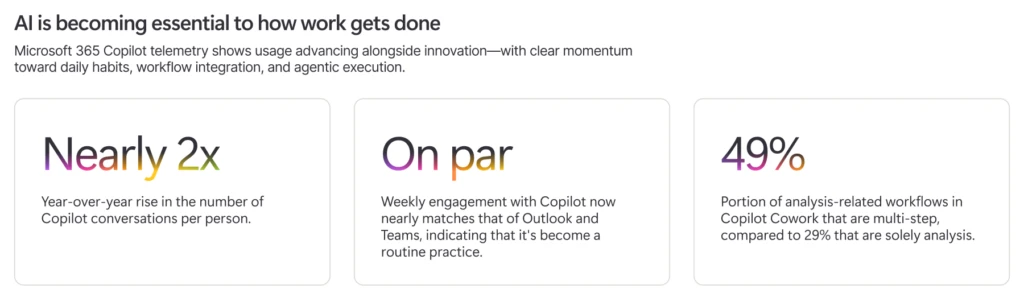
Microsoft’s findings suggest that the organizations seeing the most significant returns are those that tailor AI to specific roles rather than deploying it as a one-size-fits-all tool.
S&P Global, for example, used Microsoft Copilot Agent Builder to create a specialized agent within Microsoft Teams. This allows customers to interact directly with commodities research and market insights. The result was a 95% increase in the speed of data extraction and a 98% improvement in the speed of comparative analysis, turning vast amounts of data into actionable intelligence almost instantly.
Internally, Microsoft’s own sales team has seen success by mapping distinct "seller personas" to dedicated agents, such as "Researcher," "Analyst," and "Deal Agent." By delegating administrative and coordination tasks to these agents, the time sellers spend in customer-facing activities doubled from 25% to 50%. This specialization led to a 9.4% increase in revenue per head and 20% faster deal closures.
Similarly, the marketing data firm Kantar developed a "people agent" for HR queries. This system, which consists of about 10 interconnected agents, now handles approximately 40% of HR queries without human intervention—up from zero in February. Simple tasks, such as generating an employment verification letter, have seen their turnaround time drop from three days to just 120 seconds.
Looking Ahead: The Rise of the Frontier Firm
As organizations move deeper into this collaborative era, Microsoft is introducing "Frontier Tuning" to help scale specialized expertise. Microsoft’s own People Operations team, which manages over a million employee interactions annually, is using this method to capture the expertise of seasoned practitioners and turn it into organizational capability. By tuning agents with specific rubrics and quality standards, the team achieved a fivefold improvement in task completion compared to general-purpose models.
The trajectory of the market suggests that the metrics for success are changing. While the first wave of AI was measured by the number of licenses sold, the next wave will be measured by the depth of use, the measurable redesign of workflows, and the emergence of capabilities that were previously technically or economically unfeasible.
Microsoft characterizes the organizations leading this charge as "Frontier Firms"—places where technology, operating models, and human agency evolve in lockstep. As AI agents become more autonomous and specialized, the focus for leadership is shifting from simply adopting new tools to fundamentally rethinking what a human-agent workforce can achieve.
 Productivity Software & Office Suites
Microsoft to Headline ESPC 2026 in Amsterdam: A Deep Dive into the Future of AI-Powered Work and Agentic Ecosystems
The landscape of enterprise technology is currently undergoing one of its most...
 Productivity Software & Office Suites
Microsoft Set to Headline ESPC 2026 in Amsterdam: A Deep Dive into the Future of AI-Powered Work
The European tech landscape is bracing for a significant milestone in the...
 Productivity Software & Office Suites
Microsoft Announces Global Launch of Copilot Cowork, Introducing Agentic AI to the Modern Enterprise
In a move that signals a significant shift in the landscape of...