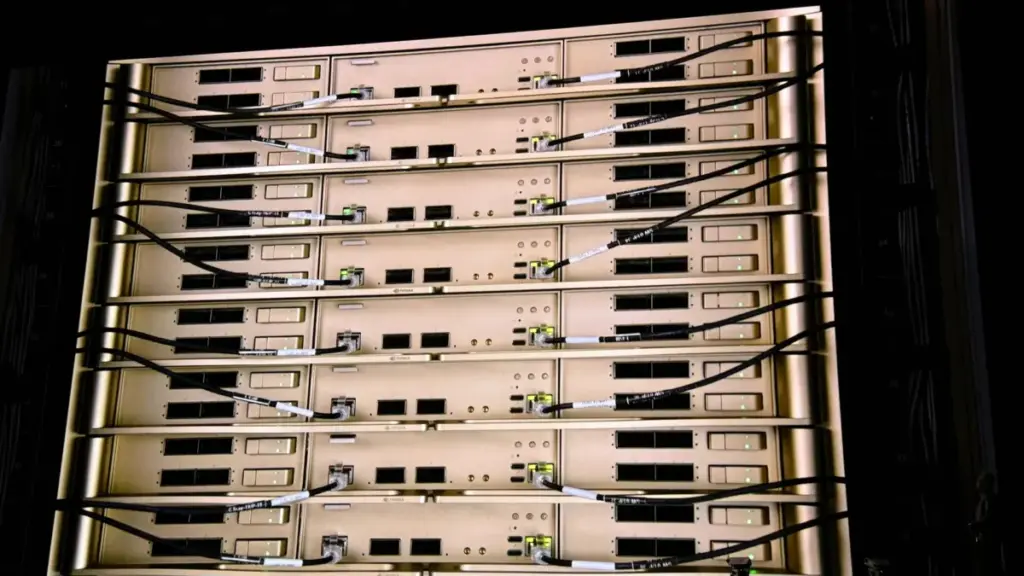
The "Kessel" system is built upon the foundation of Nvidia’s upcoming Rubin architecture, the successor to the highly anticipated Blackwell platform. While standard Vera Rubin NVL72 configurations are designed to maximize throughput and efficiency for ground-based AI training and inference, the SpaceX and xAI variant seeks to redefine the physical structure of the rack itself. The core specifications of the system remain formidable, retaining the high-density compute power that defines Nvidia’s flagship offerings. The Kessel architecture is set to feature 36 Vera CPUs and 72 Rubin GPUs, supported by nine NVLink switch trays. However, the move to an 84-layer PCB as a primary interconnect represents a significant leap in manufacturing complexity. In the world of high-end electronics, most sophisticated motherboards or server backplanes rarely exceed 20 to 30 layers. An 84-layer board suggests a level of signal density and integration that pushes the current limits of materials science and fabrication technology.
The decision to move toward a solid-state interconnect via a massive PCB is likely influenced by the harsh realities of spaceflight and orbital operations. SpaceX has long been a proponent of vertical integration and custom hardware design, as evidenced by the specialized radiation-hardened electronics used in its Falcon rockets and Dragon spacecraft, as well as the proprietary phased-array antennas in Starlink satellites. For an orbital data center, the mechanical stresses of a rocket launch—characterized by intense vibration and high G-forces—pose a significant risk to traditional cabling. Standard NVLink cable assemblies, while efficient for ground use, involve numerous connectors and physical points of failure that could become unseated or damaged during ascent. By moving to a solid-state, PCB-based architecture, SpaceX can create a more rigid, structurally sound unit that is better equipped to survive the journey to orbit and operate reliably in a vacuum.
Beyond the mechanical advantages, the 84-layer PCB architecture likely addresses the critical issue of signal integrity at extreme scales. As AI models continue to grow, the bandwidth requirements between GPUs have skyrocketed. Nvidia’s NVLink is designed to facilitate this high-speed communication, but as data rates increase, the physical distance and the quality of the medium through which signals travel become paramount. A custom-designed PCB allows for tighter control over trace lengths, impedance, and electromagnetic interference, potentially offering a more stable environment for the massive data transfers required by the Rubin GPUs. This level of optimization is essential for xAI, which has been rapidly scaling its compute capabilities to train its Grok large language models. By collaborating with SpaceX on the Kessel project, xAI gains access to a hardware platform that is not only robust enough for space but also potentially more efficient in terms of power delivery and thermal dissipation.
The mention of orbital data centers highlights a growing interest in moving compute resources closer to where data is generated in space. Currently, Earth-observation satellites and telecommunications constellations like Starlink generate vast amounts of data that must be transmitted back to Earth for processing. This creates a bottleneck due to limited downlink bandwidth and high latency. By deploying AI-capable hardware like the Kessel system directly into orbit, SpaceX could enable edge computing on a planetary scale. Satellites could process high-resolution imagery, perform complex signal analysis, or manage network traffic autonomously, sending only the most relevant results back to the ground. This would drastically reduce the time required for data-driven decision-making and optimize the use of existing satellite-to-ground communication links.
 Hardware Reviews & PC Building
GlobalFoundries Unveils FDX Fusion: Aiming for 7nm Performance with Planar Transistors and No EUV by 2030
In a strategic move that reinforces its departure from the traditional "leading-edge"...
 Hardware Reviews & PC Building
Nvidia’s Strategic "Design Intuition": Ian Finder Addresses Skepticism Over Vera CPU’s Agentic AI Roots
The landscape of high-performance computing and artificial intelligence is currently defined by...
 Hardware Reviews & PC Building
Nvidia Unveils Rubin HPC Architecture at Supercomputing 2026 to Power Next-Generation Scientific Simulation and Agentic Workflows
The Supercomputing 2026 conference has officially opened its doors, serving as the...