
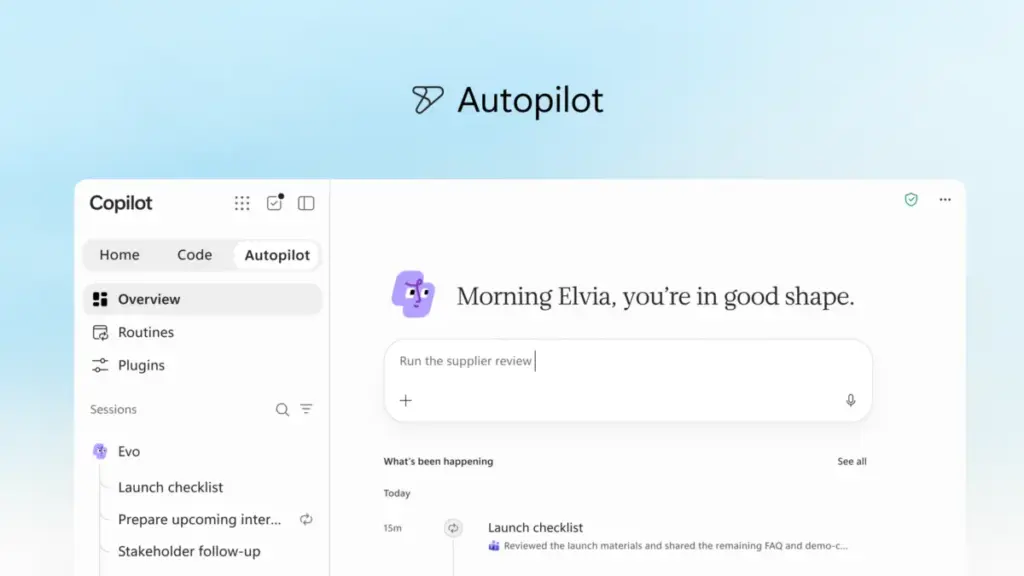
REDMOND, Wash. — Microsoft has announced a comprehensive reimagining of its Copilot platform, signaling a strategic shift toward more proactive, agentic, and deeply integrated artificial intelligence. The updates, which introduce a redesigned Copilot app featuring three distinct modes—Home, Code, and Autopilot—aim to transform how individuals and organizations manage the "flow of human ambition" by connecting familiar productivity tools with next-generation AI capabilities.
The overhaul reflects a broader industry trend toward "agentic AI," where software no longer simply responds to prompts but anticipates needs and completes complex, multi-stage tasks autonomously. By embedding the full power of Microsoft Office directly into the Copilot experience and introducing tools for non-developers to build custom software solutions, Microsoft is attempting to position Copilot as the central nervous system of the modern workplace.
A New Experience for Every Mode of Work
At the center of this transformation is a redesigned entry point for users. The new Copilot app is structured around three primary capabilities, each designed to address a different aspect of the professional workday. The first of these, "Home," serves as the primary starting point where the traditional conversational AI experience, known as Chat, converges with "Cowork," a mode designed for delegated, end-to-end task execution.
As professionals navigate a landscape of constant context-switching—moving between emails, meetings, and documents—Microsoft intends for Home to act as a grounding mechanism. From this interface, users can review recent activities, receive suggestions for upcoming tasks, and resume projects exactly where they left off. While Chat remains the destination for instant queries and quick drafts, Cowork is designed for more complex assignments. In Cowork, a user defines a task—such as responding to a Request for Proposal (RFP), creating a product launch kit, or preparing a financial close package—and the AI iterates on the project until it reaches a completed result.
Significantly, Microsoft is integrating the full suite of its flagship productivity software—Word, Excel, and PowerPoint—directly into this new interface. Dubbed "Office in Copilot," this feature allows users to generate and edit documents without the friction of app-switching. This integration is designed to prevent issues like broken formatting or version control errors that often occur when moving content between a standalone AI chat and a traditional document editor.
From the Home screen, a user can request that Copilot draft a brief or model a budget. The system then creates a live, editable document or spreadsheet that is immediately accessible to the user’s entire team. This collaborative aspect is further enhanced by the ability to @mention colleagues within the Copilot interface, ensuring that edits and updates remain synchronized across both the Copilot app and the traditional Office applications.

The specific capabilities within the Office suite have also seen refinements. PowerPoint can now automatically ensure that decks remain on-brand while allowing for fine-tuned slide adjustments. Excel has been updated to provide clearer transparency; when Copilot or a collaborator makes changes to a workbook, the system explains what was changed and why, while also recommending data visualizations. Furthermore, "Skills" are being introduced to bring specialized domain expertise—such as legal or financial workflows—directly into these applications.
Democratizing Solution-Building through Code
Perhaps the most significant departure from traditional productivity software is the introduction of the "Code" mode. Microsoft executives noted that, historically, the fundamental unit of knowledge work has been the file—the document, the deck, or the spreadsheet. With the new Copilot, the company is introducing a fourth unit: the small, purpose-built solution.
 Productivity Software & Office Suites
Microsoft Reimagines Copilot as a Centralized Engine for the Future of AI-Driven Work
In a major strategic shift aimed at redefining the intersection of human...
 Productivity Software & Office Suites
Microsoft and European Tech Leaders Set Sights on Amsterdam for ESPC 2026: A Deep Dive into the Future of AI-Powered Work
As the global landscape of enterprise technology continues its rapid shift toward...
 Productivity Software & Office Suites
Microsoft Unveils the "New Copilot": A Strategic Shift Toward Proactive AI Agents and Integrated Productivity
In a significant move to redefine the landscape of digital labor, Microsoft...







