
Managing AI Spend and Optimization
As organizations scale their use of AI, managing the associated costs has become a primary concern for leadership. Microsoft is addressing this through a dual-pronged pricing strategy and the introduction of "FinOps for AI" capabilities.
For "everyday" AI tasks like drafting summaries or answering quick questions, Microsoft offers a User Subscription License (USL), which provides a fixed-cost model for Copilot across the standard Office apps. Within this model, a feature called "Auto" dynamically routes requests to the most appropriate AI model based on the required accuracy, speed, and cost.
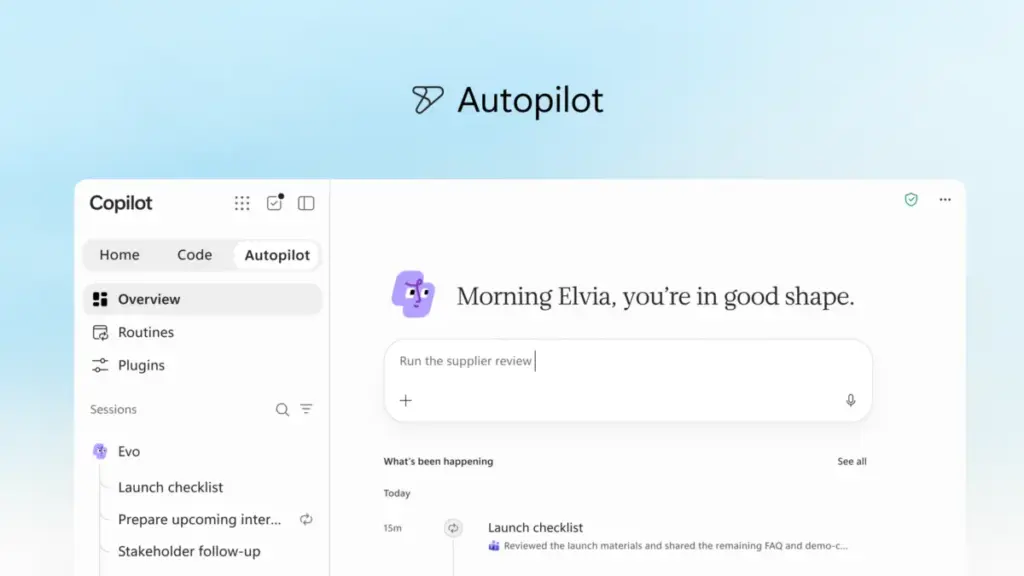
For more intensive, "agentic" work—such as the long-running tasks performed by Cowork, Code, and Autopilot—Microsoft is utilizing Usage-Based Billing (UBB). This approach allows organizations to match their costs directly to the value generated by advanced frontier models.
To help organizations navigate these costs, new FinOps tools are being integrated into Agent 365 and Microsoft Copilot. These tools allow administrators to set spending policies, route credit requests through automated approval workflows, and restrict certain high-cost models to specific groups of users. Business leaders can also analyze which AI tasks are generating the highest return on investment, while individual users can track their own credit usage and history directly within the Copilot app.

A Sneak Peek at Future Innovations
While many of these features are beginning to roll out now, Microsoft also provided a glimpse into the near future of the platform. Coming soon to the Home screen is "Today," a personalized command center that aggregates information from email, calendars, Teams threads, and tasks. Rather than just listing what needs to be done, "Today" is designed to proactively prepare work, such as drafting responses to forgotten follow-ups or proposing schedule changes before the user even asks.
Additionally, the company announced "@Copilot in Teams," a feature that allows the AI to participate in group chats or meetings with the full context of the channel’s history. If a team is discussing a product decision, Copilot can pull background information from previous conversations to explain the reasoning behind the choice. It can also identify dependencies across different departments—such as how a delay in manufacturing might affect launch timing—and prepare cross-functional reviews to keep the project aligned.
The new Copilot capabilities are currently rolling out through Microsoft’s Frontier program, with Home and Code expected to see broader availability in the coming weeks. Autopilot is set to enter private preview at the end of the month, followed by the "Today" command center in October.
Microsoft is expected to share further details on these innovations and how they empower organizations to reimagine work during its upcoming Ignite conference, scheduled for mid-November. For now, the company’s message is clear: the era of the passive AI assistant is ending, replaced by a system of proactive agents and integrated tools designed to keep pace with human ambition.
 Productivity Software & Office Suites
Microsoft Reimagines Copilot as a Proactive AI Ecosystem for the Enterprise
Microsoft has announced a comprehensive overhaul of its Copilot platform, signaling a...
 Productivity Software & Office Suites
Microsoft Shifts Focus from AI Hype to Enterprise Utility as Jared Spataro Outlines New Strategic Roadmap
In a comprehensive message addressed to the global business community, Jared Spataro,...
 Productivity Software & Office Suites
Microsoft Reimagines Copilot as a Centralized Hub for Autonomous Work and Agentic Productivity
In a significant move to redefine the landscape of digital productivity, Microsoft...







