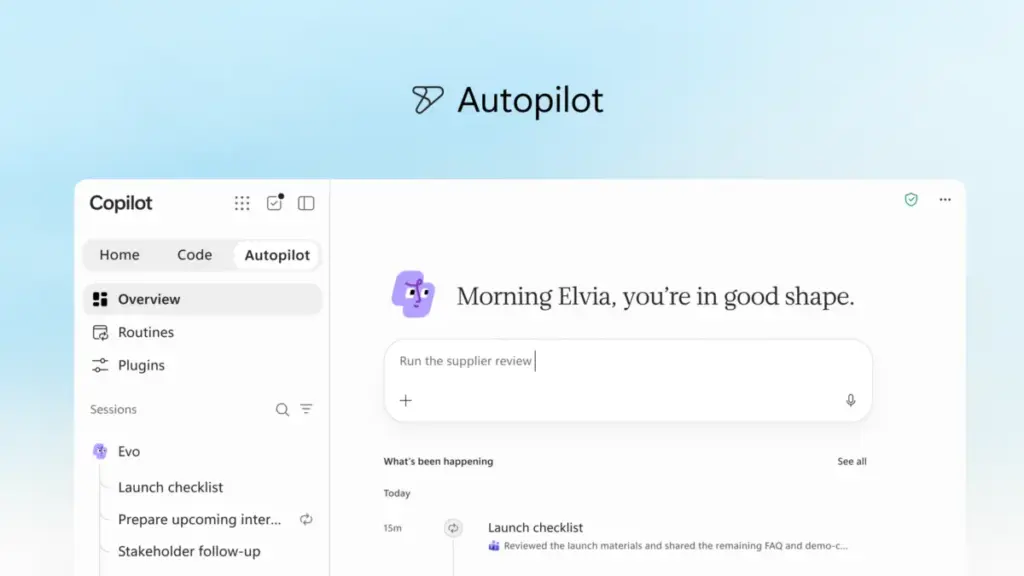
REDMOND, Wash. — Microsoft has announced a comprehensive reimagining of its Copilot platform, signaling a strategic shift toward more proactive, agentic, and deeply integrated artificial intelligence. The updates, which introduce a redesigned Copilot app featuring three distinct modes—Home, Code, and Autopilot—aim to transform how individuals and organizations manage the "flow of human ambition" by connecting familiar productivity tools with next-generation AI capabilities.
The overhaul reflects a broader industry trend toward "agentic AI," where software no longer simply responds to prompts but anticipates needs and completes complex, multi-stage tasks autonomously. By embedding the full power of Microsoft Office directly into the Copilot experience and introducing tools for non-developers to build custom software solutions, Microsoft is attempting to position Copilot as the central nervous system of the modern workplace.
A New Experience for Every Mode of Work
At the center of this transformation is a redesigned entry point for users. The new Copilot app is structured around three primary capabilities, each designed to address a different aspect of the professional workday. The first of these, "Home," serves as the primary starting point where the traditional conversational AI experience, known as Chat, converges with "Cowork," a mode designed for delegated, end-to-end task execution.
As professionals navigate a landscape of constant context-switching—moving between emails, meetings, and documents—Microsoft intends for Home to act as a grounding mechanism. From this interface, users can review recent activities, receive suggestions for upcoming tasks, and resume projects exactly where they left off. While Chat remains the destination for instant queries and quick drafts, Cowork is designed for more complex assignments. In Cowork, a user defines a task—such as responding to a Request for Proposal (RFP), creating a product launch kit, or preparing a financial close package—and the AI iterates on the project until it reaches a completed result.
Significantly, Microsoft is integrating the full suite of its flagship productivity software—Word, Excel, and PowerPoint—directly into this new interface. Dubbed "Office in Copilot," this feature allows users to generate and edit documents without the friction of app-switching. This integration is designed to prevent issues like broken formatting or version control errors that often occur when moving content between a standalone AI chat and a traditional document editor.
From the Home screen, a user can request that Copilot draft a brief or model a budget. The system then creates a live, editable document or spreadsheet that is immediately accessible to the user’s entire team. This collaborative aspect is further enhanced by the ability to @mention colleagues within the Copilot interface, ensuring that edits and updates remain synchronized across both the Copilot app and the traditional Office applications.

The specific capabilities within the Office suite have also seen refinements. PowerPoint can now automatically ensure that decks remain on-brand while allowing for fine-tuned slide adjustments. Excel has been updated to provide clearer transparency; when Copilot or a collaborator makes changes to a workbook, the system explains what was changed and why, while also recommending data visualizations. Furthermore, "Skills" are being introduced to bring specialized domain expertise—such as legal or financial workflows—directly into these applications.
Democratizing Solution-Building through Code
Perhaps the most significant departure from traditional productivity software is the introduction of the "Code" mode. Microsoft executives noted that, historically, the fundamental unit of knowledge work has been the file—the document, the deck, or the spreadsheet. With the new Copilot, the company is introducing a fourth unit: the small, purpose-built solution.
The Code capability is designed to move software development out of the exclusive realm of professional developers. Powered by the same underlying technology as GitHub Copilot, this feature allows any user to describe an app, a data tracker, or an automation workflow in natural language. Copilot then selects the appropriate technical approach and builds the solution, which can range from a persistent desktop widget to a cloud-hosted internal app shared with a team.
To ensure these user-generated solutions meet enterprise security standards, Microsoft is launching the Copilot Managed Runtime. This hosting infrastructure allows code to run safely within a company’s existing Microsoft 365 environment. While the environment is governed by IT departments, it remains accessible for everyday users to connect their custom apps to live data. This same foundation supports apps built in Cowork and Copilot Studio, and Microsoft plans to open the runtime to third-party and professional developers in the future.
The Rise of the Digital Teammate: Autopilot
The third pillar of the new experience is "Autopilot," a persistent and proactive agent previously referred to by the internal codename "Scout." Unlike traditional AI assistants that wait for a user to initiate a conversation, Autopilot is designed to function as a digital teammate that works in the background.
Users can assign Autopilot a specific name, role, and goal. Once activated, the agent can monitor communication channels, follow up on email threads, and manage recurring workflows without constant supervision. For example, Autopilot can manage a full supplier review process, which includes building a schedule, handling preparatory work, attending to follow-ups, and reaching out to stakeholders for updates.
Because Autopilot is cloud-hosted, it continues to operate even when the user is offline. It exists within the organization’s tenant with its own identity, memory, and workspace. Built on the "Microsoft IQ" intelligence platform, the agent understands the specific nuances of an organization’s operations. It appears where employees already collaborate—such as in Teams and Outlook—allowing team members to interact with it as they would a human colleague, albeit with built-in audit trails and governance controls.

Expanding Business Context and Connectivity
The effectiveness of these AI agents relies heavily on their ability to understand the specific context of a business. To address this, Microsoft is expanding the data "grounding" available to Copilot through Fabric IQ. This unified intelligence platform connects Copilot to the 20 million semantic models currently in Power BI, providing a real-time view of business operations.
This grounding is also extending into Dynamics 365 and the Power Platform. In practical terms, this means a salesperson working on a proposal can have Copilot automatically incorporate deal histories or customer support tickets directly into a document without having to manually search through different databases.
To further extend these capabilities, Microsoft is introducing a new unified plugin registry. This catalog brings together Microsoft-developed, partner-built, and custom plugins into a single location. This allows IT administrators to centrally approve and manage the tools that extend Copilot’s functionality, while developers can publish a plugin once and see it integrated across the entire Microsoft ecosystem.
Managing AI Spend and Optimization
As organizations scale their use of AI, managing the associated costs has become a primary concern for leadership. Microsoft is addressing this through a dual-pronged pricing strategy and the introduction of "FinOps for AI" capabilities.
For "everyday" AI tasks like drafting summaries or answering quick questions, Microsoft offers a User Subscription License (USL), which provides a fixed-cost model for Copilot across the standard Office apps. Within this model, a feature called "Auto" dynamically routes requests to the most appropriate AI model based on the required accuracy, speed, and cost.
For more intensive, "agentic" work—such as the long-running tasks performed by Cowork, Code, and Autopilot—Microsoft is utilizing Usage-Based Billing (UBB). This approach allows organizations to match their costs directly to the value generated by advanced frontier models.
To help organizations navigate these costs, new FinOps tools are being integrated into Agent 365 and Microsoft Copilot. These tools allow administrators to set spending policies, route credit requests through automated approval workflows, and restrict certain high-cost models to specific groups of users. Business leaders can also analyze which AI tasks are generating the highest return on investment, while individual users can track their own credit usage and history directly within the Copilot app.

A Sneak Peek at Future Innovations
While many of these features are beginning to roll out now, Microsoft also provided a glimpse into the near future of the platform. Coming soon to the Home screen is "Today," a personalized command center that aggregates information from email, calendars, Teams threads, and tasks. Rather than just listing what needs to be done, "Today" is designed to proactively prepare work, such as drafting responses to forgotten follow-ups or proposing schedule changes before the user even asks.
Additionally, the company announced "@Copilot in Teams," a feature that allows the AI to participate in group chats or meetings with the full context of the channel’s history. If a team is discussing a product decision, Copilot can pull background information from previous conversations to explain the reasoning behind the choice. It can also identify dependencies across different departments—such as how a delay in manufacturing might affect launch timing—and prepare cross-functional reviews to keep the project aligned.
The new Copilot capabilities are currently rolling out through Microsoft’s Frontier program, with Home and Code expected to see broader availability in the coming weeks. Autopilot is set to enter private preview at the end of the month, followed by the "Today" command center in October.
Microsoft is expected to share further details on these innovations and how they empower organizations to reimagine work during its upcoming Ignite conference, scheduled for mid-November. For now, the company’s message is clear: the era of the passive AI assistant is ending, replaced by a system of proactive agents and integrated tools designed to keep pace with human ambition.
 Productivity Software & Office Suites
Microsoft 365 Copilot Surpasses 30 Million Paid Seats as Enterprise AI Shifts from Assistance to Autonomous Agency
In a landmark update during its most recent earnings call, Microsoft announced...
 Productivity Software & Office Suites
Microsoft and ESPC Announce 2026 Microsoft 365 and AI Conference in Amsterdam
The European tech landscape is preparing for a significant milestone in the...
 Productivity Software & Office Suites
Microsoft Confirmed as Headline Sponsor for ESPC 2026 in Amsterdam as AI Transformation Takes Center Stage
The European Microsoft community is preparing for one of its most significant...