The Code capability is designed to move software development out of the exclusive realm of professional developers. Powered by the same underlying technology as GitHub Copilot, this feature allows any user to describe an app, a data tracker, or an automation workflow in natural language. Copilot then selects the appropriate technical approach and builds the solution, which can range from a persistent desktop widget to a cloud-hosted internal app shared with a team.
To ensure these user-generated solutions meet enterprise security standards, Microsoft is launching the Copilot Managed Runtime. This hosting infrastructure allows code to run safely within a company’s existing Microsoft 365 environment. While the environment is governed by IT departments, it remains accessible for everyday users to connect their custom apps to live data. This same foundation supports apps built in Cowork and Copilot Studio, and Microsoft plans to open the runtime to third-party and professional developers in the future.
The Rise of the Digital Teammate: Autopilot
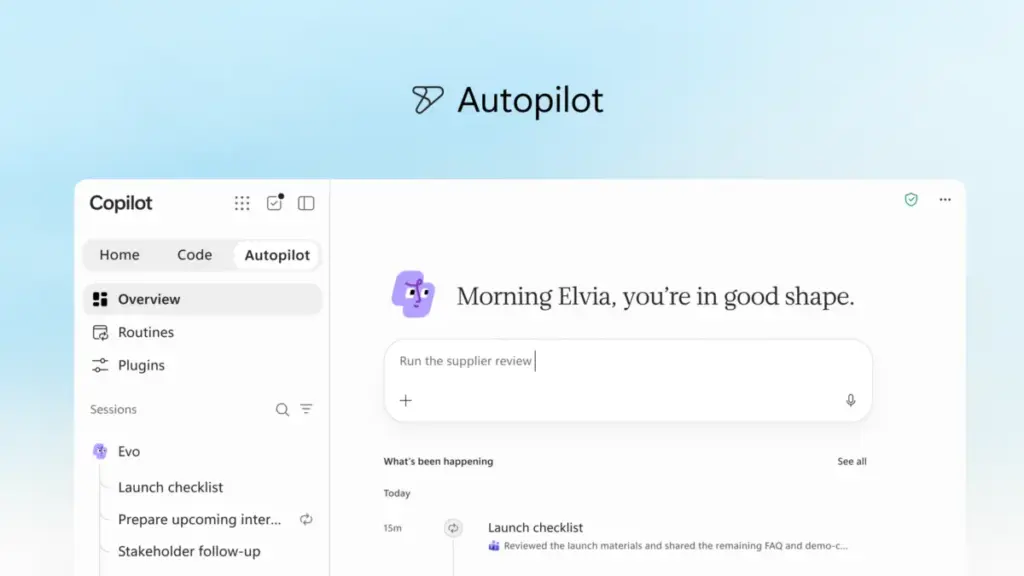
The third pillar of the new experience is "Autopilot," a persistent and proactive agent previously referred to by the internal codename "Scout." Unlike traditional AI assistants that wait for a user to initiate a conversation, Autopilot is designed to function as a digital teammate that works in the background.
Users can assign Autopilot a specific name, role, and goal. Once activated, the agent can monitor communication channels, follow up on email threads, and manage recurring workflows without constant supervision. For example, Autopilot can manage a full supplier review process, which includes building a schedule, handling preparatory work, attending to follow-ups, and reaching out to stakeholders for updates.
Because Autopilot is cloud-hosted, it continues to operate even when the user is offline. It exists within the organization’s tenant with its own identity, memory, and workspace. Built on the "Microsoft IQ" intelligence platform, the agent understands the specific nuances of an organization’s operations. It appears where employees already collaborate—such as in Teams and Outlook—allowing team members to interact with it as they would a human colleague, albeit with built-in audit trails and governance controls.

Expanding Business Context and Connectivity
The effectiveness of these AI agents relies heavily on their ability to understand the specific context of a business. To address this, Microsoft is expanding the data "grounding" available to Copilot through Fabric IQ. This unified intelligence platform connects Copilot to the 20 million semantic models currently in Power BI, providing a real-time view of business operations.
This grounding is also extending into Dynamics 365 and the Power Platform. In practical terms, this means a salesperson working on a proposal can have Copilot automatically incorporate deal histories or customer support tickets directly into a document without having to manually search through different databases.
To further extend these capabilities, Microsoft is introducing a new unified plugin registry. This catalog brings together Microsoft-developed, partner-built, and custom plugins into a single location. This allows IT administrators to centrally approve and manage the tools that extend Copilot’s functionality, while developers can publish a plugin once and see it integrated across the entire Microsoft ecosystem.
 Productivity Software & Office Suites
Microsoft Unveils Major Copilot Redesign, Integrating Proactive Agents and Low-Code Solution Building into the Flow of Work
In a significant move to redefine the landscape of artificial intelligence in...
 Productivity Software & Office Suites
Microsoft Democratizes Software Development with Natural Language App Building in Copilot Studio
The landscape of software development is undergoing a fundamental transformation as artificial...
 Productivity Software & Office Suites
Microsoft Reimagines Copilot as a Central Hub for AI-Driven Enterprise Productivity
In a significant move to redefine the landscape of modern work, Microsoft...