
As artificial intelligence shifts from simple chat interfaces to "super-agents" capable of managing complex, multi-day workflows, a fundamental technical bottleneck has emerged: the limits of the context window. In a recent design essay titled “Exploring Super-agent Design,” researchers associated with DeepSeek Harness introduced a conceptual framework known as "Chain of Recall." This architectural pattern proposes a way to grant long-running AI agents a persistent, reliable memory without saturating their limited context capacity, using a system of stable identifiers and a graph-based retrieval strategy.
The proposal, published on November 1, 2026, arrives at a time when the industry is grappling with the "forgetfulness" of autonomous agents. While large language models (LLMs) have seen their context windows expand significantly, they remain a finite resource. An agent tasked with monitoring GitHub repositories, managing continuous integration (CI) pipelines, and participating in team chats can generate hundreds of events daily. For an agent that never stops running, the work performed yesterday quickly pushes today’s relevant data out of the active context, leading to errors, hallucinations, or a complete loss of task continuity.
The Context Window as a Cache
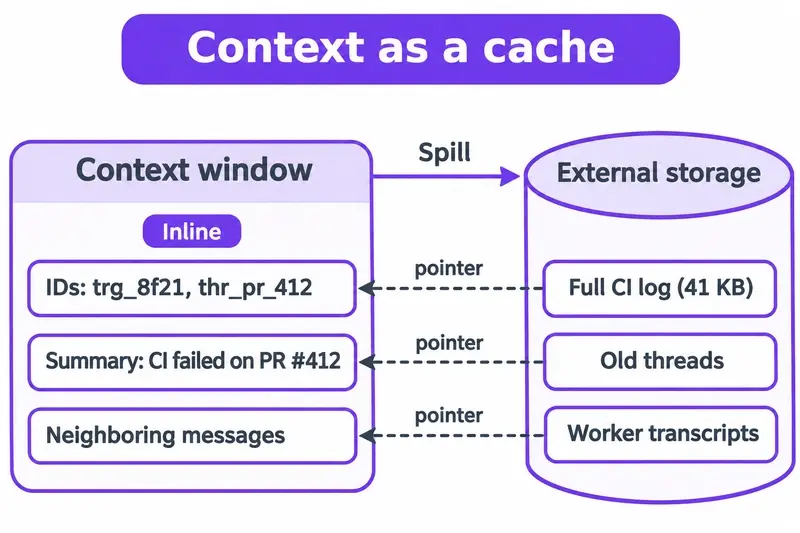
The core philosophy behind Chain of Recall is to treat an AI agent’s context window not as a permanent storage area, but as a high-speed cache. In traditional computing, a cache holds the most frequently or recently used data, while the bulk of information stays in slower, larger storage. Chain of Recall applies this logic to AI by utilizing two distinct actions: "inline" and "spill."
In this model, "inline" information consists of essential data points that remain directly within the prompt, such as unique IDs, brief summaries of recent events, and the most immediate messages in a conversation. Everything else—full logs, historical transcripts, and massive data payloads—is "spilled" to external storage. When data is spilled, it is not deleted; rather, it is replaced in the context window by a stable pointer or identifier.
This approach ensures that the agent’s prompt remains lean. For instance, if a CI failure occurs, the agent does not need to keep a 40-kilobyte log file in its active memory. Instead, it retains a single-line summary and a stable ID. If the agent later determines that the specific details of that failure are necessary to solve a problem, it can use the ID to "recall" the full log from the external database. This method prevents the agent from paying the "token tax" on large files until they are absolutely required for the task at hand.
The Architecture of Stable Identifiers
The reliability of Chain of Recall hinges on the permanence of its identifiers. In the architecture described by DeepSeek Harness, three primary types of objects form the backbone of the agent’s memory: Triggers, Threads, and Workers.
Triggers represent incoming events, such as a new chat message, a webhook notification, or a CI callback. Each trigger is assigned a unique, immutable ID. These triggers are organized into Threads, which represent a sequence of related events, such as a specific pull request discussion or a single email chain. Finally, Workers are isolated agent sessions responsible for executing specific tasks.

These objects do not exist in isolation; they form a reference graph. A Trigger belongs to a Thread, a Thread is managed by one or more Workers, and a Worker’s final report cites the specific Triggers it acted upon. By maintaining these links, the agent creates a navigable map of its own history. Because the IDs never change, the agent can traverse this graph to find information across different sessions and timeframes, effectively creating a "chain" of memories that can be pulled into focus as needed.
 Software Development & Scripting for IT
Microsoft Unveils C# 15: A Deep Dive into Union Types, Enhanced Memory Safety, and Language Refinements
As the annual release cycle for the .NET ecosystem approaches, Microsoft has...
 Software Development & Scripting for IT
Re-evaluating the Enterprise Test Automation Stack: Why Past Decisions Require New Scrutiny in the Age of AI
In the fast-moving world of enterprise software, a test automation tool that...
 Software Development & Scripting for IT
The Evolution of Polymorphic Serialization: Why System.Text.Json Offers a Safer Path for Obfuscated .NET Applications
In the landscape of .NET development, maintaining the integrity of serialized data...







