
The internet is often perceived as a permanent archive, a vast repository of information where nothing truly disappears. However, for those who monitor the secondary market for domain names, the reality is far more fluid and, at times, unsettling. When a website ceases to function—whether due to a business closure, a non-profit’s dissolution, or a personal project’s end—the domain name itself enters a high-stakes afterlife. In this space, the value of a URL is rarely determined by its name alone, but rather by the "ghost" of its former authority: the SEO metrics, the backlink profile, and the residual organic traffic it still commands from search engines like Google.
Industry expert Sean Markey recently returned from a brief hiatus to document the most intriguing domain sales from September, primarily sourced from major auction platforms NameJet and SnapNames. His findings offer a rare glimpse into the "rabbit holes" of the domain industry, revealing how expired URLs are being repurposed for everything from "Potemkin village" content sites to sophisticated international betting schemes and elaborate "EEAT" (Experience, Expertise, Authoritativeness, and Trustworthiness) theater.
The Rise and Fall of Eramuslim.com: A Lesson in Mismanaged Potential
One of the most notable sales in the September cohort was Eramuslim.com, which fetched $3,215 at SnapNames. To the uninitiated, this might seem like a high price for a non-English site, but for an SEO professional, the value was clear. At the start of 2026, the site was attracting between 34,000 and 39,000 organic visits per month. Even as the domain went through the expiration process and "dropped," it maintained an estimated 7,000 monthly visits.
The buyer’s strategy was immediate and aggressive: they reconstructed a version of the original site to capture that residual traffic. This is a common, though ethically debated, tactic in the domain world. By making a new site look like the old one, owners hope to keep search engine crawlers and users from realizing the ownership has changed.
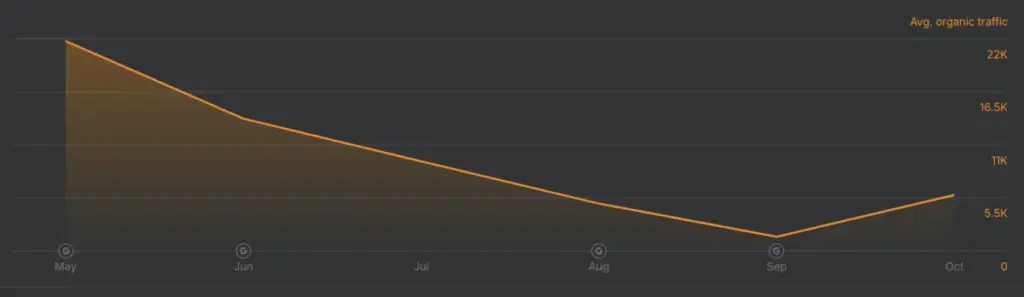
However, the case of Eramuslim.com serves as a cautionary tale. While the site’s traffic initially bounced back to over 5,000 visits, it soon began to plummet. Upon closer inspection, the reason became clear: the site was a "Potemkin village." While the homepage and navigation appeared functional, clicking on any specific article revealed a total lack of content. The buyer had spent over $3,000 on the domain but failed to invest the few hundred dollars necessary for a full site rebuild. As a result, the valuable organic traffic that made the domain worth its price is now evaporating. This highlights a critical reality in the secondary market: a domain’s past authority can only carry it so far if the new content—or lack thereof—fails to meet the basic requirements of a functional website.
From Public Service to Shadow Betting: The Curious Case of HRRJ.org
Perhaps the most jarring example of a domain’s "afterlife" is HRRJ.org. Formerly the official website for the Hampton Roads Regional Jail in Portsmouth, Virginia, the domain became available after the jail’s board voted to close the facility in 2023. Despite the physical jail no longer operating, its digital presence remained incredibly strong. The domain continues to rank as the number one result for "hampton roads regional jail inmate search" and holds a top-three position for the jail’s name itself.
 Web Hosting & Domain Management
Domain Registrants Face Looming Deadline as Verisign Prepares to Increase .Com Pricing on November 1
The global market for .com domain names is approaching a significant financial...
 Web Hosting & Domain Management
Danish Green Energy Firm Found Guilty of Reverse Domain Name Hijacking After Failed Attempts to Purchase windspace.com
A Danish green energy developer, WindSpace A/S, has been issued a rare...
 Web Hosting & Domain Management
Meta Platforms Faces Regulatory Hurdle in Quest for .meta Domain Due to Colombian Geographic Conflict
Meta Platforms, the parent company of Facebook, Instagram, and WhatsApp, is navigating...







