
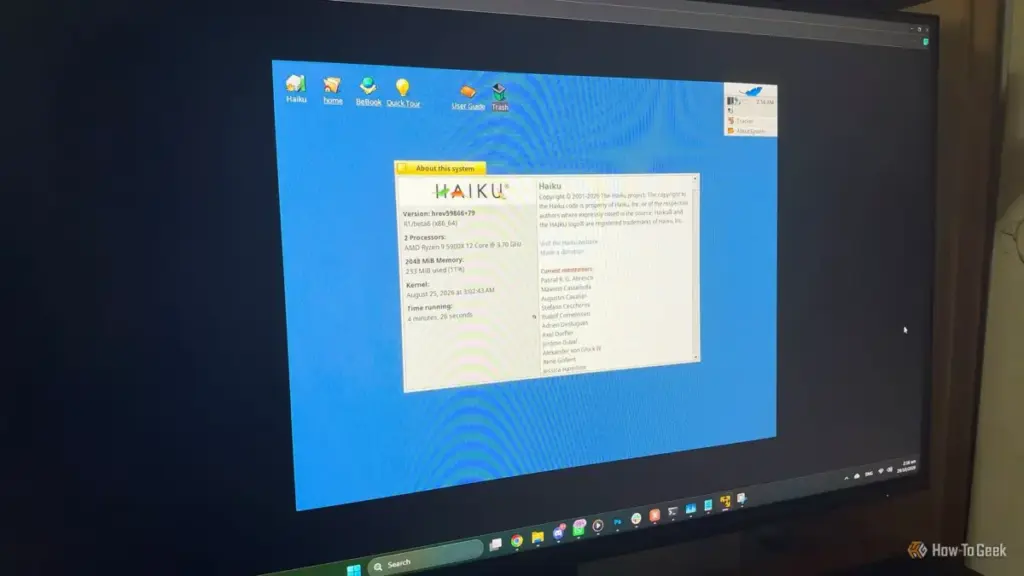
For years, the standard recommendation for any computer deemed too slow for Windows or macOS was to install a lightweight Linux distribution. This path provided a reliable escape from the planned obsolescence of mainstream operating systems, allowing hardware from a decade ago to remain functional for basic tasks. However, that window of opportunity is slowly closing. As modern Linux distributions grow in complexity and many abandon support for older 32-bit architectures, the "Linux-as-a-savior" narrative is facing its first real challenge.
Into this gap steps Haiku, an independent, open-source operating system that takes a fundamentally different approach to computing. With the recent release of its R1/beta6 version, Haiku is making a surprisingly strong case for itself, not merely as a curiosity for retro-computing enthusiasts, but as a viable way to revive ancient machines that even the leanest Linux distros might struggle to support.
What Is Haiku OS, Exactly?
To understand Haiku, one must first understand its predecessor, BeOS. Developed by Be Inc. in the 1990s, BeOS was designed from the ground up as a modern, media-centric alternative to the aging architectures of the Mac OS and Windows 95. At a time when multi-threading and preemptive multitasking were still novel concepts for consumer desktops, BeOS delivered a level of responsiveness and speed that felt years ahead of its time. Despite its technical superiority and a loyal cult following, Be Inc. failed to find a sustainable market position. The company’s assets were eventually sold to Palm in 2001, and the operating system was officially discontinued.
Haiku began that same year under the name OpenBeOS. It was a project born of passion, with a goal to recreate the BeOS experience as an open-source platform. Unlike many other hobbyist operating systems, Haiku was built as a clean-room implementation, meaning the developers wrote the code from scratch to avoid legal entanglements while maintaining binary compatibility with the original BeOS applications.
The most critical distinction to make is that Haiku is not Linux. It is not a Unix derivative, nor does it share a kernel with any other mainstream operating system. It is a unique, cohesive system where the kernel, the drivers, the graphical user interface, and the core applications are all developed by the same project. In the Linux world, a "distribution" is a collection of disparate parts—the Linux kernel, a display server like Wayland or X11, a desktop environment like GNOME or KDE, and various system utilities—often developed by different organizations with different philosophies. Haiku avoids this fragmentation, resulting in a system that feels remarkably unified and exceptionally fast.
This architectural unity allows Haiku to maintain a level of responsiveness that is difficult to replicate on other platforms. Even when the system is under heavy load, the user interface rarely stutters. Furthermore, Haiku retains the distinctive features of BeOS, such as the Be File System (BFS). BFS is more than just a place to store data; it supports rich extended attributes and fast queries, essentially allowing the file system to function like a database. Users can tag files with custom metadata and search through thousands of items nearly instantaneously, a feature that remains impressive even by modern standards.
 Tech Tutorials & How-To Guides
Strategic Streaming: Top Netflix Series to Download Ahead of Hurricane Season Power Outages
As the United States moves into the peak of hurricane season, residents...
 Tech Tutorials & How-To Guides
Essential Roadside Resilience: Why Modern Drivers are Turning to Portable Battery-Powered Solutions
The modern driving experience is often defined by a sense of seamless...
 Tech Tutorials & How-To Guides
Microsoft Security Reports Highlight Growing Need for Advanced Windows 11 Protection Measures
The landscape of digital security is undergoing a fundamental shift as cybercriminals...







