
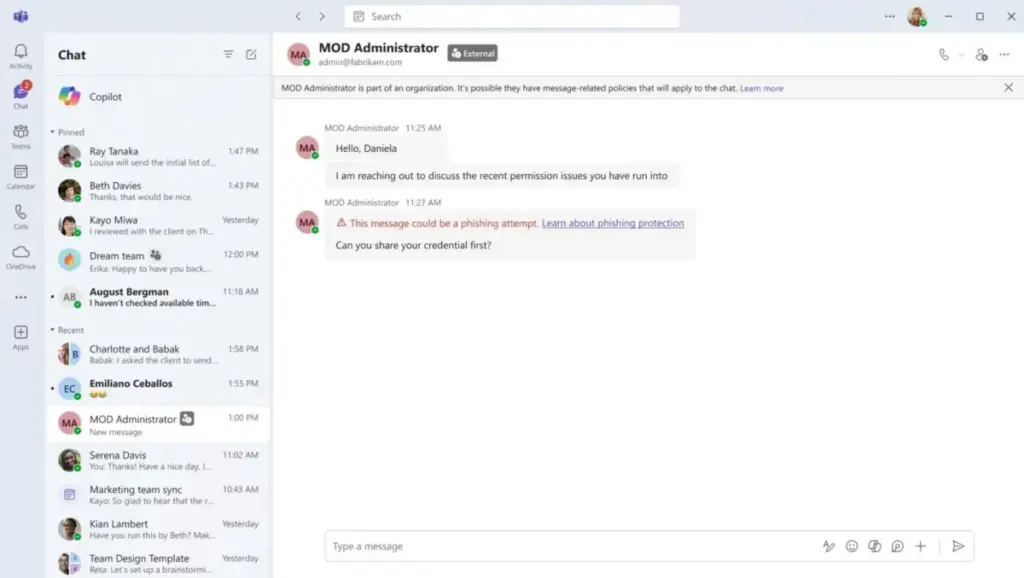
As the landscape of cyber threats continues to evolve from traditional email-based attacks toward more sophisticated social engineering on collaboration platforms, Microsoft has announced a significant upgrade to its security suite for Microsoft Teams. The tech giant is preparing to launch a new AI-powered security feature designed specifically to detect phishing, scams, and identity theft by analyzing the context and content of conversations in real-time. This move represents a strategic shift in how the company approaches platform security, moving beyond the simple scanning of malicious links and attachments to a more nuanced understanding of conversational behavior.
The new tool, first reported by Bleeping Computer, marks a departure from legacy security protocols that often rely on static signatures or known "bad" URLs. Instead, this AI-driven system will scrutinize the linguistic patterns and intent within messages to identify red flags that might suggest a user is being targeted by a bad actor. By focusing on the nuances of human interaction, Microsoft aims to close a critical gap in enterprise security that has been increasingly exploited by cybercriminals over the last several years.
A Shift Toward Behavioral and Contextual Analysis
For years, the primary line of defense in digital communication has been the identification of technical indicators of compromise (IoCs). These include things like suspicious file extensions, blacklisted IP addresses, or URLs that lead to known credential-harvesting sites. While these methods remain essential, they are often insufficient against modern social engineering tactics where no malicious payload is immediately present. In many contemporary attacks, the initial interaction is entirely benign—a simple "Hello" or an inquiry about a project—designed solely to build rapport before the "hook" is delivered.
Microsoft’s new AI-powered feature is designed to address this "long game" of social engineering. By analyzing the behavior within messages, the tool can identify requests that are out of character or typical of a scammer’s playbook. This includes high-pressure language, unusual requests for sensitive information, or attempts to move a conversation toward an unsecure or unauthorized platform. According to Microsoft, the tool will be particularly vigilant when a user interacts with new contacts. Because these individuals have no established history of interaction within the organization, they naturally pose a higher security risk, and the AI will prioritize these threads for deeper contextual analysis.
This focus on behavioral context is a direct response to the increasing complexity of "Business Communication Compromise" (BCC). Just as Business Email Compromise (BEC) costs organizations billions of dollars annually, attackers have realized that the informal and high-trust environment of Microsoft Teams makes it an ideal breeding ground for similar exploits. Users who might be skeptical of an unsolicited email are often more inclined to trust a message received through an internal collaboration tool, assuming that the sender has already been vetted by their organization’s IT department.
Addressing the Threat of IT Help Desk Impersonation
The development of this feature follows a series of urgent warnings from Microsoft regarding a specific and highly effective attack vector: the impersonation of IT help desk staff. In these scenarios, attackers gain access to a Teams environment—often through a compromised guest account or by exploiting external access settings—and then message employees while masquerading as technical support personnel.
 Small Business IT & Cloud Computing
SAP Integrates AI-Powered Roleplays into Recertification Program to Prioritize Practical Skills Over Rote Memorization
In a significant move to modernize its professional ecosystem, SAP has announced...
 Small Business IT & Cloud Computing
GhostCode: The Emerging Phishing Threat Exploiting Microsoft 365 Device Authorization Flows
In a significant escalation of identity-based cyberattacks, security researchers have uncovered a...
 Small Business IT & Cloud Computing
Microsoft Issues Massive October 2026 Security Update Addressing Record 1,408 Vulnerabilities Amid Active SharePoint Exploits
In an unprecedented move that has sent shockwaves through the cybersecurity and...







